
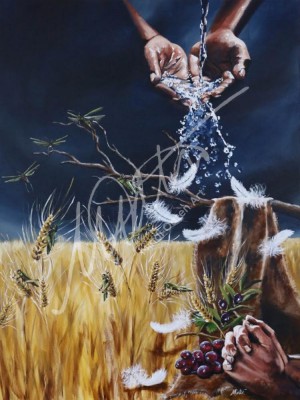
Judgement Of The Nations
Discover Jesus as: Avenger Joel 1-3 Read on Bible Gateway (HCSB)
Lesson
Audio Only
Teaching Notes
INTRO
This week, we’ve already looked at Hosea, one of the minor prophets. Hosea clearly had a word for the Israelites, both in the northern and the southern kingdoms. This is the first and only lesson on the minor prophet, Joel. The book of Joel is truly one of a kind. Joel’s name means, “the Lord of God,” and there were at least 12 men in the Old Testament, and one in the New Testament, with the name Joel. In Joel 1:1, the author was identified as “Joel the son of Pethuel.”
MacArthur points out that, “Although Joel displayed a profound zeal for the temple sacrifices (Joel 1:9; 2:13-16), his familiarity with pastoral and agricultural life and his separation from the priests (Joel 1:13,14; 2:17), suggest he was not a Levite.”1 However, extrabiblical writings state that Joel was a member of the tribe of Reuben and from the town of Bethom or Bethharam, which was located to the northwest on the border of Reuben and Gad. Evidence within the book itself suggests that Joel was Judean and from Jerusalem. This is based on the fact that he did not write from the perspective of a stranger.2
The book’s date is based on where it was placed in the canon of Scripture, as well as on historical evidence within the book and the book’s language and grammar. MacArthur explains that, “Because of: (1) the lack of any explicit mention of later world powers (Assyria, Babylon, or Persia); (2) the fact that Joel’s style is like that of Hosea and Amos, rather than of the post-exilic prophets; and (3) the verbal parallels with other early prophets (Joel 3:16/Amos 1:2; Joel 3:18/Amos 9:13), a late-ninth-century-B.C. date during the reign of Joash (c. 835-796 B.C.), seems most convincing.”3 Interestingly, J. Vernon McGee suggests that Joel would have known both Elijah and Elisha.4
According to Joel 3:2-4, Tyre, Sidon, and Philistia had made military attacks into Israel. MacArthur explains that “an extended drought and massive invasion of locusts had stripped every green thing from the land and brought severe economic devastations (Joel 1:7-20), leaving the Southern Kingdom weak.”5 Joel used the locust invasion as an example of God’s coming judgment on sin and “God’s future judgments during the Day of the Lord [that] will far exceed them.”6 Of the eight Old Testament authors who used the phrase “the day of the Lord” a total of 19 times, Joel put the most emphasis on it. There are four other uses of it in the New Testament. Joel was the prominent prophet on the Day of the Lord, and his prophecy will tie into Matthew and Revelation. The Day of the Lord will come “possibly due to a calloused indifference” to the Lord.7
MacArthur explains that the Day of the Lord is not always used as foretelling as eschatological event. It can also be used to explain “a near historical fulfillment” (Ezekiel 13:5). The Day of the Lord is often used to explain “seismic disturbances, violent weather, clouds and thick darkness, cosmic upheaval, and as a ‘great and very terrible’ (Joel 2:11) day that would ‘come as destruction from the Almighty’ (Joel 1:15),” as well as point to the promise of hope and “a pouring out of the Spirit on all flesh.”8
Our phrase for Joel is Avenger. In Joel, the nations will come together in the Valley of Jehoshaphat at the end of the seven years of tribulation on the Day of the Lord to fight against Israel and King Jesus. Jesus will serve as the Avenger (Joel 3:19- 21) and will exact satisfaction for doing wrong by punishing the person who did wrong. Jesus will come in the end times and avenge those who have done wrong against the nations.
TEACHING
Joel 1:1-14: Joel prophesied of the plague of locusts. He described 4 types of locust who would continue destroy everything. In verse 5, the locusts even destroyed the vineyards. In verses 6-7, Joel compared the locusts to an invading army. The invading army will totally destroy everything (vv. 8-10). Joel outlined ten groups who would mourn and suffer because of the locusts: drunkards, farmers, fruit growers, priests, ministers of the altar, the ministers of God, the residents/elders of the land in worship, and the entire assembly. They will all cry out to the Lord for help (vv. 9–14).
Joel 1:15––2:32: Joel said the Day of the Lord was near, and His judgment would come. Verses 16–20 describe the results of the plague. In Joel 2:1–10, Joel told them to sound the alarm because the Day of the Lord was near and then described what the Great Tribulation would be like. Darkness will cover the earth before Christ comes. In verses 12–17, Joel said there would be one last call for repentance. Verse 14 calls for a remnant. God called for the people to return to Him. Verses 18–19 give God’s blessings, and then God will begin to drive back the invading armies (vv. 20–24). God will bring restoration to the land (vv. 26–27). Verses 28–32 was quoted by Peter (Acts 2:16–21), and promised the pouring out of God’s Spirit on His people.
Joel 3:1–10: God will restore the fortunes of His people and then gather the nations in the Valley of Jehoshaphat. He will judge the nations who did not treat the Jewish nation right (vv. 1–6). The Jews had been sold into slavery, and forced into prostitution for money or pleasure. The temple treasures of gold and silver had been stolen and the people of Judah and Jerusalem had been sold to foreign masters and deported from their lands. God promised to bring retribution against these, bring His people back, and then do to these nations what they had done to the Jews (vv. 7–8). God told the Gentile nations to prepare for a holy war (v. 9). These nations were to beat the plows into swords and their pruning knives into spears. Even the weaklings would be needed as warriors (v. 10).
Joel 3:11–21: God told them to come quickly, for there He would judge them all (vv. 11–13). Joel said the Day of the Lord is near and multitudes would come to the valley for His decision because the Day of the Lord is near (v. 14). This refers to the Battle of Armageddon. The sun and moon will grow dark and even the stars will not shine (v. 15). The Lord will roar from Zion and heaven and earth will shake. And the Lord will be a refuge for His people, the Jews (v. 16).
Through this, everyone will know that God is the God of the Israelites, and that Jerusalem is His holy city (v. 17). Verse 18 is a picture of the temple flowing with water described in Ezekiel 47:1-5. Egypt and Edom will be desolated for their actions to the people of Judah (v. 19). And Judah and Jerusalem will be inhabited forever (v. 20). God will pardon their bloodguilt, for He dwells in Zion (v. 21) (Genesis 12:3; Matthew 25––sheep and goat nations.
CLOSING
The beauty of this picture is that God will always have our backs when we repent, we turn to Him, when we cry out to the Lord and pray. Jesus serves as the Avenger for those that choose to go against us.
John MacArthur, The MacArthur Bible Commentary (Nashville: Thomas Nelson Publishers, 2005), pp. 982.
MacArthur, p. 982.
MacArthur, p. 982.
J. Vernon McGee, “Notes for Joel”; https://www.blueletterbible.org/Comm/mcgee_j_vernon/notes-outlines/joel/joel-notes.cfm.
MacArthur, p. 982.
MacArthur, p. 982.
MacArthur, p. 982.
MacArthur, p. 983.
Questions
-
How does Joel 1:1-4 and 7 compare to Amos 4:9-10? Were the two prophets speaking to the same audience at the same time? In general, do you think people learn from their past mistakes? What does this say about God’s mercy toward us?
-
In Joel 1:13-14, what did the prophet Joel tell the people to do? Do you believe the Church would be in a better state today if we did more of this?
-
What does God promise to do if God’s people repent and turn their hearts back to Him? (Joel 2:12-13)
-
Who in the New Testament, quoted the prophet Joel’s words in Joel 2:28-32 (Acts 2:14-21)? Why did he quote them? What was happening?
-
What did the Holy Spirit highlight to you in Joel 1—3 through the reading or the teaching?
Daily Word
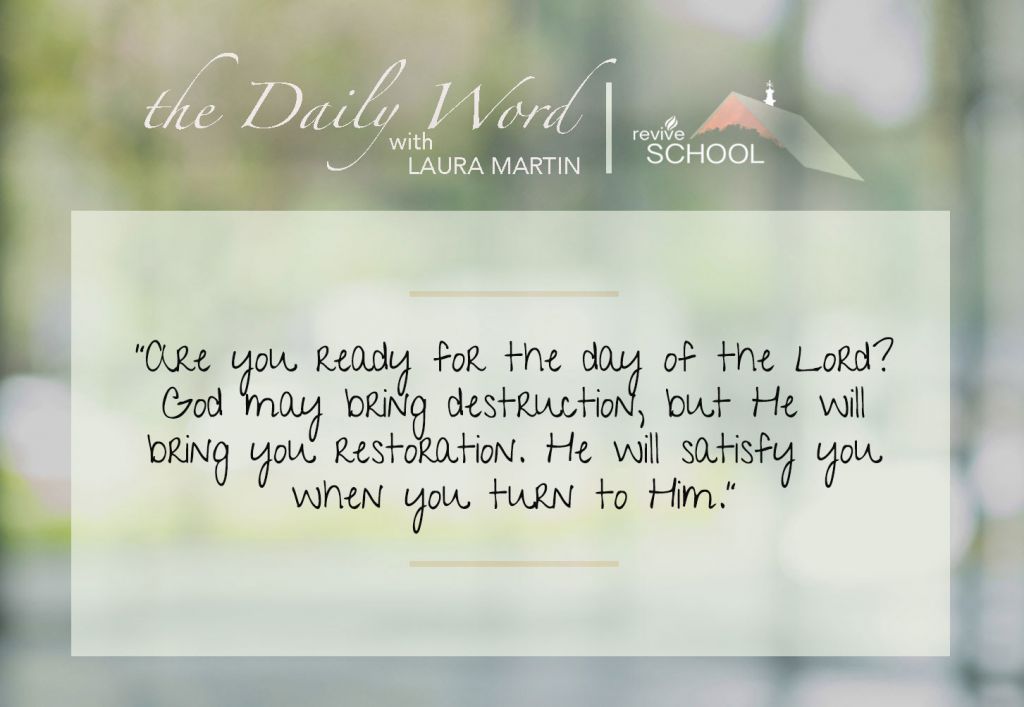
Laura Martin Joel 2:26-27
“You will have plenty to eat and be satisfied. You will praise the name of Yahweh your God, who has dealt wondrously with you. My people will never again be put to shame. You will know that I am present in Israel and that I am Yahweh your God, and there is no other. My people will never again be put to shame.”
FURTHER SCRIPTURE
- Psalm 22:26 — “The humble will eat and be satisfied; those who seek the Lord will praise Him. May your hearts live forever!”
- Isaiah 44:6 — “This is what the Lord, the King of Israel and its. Redeemer, the Lord of Hosts, says: I am the first and I am the last. There is no God but Me.”
- Joel 2:28-30a — “After this I will pour out My Spirit on all humanity; then your sons and your daughters will prophesy, your old men will have dreams, and your young men will see visions. I will even pour out My Spirit on the male and female slaves in those days. I will display wonders in the heavens and on the earth.”
Lesson and Daily Word
Each day has two parts: the Lesson and the Daily Word. Use these buttons to go from one to the other.
Teaching Notes and Questions
Next to the video, these tabs show the Teaching Notes and the Questions. Your answer to a question saves when you leave the answer box.
The Bible passage
This link opens the passage on Bible Gateway, and that gives the passage its tick. If you read it in your own Bible, tick it by hand in Progress.
Your progress on this lesson
A part ticks itself when you play the video or audio to the end, read the notes or the Daily Word to the end, or answer every question. You can also tick a part by hand here.
Downloads
Here you can save the video, the audio and the lesson as PDF files. Downloads do not count toward your progress.
Need help?
Use this button to send us a question or tell us about a problem. You can also take this tour again from there.