

Repentance And Restoration
Discover Jesus as: Unconditional Love Hosea 12-14 Read on Bible Gateway (HCSB)
Lesson
Audio Only
Teaching Notes
INTRO
In Hosea, the two primary characters of the book were Hosea and his wife Gomer. They had three children, but she was not faithful to Hosea. In all of this, God asked Hosea to show Unconditional Love to his unfaithful wife. The lives of Hosea and Gomer represent God and unfaithful Israel. The bottom line is that Gomer, who represented the Israelites, was not faithful to Hosea, who represented God. Gomer refused to be faithful in the marriage just as the Israelites were unfaithful to God.
TEACHING
Hosea 12: In Hosea 12:1, Ephraim made a covenant with Egypt to trade goods. The Israelites’ unfaithfulness was shown in their dependence on their own prosperity. They put their trust in everything they would produce for themselves, rather than the Lord. They doubted the Lord’s care for them.
The people claimed there was no crime in them, and that they were only doing what was necessary to survive. But the judgement of God caught up with them because they chose to put their trust in their own prosperity rather than in the promises of God.
J. Vernon McGee states, “There is a prophetic sidelight here that is very interesting. In Daniel’s vision (Daniel 7), Babylon is pictured as a lion, Greece (under Alexander the Great), is pictured as a leopard, and the empire of Media-Persia is pictured as the bear. Now here in Hosea’s prophecy God is saying that in the future He will come against them like a lion and a leopard, but in the immediate future He will come like a bear represented by Media-Persia, which at that early date was dominated by Assyria.”1 The people of Israel had no help available but God. And they had chosen not to trust in Him.
God referred to King Saul and the fact that judgement was coming. Paul quoted Hosea 13:14 in I Corinthians 15:55. The only way the people of Israel could understand that death no longer had a grip was because through God they could be set free. God’s love was unconditional.
Hosea 13: Hosea 13:14-16 is a reference to guilt and severe punishment. These verses provide the introduction to chapter 14. Constable states, “As usual in the major sections of Hosea, promises of restoration follow announcements of judgment. This final section of restoration promises begins with an appeal for repentance and closes with the prospect of full and complete restoration.”2
Hosea 14:1-8: In verse 1, Hosea stressed having humility and a contrite spirit. If the people had truly repented, they would be allowed to walk in freedom through God. Despite their disobedience and lack of trust, the people could come back to the Lord at any time with true praise and repentance.
MacArthur explains, “Israel was invited to return, bringing words of repentance accompanied with obedience, repaying God’s gracious acceptance of them with genuine ‘sacrifices of our lips’ (Hebrews 13:15). God condemns lip service worship (Isaiah 29:13; Matthew 15:8).”3 Hosea 14 was referring to genuine repentance and not lip service. God was going to do something about the circumstances with Israel. He was going to continue to love His people and free them from apostasy. He would heal their condition.
Israel was realizing they needed the Lord. Therefore, God’s anger was turning away. God would provide new life. The source of their new life was God. Wiersbe outlined verses 2-5 as, “He will receive us (vv. 2-3), He will restore us (v. 4), and He will revive us (vv. 5-8).”4 The people finally realized they needed repentance.
Constable explains the significance of these verses: “Israel would become productive and attractive to the eye and nose, namely: totally appealing. ‘Shoots’ imply stability, ‘beauty’ suggests visibility, and ‘fragrance’ connotes desirability.”5 The people would return to God. MacArthur states, “Their scent (‘remembrance’) denotes worldwide fame and admiration.”6 Constable points out that “other nations would also flourish as they benefited from Israel’s good influence.”7
Hosea 14:9: Now the Israelites realized that they should have nothing more to do with idols. Verse 9 represents a picture of all of Hosea.
CLOSING
The message of the book of Hosea is about God’s Unconditional Love and it prefaced the message of Christ. Christ wanted to set everyone free in spite of sin. Romans 3:23 states all have sinned. Romans 6:23 is about sin leading to death. Romans 5:8 offers hope in God’s love. Christ in His death offers the people salvation. Ephesians 2:8-9 states that salvation is a gift of God. Sin, death, love, faith, and life are the five words that described the message of Hosea. The name Hosea means “salvation.”
Take-aways from Hosea include that the ways of the Lord are right. Hosea presented two conditions: (1) obedience, or
(2) disobedience. The wise obey and the foolish disobey. Ultimately, despite their disobedience, God showed compassion because of His Unconditional Love.
J. Vernon McGee, Thru the Bible Volume 3: Proverbs-Malachi, (Nashville Thomas Nelson Publishers, 1983), p. 655.
Thomas Constable, Dr. Constable’s Expository Bible Study Notes: Joshua, p. 2; available at http://planobiblechapel.org/tcon/notes/pdf/joshua.pdf.
Charles Wesley; quoted in Warren Wiersbe, The Bible Exposition Commentary: Joshua (Nashville: Thomas Nelson Publications, 2003), p. 16.
Warren W. Wiersbe, The Bible Exposition Commentary: Old Testament, The Prophets Isaiah-Malachi (Colorado Springs, David C. Cook, 1989), p. 329, 330.
Constable, p. 107.
MacArthur, p. 981.
Constable, p. 107.
Questions
-
Where else in Scripture can you find the story of Jacob wrestling with God (Genesis 32:24-30)? What do you think that looked like? Was it God Himself? In Genesis 32:30, Jacob said he saw God face to face. What do you think he meant by this, since John 1:18 and 4:12 both say that no one has ever seen God at any time? (Deuteronomy 5:4; 34:10)
-
In Hosea 13:11, what king is Hosea referring to (1 Samuel 9:15-17)? Why do you suppose the people wanted an earthly leader to rule over them as opposed to God Himself? How is this similar to today’s political/worldly view?
-
How is Hosea 13:14 a prediction of Jesus’ saving grace? (1 Corinthians 15:55-56)
-
What was Hosea saying in Hosea 14:9? (Job 34:10-12; Romans 9:32-33)
-
What did the Holy Spirit highlight to you in Hosea 12—14 through the reading or the teaching?
Daily Word
Laura Martin Hosea 14:1-2
“Israel, return to Yahweh your God, for you have stumbled in your sin. Take words of repentance with you and return to the Lord. Say to Him: ‘Forgive all our sin and accept what is good, so that we may repay You with praise from our lips.’”
Hosea continued to love Gomer despite how she rejected him and loved others. Even though Gomer broke her marriage vow to Hosea, he remained willing to receive her when she returned to him. He loved her unconditionally. The Lord God loves Israel unconditionally. Despite their covenant with God, Israel rejected Him and worshipped other gods. Even so, Israel can always return to Yahweh their God. The Lord will receive their repentance and restore them to new life rooted in Him.
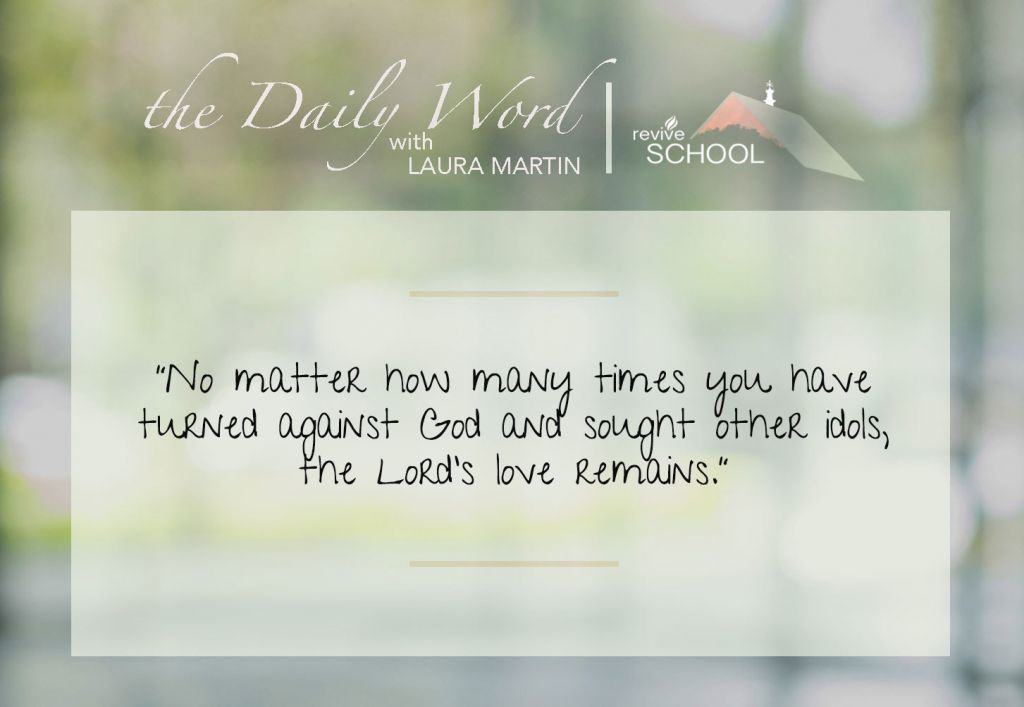
Do you need this truth today? No matter how many times you have turned against God and sought other idols, the Lord’s love remains. Do you hear His voice calling you back to Him? Do you have a tug in your heart to turn to Him in humility as your one source for love and satisfaction? Turn to the one, Jesus Christ, and His unconditional love. He will heal you. He will restore you. He will give you new life. Take root in Him, and He will bring you growth. You will blossom in new ways as you surrender completely to Him. Today, surrender and ask the Lord to be the king of your heart.
“Israel, return to Yahweh your God, for you have stumbled in your sin. Take words of repentance with you and return to the Lord. Say to Him: ‘Forgive all our sin and accept what is good, so that we may repay You with praise from our lips.’”
— Hosea 14:1-2
FURTHER SCRIPTURE
- Hosea 14:4-7a — “I will heal their apostasy; I will freely love them, for My anger will have turned from him. I will be like the dew to Israel; he will blossom like the lily and take root like the cedars of Lebanon. His new branches will spread, and his splendor will be like the olive tree, his fragrance, like the forest of Lebanon. The people will return and live beneath his shade.”
- Hosea 14:9 — “Let whoever is wise understand these things, and whoever is insightful recognize them. For the ways of the Lord are right, and the righteous walk in them, but the rebellious stumble in them.”
- Ephesians 2:8-9 — “For you are saved by grace through faith, and this is not from yourselves; it is God’s gift — not from works, so that no one can boast.”
Lesson and Daily Word
Each day has two parts: the Lesson and the Daily Word. Use these buttons to go from one to the other.
Teaching Notes and Questions
Next to the video, these tabs show the Teaching Notes and the Questions. Your answer to a question saves when you leave the answer box.
The Bible passage
This link opens the passage on Bible Gateway, and that gives the passage its tick. If you read it in your own Bible, tick it by hand in Progress.
Your progress on this lesson
A part ticks itself when you play the video or audio to the end, read the notes or the Daily Word to the end, or answer every question. You can also tick a part by hand here.
Downloads
Here you can save the video, the audio and the lesson as PDF files. Downloads do not count toward your progress.
Need help?
Use this button to send us a question or tell us about a problem. You can also take this tour again from there.