
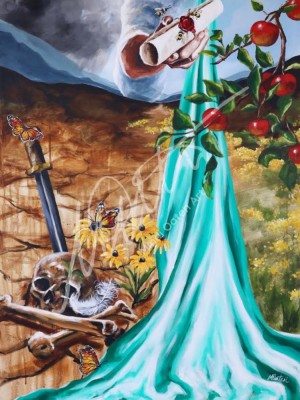
Announcement Of The End
Discover Jesus as: New David Ezekiel 6-7 Read on Bible Gateway (HCSB)
Lesson
Audio Only
Teaching Notes
INTRO
The things that happen in the book of Ezekiel are possibly the most bizarre in Scripture:
- In chapter 1 Ezekiel had the vision of the throne of God with the four cherubim with crazy wheels.
- Chapter 2 contains Ezekiel’s calling as a priest and a prophet.
- In chapter 3 God instructed Ezekiel to eat a scroll.
- In chapter 4 Ezekiel was told to lay on his left side for 390 days, taking on the iniquity of Israel, and then on his right side for 40 days, taking on the iniquity of Judah.
- In chapter 5 Ezekiel shaved his head and beard, and then used his hair to symbolize what would happen to the people during the destruction of Jerusalem.
Isaiah prophesied about the coming destruction of Jerusalem long before it actually happened. Jeremiah prophesied before it happened and then even experienced the exile personally. Ezekiel prophesied from captivity and received word of Jerusalem’s fall while there.
In Ezekiel 6:1-7, Ezekiel was told to prophesy against the idols that Israel worshipped and about the destruction that Israel had brought upon itself. In verses 8-10 Ezekiel reiterated God’s promise to spare the faithful remnant. In verses 11–14 Ezekiel began a lament over the fall of Jerusalem in which God would bring the sword, famine, and plague against His people. God’s judgment was given because of the people’s disobedience, rebellion, and their idol worship.
TEACHING
Ezekiel 7:1-9: Wiersbe notes that chapter 7 contains the second spoken message about the coming destruction of Jerusalem and outlines verses 1-7 as “disaster announced.”1 God announced that the end had come on Israel—“the four corners of the land.” (v. 2) That means everyone in Israel (the land) would face the destruction and judgment through the Babylonian army.
Wiersbe explains that as God’s weapon, “The Babylonian army was coming from the north to invade the land, rob it, and ruin it.”2 The words, “the end,” in verse 3, “stresses that the fulfillment of the prophecy was at hand.”3 God said He would not look at His people with pity and He would not spare them. They would be punished for the detestable things that they had chosen to do (v. 4). God stressed that only when the people experienced His wrath, would they know that He is the Lord (Yahweh).
In verses 5-9 Ezekiel began again with the message of the coming destruction of Jerusalem. The language is similar, but the warning seems more urgent and more intent (Romans 13:11). The fulfillment was nearer than it had ever been before.
Ezekiel 7:10-21: Wiersbe outlines these verses as “the disaster pictured.”4 Ezekiel announced the day was coming— arrogance had bloomed and violence had become wickedness (vv. 10-11). The first image, “the budding rod” was used to show “their sins had ‘ripened’ and the nation would have to reap what they sowed”5 (v. 11).
In verse 13, the second image was business-oriented. During the sabbatical year, every seven years, land was not farmed, and debts were cancelled. After seven sabbatical years, the next year (the fiftieth year) was the year of jubilee, “when the land lay fallow, debts were cancelled, servants were set free, and the land was returned to the original owners.”6 Jeremiah 29:10 says that the exiles would be in Babylon for 70 years. However, because they would be in exile for 70 years, nothing would be restored in the sabbatical years or in the year of jubilee. That meant the judgment couldn’t be recalled and the people wouldn’t experience these times of grace during their captivity.7
In verses 14-15 the destruction of the nation was discussed through the image of the watchman (which we discussed in chapter 2). Ezekiel described that the watchman on the wall had already blown the trumpet to signal the coming of invaders, but no one would be there because God’s wrath was on them all (v. 14). Verse 15 states that if there was an invading army, they would die by the sword, and if they stayed inside the city, they would die by famine and plague.
In verses 16-18 the image is of doves, as some survivors who would escape to the mountains like the doves of the valley, moaning over their own iniquity. They would put on sackcloth in mourning and in shame. These were again the remnant who could see their sin and repent of it. There is hope in this image.
In verses 19-21 the image describes the people who would try to get rid of everything that they had held onto as riches. Wiersbe states, “People [were] throwing away their valuables,” because “during the final years of the kingdom of Judah, the rich were getting richer and the poor were getting poorer, with the rich robbing the poor without any interference from the courts.”8 The foreigners would take those things away as plunder and would profane them (v. 21).
Ezekiel 7:22-27: God would allow the destruction to come through the wicked who would profane His “treasured place,” the Holy of Holies. MacArthur explains, “The Holy of Holies in the temple will be desecrated by pagans, that place where the high priest could only enter once a year to make atonement in God’s presence.”9 God was going to bring the most evil of nations— Babylon—to take possession of their houses and their treasures (v. 24). He promised that anguish was coming, and that they would try to seek peace, but without success. Wiersbe explains, “Judah sought alliances with Egypt and tried to negotiate a way to peace, but the Lord had determined that His people should be chastened, and no political power can overrule the sovereign will of God”10 (v. 25). As disaster after disaster was experienced, the people would seek out a prophet to tell them what to do, but “there would be no help from the religious leaders, neither the prophets nor the priests”11 (v. 26). Ezekiel ended the message by explaining, “Not only would there be religious chaos, but the political system would fall apart”12 (v. 27).
CLOSING
Ezekiel proclaimed that judgment was coming, and that judgment would be terrible. The judgment was coming so the people would know that God is the great I Am—Yahweh.
Warren W. Wiersbe, The Exposition Bible Commentary (Colorado Springs: David C. Cook, 2002), p. 175–176.
Wiersbe, p. 176.
Earl Radmacher, Ronald B. Allen, and H. Wayne House, eds., Nelson’s New Illustrated Bible Commentary (Nashville: Thomas Nelson Publishers, 1999), p. 964.
Wiersbe, p. 176.
Wiersbe, p. 176.
Wiersbe, p. 176.
Wiersbe, p. 176-177.
Wiersbe, p. 177.
John MacArthur, The MacArthur Bible Commentary (Nashville: Thomas Nelson Publishers, 2005), p. 901.
Wiersbe, p. 177.
Wiersbe, p. 177.
Wiersbe, p. 177.
Questions
-
In Ezekiel 6:8 why did God promise to leave a remnant? Do you believe God still does this today, and if so, why? How do you see God using a remnant of people for the good of His church/kingdom?
-
Why do you think, God repeatedly said throughout Ezekiel, “Then they shall know that I am the Lord”? Do you believe God punishes His people out of revenge or for some other reason or both? (Proverbs 3:1; Hebrews 12:6)
-
Where else in Scripture do we hear something similar to Ezekiel 7:19 (Proverbs 11:4; Isaiah 2:20; Zephaniah 1:8)? What does this tell you about riches? Do you know anybody who has riches and uses them for good instead of selfishness and evil?
-
What does Ezekiel 7:18 tell you about this particular time that Ezekiel was mentioning (Job 21:6; Isaiah 15:3; Amos 8:10)? How do you think this time of God’s wrath (Ezekiel 7) will compare to hell?
-
What did the Holy Spirit highlight to you in Ezekiel 6—7 through the reading or the teaching?
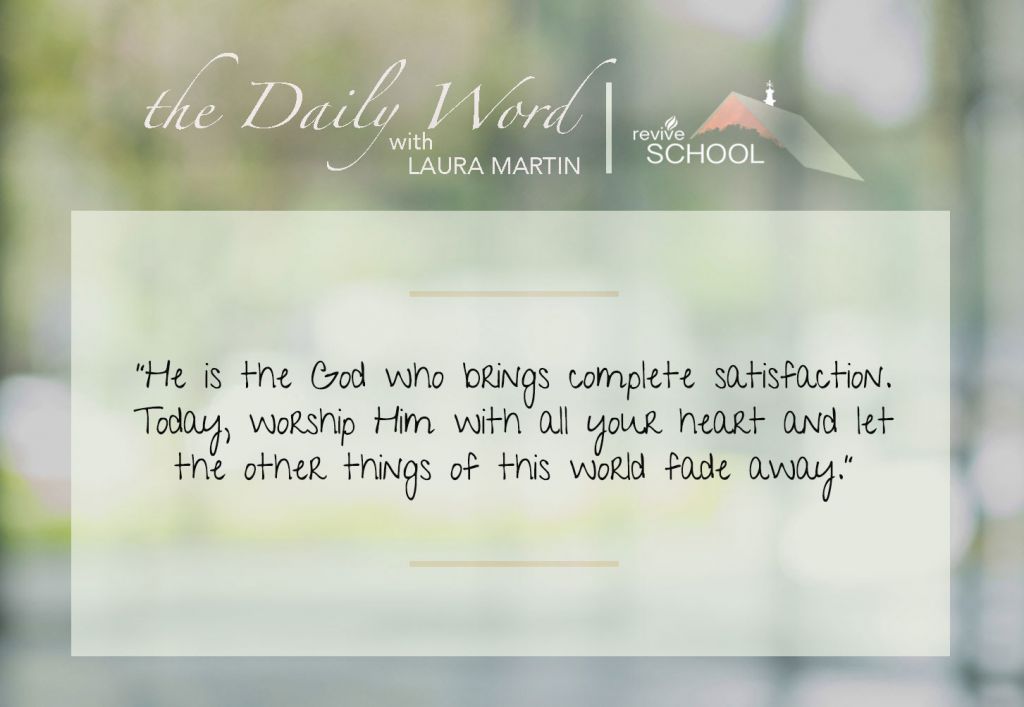
Daily Word
Laura Martin Ezekiel 7:24, 27
“So I will bring the most evil of nations to take possession of their houses. I will put an end to the pride of the strong, and their sacred places will be profaned . . . The king will mourn; the prince will be clothed in grief; and the hands of the people of the land will tremble. I will deal with them according to their own conduct, and I will judge them by their own standards. Then they will know that I am Yahweh.”
FURTHER SCRIPTURE
- Ezekiel 7:19 — “They will throw their silver into the streets, and their gold will seem like something filthy. Their silver and gold will be unable to save them in the day of the Lord’s wrath. They will not satisfy their appetites or fill their stomachs, for these were the stumbling blocks that brought about their iniquity.”
- Matthew 5:6 — “Those who hunger and thirst for righteousness are blessed, for they will be filled.”
- 1 John 2:15 — “Do not love the world or the things that belong to the world. If anyone loves the world, love for the Father is not in him.”
Lesson and Daily Word
Each day has two parts: the Lesson and the Daily Word. Use these buttons to go from one to the other.
Teaching Notes and Questions
Next to the video, these tabs show the Teaching Notes and the Questions. Your answer to a question saves when you leave the answer box.
The Bible passage
This link opens the passage on Bible Gateway, and that gives the passage its tick. If you read it in your own Bible, tick it by hand in Progress.
Your progress on this lesson
A part ticks itself when you play the video or audio to the end, read the notes or the Daily Word to the end, or answer every question. You can also tick a part by hand here.
Downloads
Here you can save the video, the audio and the lesson as PDF files. Downloads do not count toward your progress.
Need help?
Use this button to send us a question or tell us about a problem. You can also take this tour again from there.