

The Departure Of The Shekinah Glory Of God
Discover Jesus as: New David Ezekiel 8-10 Read on Bible Gateway (HCSB)
Lesson
Audio Only
Teaching Notes
INTRO
So far in the study of Ezekiel, we’ve seen God continue to give His message of judgment to Ezekiel. We’ve not seen Ezekiel say much to the people, yet. So far Ezekiel had preached through his visions and through the images and descriptions God gave him. While Ezekiel did an amazing job, it didn’t really matter because the people didn’t listen. Chapters 8–9 are still more of the same.
J. Vernon McGee describes chapter 8 as “the vision of the glory” and says, “Temple defilement by idolatry explains its destruction.”1 He goes on to say, “The vision transports Ezekiel back to Jerusalem,” and, “God’s glory appears in the temple at Jerusalem”2 (vv. 2-4). The description in verses 2-4 almost mirror the description of his vision in chapter one. Further, “The exposure of the idolatry practiced in the temple explains why God will destroy it”3 (vv. 16-18). Ezekiel was in Babylon when he received this vision. He was taken up to a place between earth and heaven, and God showed him what was happening in Jerusalem.
In chapter 9 Ezekiel saw the six executioners of the city of Jerusalem. These were angels coming to execute God’s judgment on Jerusalem. They entered the temple and stood by the bronze altar (vv. 1–2). Another man with writing equipment came with them. The glory of God (Shekinah) rose from within the temple and came to the threshold of the temple. He called to the man (possibly the Son of Man, the pre-incarnate Christ4) with writing equipment and told him to pass through Jerusalem, marking the heads of those who groaned and sighed over the abomination that had happened to the temple (vv. 3-4). God wanted to know who grieved over what had happened to the temple (the remnant).
This account reminds me of the Passover and the placing of blood over the door to show the homes of God’s people. The spirit of death passed over those homes, saving the lives of those within. (Revelation 13:16 describes a different type of mark of the enemy.) In chapter 9, the executioners followed after the man in white, executing those left unmarked. The remnant was to be saved, but no pity was given to anyone unmarked. Unbelievably they began in front of the temple with the elders who had defiled the temple which they were charged with overseeing (v. 6b). Ezekiel asked the Lord if He was going to destroy the entire remnant of Israel (v. 8). God responded they had abandoned Him and the land, and He would “bring their actions down on their own heads” (vv. 9-10). The man in linen came back and reported that he had done what he had been commanded (v. 11).
We’ve considered this throughout our studies of the prophets. Where do these events fit on the timeline? It’s confusing. Ezekiel was by the river and went up to heaven to receive a vision of God’s temple, His sanctuary in Jerusalem. In his vision Ezekiel saw their sin and the assignment given to the man in linen to put a mark on the heads of those who grieved over what had happened. This was a picture of 586 B.C. and the destruction of Jerusalem. This vision took place near the time of the destruction (592–588 B.C., possibly). The first coming of Christ was in A.D. 0–33. In A.D. 70 the Romans destroyed the second temple. As far as we know, no marks were given in the second temple’s destruction, so this is probably not talking about the second temple. The second coming of Christ is still to come (date unknown), but first, the tribulation will come. It is possible Ezekiel’s words were prophetic about the end times. In Zechariah 12:10 people mourned over having killed the Messiah. This picture can be about both.
TEACHING
Ezekiel 10:1-8: Ezekiel was still in his vision in chapter 10. Constable summarizes verses 1-8 as, “God’s preparations to judge the city.”5 God spoke again to the man in linen and told him to go inside the cherubim’s wheelwork, fill his hands with hot coals, and scatter them over the city (v. 2). MacArthur explains, “These coals picture the fires of judgment which God’s angels are to ‘scatter’ on Jerusalem. In Isaiah 6, ‘coals’ were used for the purification of the prophet; here, they were for thedestruction of the wicked.”6 Cherubim (probably not the ones from chapter 1), were standing south of the temple as the man in linen went inside the temple, and “the cloud filled the inner court” (v. 3).
The glory of the Lord then moved from above the cherubim within the temple and moved to the temple’s threshold. The temple was filled with the cloud (presence) of His glory and the sound of the cherubim’s wings was like that of the voice of the Lord when He spoke (vv. 4-5). God told the man to take fire from inside the wheelwork again. He went in and stood beside one of the cherubim (the same four from chapter 1), who reached into the fire and put some of it in the man’s hands who then left the temple (vv. 6-7). These were the beginning preparations for the Lord to depart from the temple. The cherubim in the temple had human hands under their wings.
Ezekiel 10:9-17: Ezekiel’s vision continued as he looked at the wheels of the cherubim that gleamed of beryl (v. 9). His description of the wheels again mirrored what he saw in his chapter one vision (vv. 10–13). His description of the cherubim also mirrored chapter one, with the exception of the face of the ox that was listed as a cherub (v. 14). The four cherubim ascended with the wheels still working as had already been described (vv. 15-17).
Ezekiel 10:18-19: The glory of the Lord then left the temple and stood above the cherubim. MacArthur explains, “The gradual departure of God from His temple is depicted in stages”:
- In 592 B.C. God’s glory was in the temple when Ezekiel viewed it (Ezekiel 8:4).
- In 592 B.C. God’s glory moved from above the cherubim to the threshold of the temple (Ezekiel 9:3; 10:4).
- In 592 B.C. God’s glory moved from the temple threshold and stood above the cherubim (Ezekiel 10:18-19).
- In 592 B.C. God’s glory departed Jerusalem going east, not to return until the time of the Messiah’s millennial kingdom (Ezekiel 11:22-23)
- At some point in the future, God’s glory will return to the temple from the east to inaugurate the millennial (Ezekiel 43:2-9, 44:4).7
CLOSING
MacArthur writes about the Lord’s return in Ezekiel 43:2-9: “Here, in the millennial temple, the glory of God returns to dwell. His glory will be manifest in fullness in the future kingdom, after the Lord’s Second Advent, which is also to be glorious.”8
This is the picture of the millennium. Jesus is going to return, and God’s glory will return to Jerusalem.
J. Vernon McGee, Ezekiel: Notes & Outlines, n.p.; available at https://ttb.org/docs/default-source/notes-outlines/no18_ezekiel.pdf?sfvrsn=2.
McGee, n.p.
McGee, n.p.
John MacArthur, The MacArthur Bible Commentary (Nashville: Thomas Nelson Publishers, 2005), p. 902.
Thomas Constable, Dr. Constable’s Bible Expository Study Notes, p. 85; available online at https://planobiblechapel.org/tcon/notes/pdf/ezekiel.pdf.
MacArthur, p. 903.
MacArthur, p. 902-903.
MacArthur, p. 938.
Questions
-
In Ezekiel 8:3b when you read, “seat of the image of jealousy, which provokes to jealousy,” do you believe this to be a description of the Lord? Read Exodus 34:14, which says His name is jealousy. Have you ever thought of the Lord as jealous? What are some actions that you think would make Him jealous?
-
Research who the god Tammuz was and why the women were weeping for him, as told in Ezekiel 8:14.
-
Where else in Scripture do you see marks being put on those who are to be spared, as described in Ezekiel 9:4? (Exodus 12:12-13)
-
Ezekiel 10 describes the cherubim in the temple. Where else in Scripture are they described (Revelation 4:6-8)? If you believe these to be the same creatures, what reasons might there be for the differences in the descriptions?
-
In Ezekiel 10:4, the glory of the Lord stood over the threshold. At that moment do you think His heart was breaking for His children and Israel? They had turned their backs on Him to worship other gods. Can you feel His grief?
-
What did the Holy Spirit highlight to you in Ezekiel 8—10 through the reading or the teaching?
Daily Word
Laura Martin Ezekiel 9:3b–4
“He called to the man clothed in linen with the writing equipment at his side. ‘Pass throughout the city of Jerusalem,’ the LORD said to him, ‘and put a mark on the foreheads of the men who sigh and groan over all the detestable practices committed in it.’”
In Ezekiel’s vision from the Lord, he saw people committing terrible and detestable things inside the Temple. The place intended for God’s glory and worship was being used as a place to worship false idols, and detestable things were engraved all over the walls. Ezekiel saw the vision of the Lord’s wrath slaughtering Jerusalem. He also saw a man going through the city and marking the people who groaned and sighed at the detestable practices committed in the Temple. The Lord discerned the hearts of those not pleased with the detestable practices, and the Lord would save them from the slaughter. Ultimately, the Lord removed the presence of His glory from the Temple.
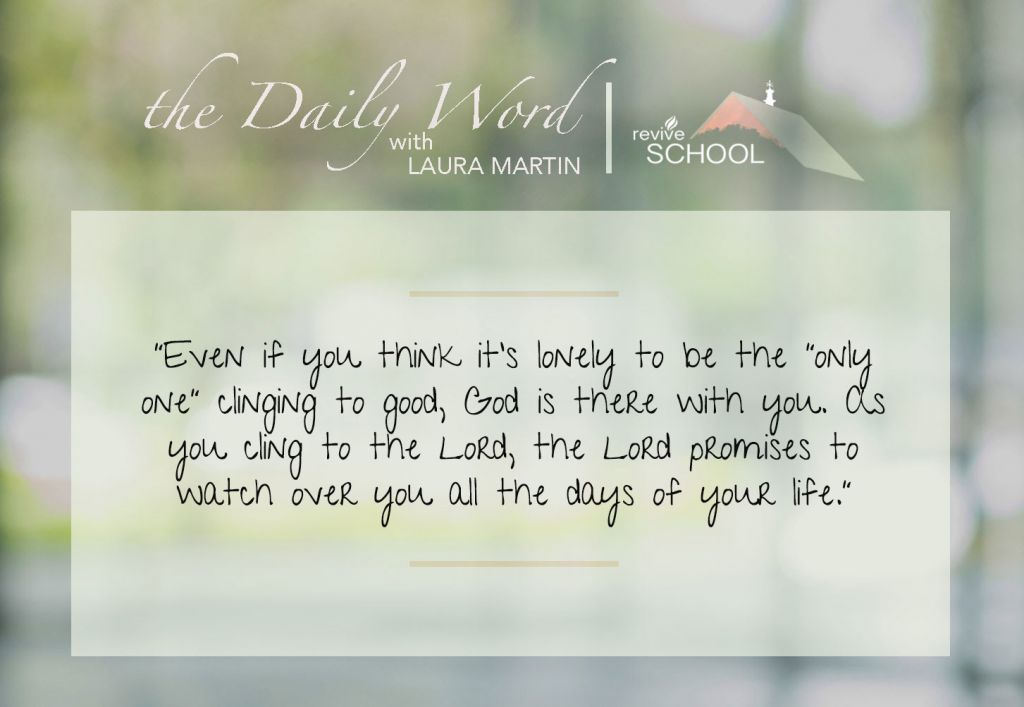
When you see people doing evil, what do you do? Walk away? Sigh and groan? Join in and experiment? Seek the Lord and ask for His wisdom and discernment? The Lord calls you to walk in His ways and to discern His good, pleasing, and perfect will. He says: Flee from evil. Do not conform to the patterns of the world. Do not love the things of this world, which is filled with pride and lust. Love without hypocrisy. Cling to what is good. Even if you think it’s lonely to be the “only one” clinging to good, God is there with you. As you cling to the Lord, the Lord promises to watch over you all the days of your life.
“He called to the man clothed in linen with the writing equipment at his side. ‘Pass throughout the city of Jerusalem,’ the Lord said to him, ‘and put a mark on the foreheads of the men who sigh and groan over all the detestable practices committed in it.’”
— Ezekiel 9:3b–4
FURTHER SCRIPTURE
- Ezekiel 9:6 — “‘Slaughter the old men, the young men and women, as well as the older women and little children, but do not come near anyone who has the mark. Now begin at My sanctuary.’ So they began with the elders who were in front of the temple.”
- Romans 12:9 — “Love must be without hypocrisy. Detest evil; cling to what is good.”
- 1 John 2:15–17 — “Do not love the world or the things that belong to the world. If anyone loves the world, love for the Father is not in him. For everything that belongs to the world—the lust of the flesh, the lust of the eyes, and the pride in one’s lifestyle—is not from the Father, but is from the world. And the world with its lust is passing away, but the one who does God’s will remains forever.”
Lesson and Daily Word
Each day has two parts: the Lesson and the Daily Word. Use these buttons to go from one to the other.
Teaching Notes and Questions
Next to the video, these tabs show the Teaching Notes and the Questions. Your answer to a question saves when you leave the answer box.
The Bible passage
This link opens the passage on Bible Gateway, and that gives the passage its tick. If you read it in your own Bible, tick it by hand in Progress.
Your progress on this lesson
A part ticks itself when you play the video or audio to the end, read the notes or the Daily Word to the end, or answer every question. You can also tick a part by hand here.
Downloads
Here you can save the video, the audio and the lesson as PDF files. Downloads do not count toward your progress.
Need help?
Use this button to send us a question or tell us about a problem. You can also take this tour again from there.