
Dramatically Sharing Jerusalem's Coming Fall
Discover Jesus as: New David Ezekiel 4-5 Read on Bible Gateway (HCSB)
Lesson
Audio Only
Teaching Notes
INTRO
Ezekiel, the third major prophet we’ve studied, was actually one of those who was deported from Jerusalem to Babylon. He was 30 years old and had already been in captivity for five years when he received God’s call to serve as a priest and a prophet. God told Ezekiel that even though he brought God’s message to the people, they would not want to hear it and he would suffer for doing so. Ezekiel’s life was going to serve as a sign for people.
In chapter 4, God instructed Ezekiel to draw a picture of the city of Jerusalem on a brick and then “lay siege” against it by building a siege wall, a ramp, military camps, and battering rams on all sides of the city (vv. 1-2). He was then to set up an iron plate to represent an iron wall between him and the city and then look to the city to besiege it (v. 3). All of this was to show what would happen to Jerusalem. After all this, Ezekiel was told to lie on his left side and place Israel’s iniquity on his side. He was to bear their iniquity for 390 days as he lay on his left side. Then he was to lie on his right side for 40 days for the iniquity of Judah with his face toward the siege of Jerusalem and prophesy against them. God put cords on Ezekiel so he could not turn over during these periods (vv. 4-8).
God then gave Ezekiel orders about what he was to prepare to eat and drink during this time. In verse 12, Ezekiel was to take the bread he prepared and cook it over dried human excrement to show the Israelites how they would “eat their bread—ceremonially unclean—among the nations where I will banish them.” Wiersbe explains all this would show the “horror” of the coming famine. The ingredients Ezekiel mixed together “would produce the very poorest kind of bread and therefore represented the scarcity of food during the siege of Jerusalem. The people would eat almost anything, including one another.”1 Wiersbe goes on to explain: “The use of human excrement was a sign of abject poverty and want.”2
What time period of 390 years was represented by Ezekiel’s laying on his side for 390 days? Wiersbe says:
“It’s like that the 390-year period begins with Solomon’s son Rehoboam who became king in 930 (1 Kings 14:21). When you add the years of the reigns of the kings of Judah from Rehoboam to Zedekiah, as recorded in 1 and 2 Kings, you have a total of 394 years. Since during three of the years of his reign Rehoboam walked with God (2 Chronicles 11:16–17), we end up with a number very close to Ezekiel’s 390 years.”3
TEACHING
Ezekiel 5:1-17: Wiersbe describes verses 1-17 as “the destiny of the people.”4 God told Ezekiel to shave his head and beard with a sharp sword, and then weigh hair and divide it into three equal sections (v. 1). Ezekiel was told to burn up one third on the siege brick, to slash up another third and scatter it all around the city and scatter the last third in the wind. However he was to secure a few strands from the hair into the folds of his robe (vv. 2-3). Wiersbe explains the significance of each of these. The first third symbolized what would happen when the siege was ended, the city was burned, and famine came on the people. The second third symbolized those who would be brutally killed at the hands of the Babylonians. The last third symbolized the exiles being taken away and scattered throughout the nations. The hair placed in Ezekiel’s garment was “a symbol of God’s special care for a remnant of the people who would be spared to return to the land.”5 God told Ezekiel to burn some of the hair in his garment to symbolize that a great fire would spread over the whole house of Israel (v. 4).
God explained He had put Jerusalem in the center of all the nations, but Jerusalem rebelled against the Lord and was even more wicked than those nations who did not know Him (vv. 5-6). MacArthur states, “Instead of being a witness to the heathen nations, Israel had exceeded them in idolatrous practices. The nations maintained their familiar idols, while Israel defected from their true and living God. God’s people were worse than the pagans in proportion to spiritual knowledge and privileges.”6
Therefore, because of their disobedience, idolatry, and rebellion, God turned against Jerusalem and proclaimed that He would execute judgments within them that the nations around them would witness (vv. 7-8). That’s the story of the book of Lamentations.
God explained that the coming judgment against Jerusalem had never happened before, and it would never happen again (v. 9). And what the people would experience would be horrendous—fathers would eat their sons, and sons would eat their fathers to survive the famine, and the survivors would be scattered in every direction (v. 10). God promised to cut them off without pity because “you have defiled My sanctuary with all your detestable practices and abominations” (v. 11).
Verse 11 again outlined the three periods of exile when the people were taken from Jerusalem. One-third would die by plague and famine (v. 12a). One-third would die from the sword (v. 12b). One-third would be scattered across the nations, even while being chased by the sword of battle (v. 12c). Remember that Ezekiel was sitting in captivity at this time, and he foretold that Jerusalem’s final fall was yet to come. God said that after He had vented His wrath, He would be appeased, and the people who had been exiled would know with certainty who God was and still is (v. 13).
The remnant was referred to twice in this passage. In verse 12c, God said He would scatter one-third of the people, but it implies that they would survive. Plus, the hair in Ezekiel’s robe symbolized those who would survive as a part of the remnant. Wiersbe explains:
“The entire nation of Israel accepted God’s covenant at Mount Sinai (Exodus 20:18–21), but most of them failed to obey the Lord and died in the wilderness. In the years that followed the nation’s entrance into the Promised Land, the people gradually declined spiritually, and it was the remnant that prayed, obeyed God’s Word, and remained faithful to the Lord. It is this remnant that will play an important role in the future of Israel (Isaiah 1:9, 11:11, 37:31; Joel 2:32; Micah 2:12, 5:7; Zephaniah 2:4-7; Zechariah 8:1-8; Malachi 3:16; Romans 9:27, 11:5.).”7
The phrase for Ezekiel is the New David, and could also have been the New Shepherd (Ezekiel 34:22-24). Think of the remnant as sheep and the New David was coming to save and take care of His sheep (the remnant).
In verse 14 God promised to make Jerusalem “a ruin and a disgrace among the nations” and everyone who passed by would see it. Jerusalem would be seen as a disgrace, a warning, and a point of ridicule by other nations. God said He would intensify the famine and send dangerous animals against them (vv. 15-17).
CLOSING
Ezekiel’s role was to deliver the message. The question is, are we going to be part of the remnant or not?
Warren W. Wiersbe, The Exposition Bible Commentary (Colorado Springs: David C. Cook, 2002), p. 172.
Wiersbe, pp. 172-173.
Wiersbe, p. 173.
Wiersbe, p. 173.
Wiersbe, p. 173.
John MacArthur, The MacArthur Bible Commentary (Nashville: Thomas Nelson Publishers, 2005), pp. 899–900.
Wiersbe, p. 174.
Questions
-
Why did God tell Ezekiel to lay on his left side for 390 days? His right side for 40 days (Ezekiel 4:4–6)? What did this symbolize?
-
In Ezekiel 4:14, Ezekiel asked God not to make him eat food cooked over human waste. Did God honor his request and, if so, why? (Leviticus 17:15, 22:8; Deuteronomy 14:3-5; Isaiah 66:17; Acts 10:14)
-
Read Ezekiel 5:1–4. What message was this supposed to convey to Jerusalem (Ezekiel 5:11-12?) Why was God angry with His people (Ezekiel 5:5-10)
-
In Ezekiel 5:9 God said, “And I will do among you what I have never done, and the like of which I will never do again, because of all of your abominations.” What was He referring to here? (Leviticus 26:14-45; Ezekiel 5:10)
-
In your opinion, what does Ezekiel 5:3 symbolize?
-
What did the Holy Spirit highlight to you in Ezekiel 4—5 through the reading or the teaching?

Daily Word
Laura Martin Ezekiel 5:3
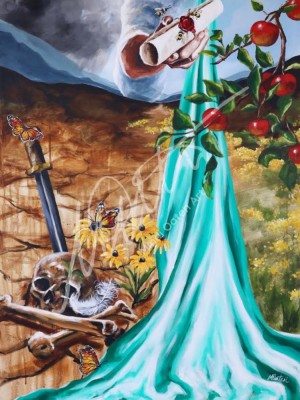
“But you are to take a few strands from the hair and secure them in the folds of your robe.”
Ezekiel proclaimed that the Lord’s anger toward Israel would soon reveal itself. Jerusalem, the center of the nations, had rebelled against the Lord, His ordinances, and His statues, and had rejected Him. The Lord’s plan would come forth: a third of the people would die by sword, a third would die by plague and famine, and a third would be scattered and die as the sword chased after them. But even in the judgment, the scattered would develop a remnant—a few surviving people from Israel, thus ensuring God would never completely wipe out His chosen people. As the Lord instructed him, Ezekiel symbolically demonstrated God’s promise as he tucked a few pieces of his beard under the folds of his robe.
Even today the Lord searches for those believers in Christ who truly follow His ways. Yes, you are saved by grace, but are you living your life fully surrendered to the Lord? As you follow Him, you will experience the goodness of the fullness of the Lord. Just as Ezekiel tucked a few pieces of hair and hid them in the folds of his robe, as you follow the Lord surrendered to His will, He will hide you in the shadow of His wings. He will protect you and care for you. He is the Good Shepherd, and He loves you.
“But you are to take a few strands from the hair and secure them in the folds of your robe.”
— Ezekiel 5:3
FURTHER SCRIPTURE
- Isaiah 1:9 — “If the Lord of Hosts had not left us a few survivors, we would be like Sodom, we would resemble Gomorrah.”
- Ezekiel 5:11–12 — “‘Therefore, as I live’—this is the declaration of the Lord God—’I am going to cut you off and show you no pity, because you have defiled My sanctuary with all your detestable practices and abominations. Yes, I will not spare you. A third of your people will die by plague and be consumed by famine within you; a third will fall by the sword all around you; and I will scatter a third to every direction of the wind, and I will draw a sword to chase after them.’”
- Ephesians 3:17b–19 — “I pray that you, being rooted and firmly established in love, may be able to comprehend with all the saints what is the length and width, height and depth of God’s love, and to know the Messiah’s love that surpasses knowledge, so you may be filled with all the fullness of God.”
Lesson and Daily Word
Each day has two parts: the Lesson and the Daily Word. Use these buttons to go from one to the other.
Teaching Notes and Questions
Next to the video, these tabs show the Teaching Notes and the Questions. Your answer to a question saves when you leave the answer box.
The Bible passage
This link opens the passage on Bible Gateway, and that gives the passage its tick. If you read it in your own Bible, tick it by hand in Progress.
Your progress on this lesson
A part ticks itself when you play the video or audio to the end, read the notes or the Daily Word to the end, or answer every question. You can also tick a part by hand here.
Downloads
Here you can save the video, the audio and the lesson as PDF files. Downloads do not count toward your progress.
Need help?
Use this button to send us a question or tell us about a problem. You can also take this tour again from there.