
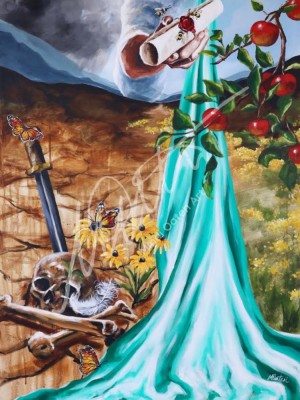
The Fall Of Tyre's Ruler
Discover Jesus as: New David Ezekiel 27-29 Read on Bible Gateway (HCSB)
Lesson
Audio Only
Teaching Notes
INTRO
The message of the Major Prophets and the Minor Prophets and the book of Revelation remains the same. The people lived in disobedience and rebellion, even though they were warned to turn back to God. They were told they would experience God’s judgment, but that there is still hope through the coming of Jesus Christ. It all points to the fulfillment of the Davidic line—the New David, the coming Messiah.
In chapter 24 we looked at the parable of the boiling pot and the death of Ezekiel’s wife. Chapters 25—26 contain the prophecies against the nations—those who had committed acts against Israel. MacArthur outlined the parables God gave Ezekiel:
- The Wood of the Vine (Ezekiel 15:1-5). The vine was useless.
- The Foundling Baby (Ezekiel 16). The baby showed how Israel had turned from God’s love.
- The Eagles and the Cedar Tree (Ezekiel 17). Showed the coming destruction by Babylon.
- The Fiery Furnace (Ezekiel 22:17-22). God was going purify the people through fire.
- The Two Harlots (Ezekiel 23). The harlots represented Israel’s and Judah’s prostituting themselves before powerful outside nations.
- The Boiling Pot (Ezekiel 24:1-14). The pot showed the desecration of Jerusalem.
- The Shipwreck (Ezekiel 27). Judgement would fall on Tyre.
- The Irresponsible Shepherds (Ezekiel 34). Includes the phrase, New David, the shepherd who will gather His lost flock from all the nations, as opposed to the irresponsible shepherds.
- The Dry Bones (Ezekiel 37).1
In chapter 27 judgment was going to come to Tyre, and later, if we get there today, will be the coming judgment to Sidon. Chapter 27 is about a shipwreck. Constable summarizes chapter 27 with these sections: “the great ship” (vv. 1-11); “the extent of Tyre’s commercial empire” (vv. 12-24); and “the sinking of the great ship” (vv. 25-36).2 The third section documents just how complete the coming destruction would be. The nation of Tyre would be silenced. Verse 36 says Tyre will never exist again
TEACHING
Ezekiel 28:1-10: Wiersbe summarizes these verses as “Judgment on the Prince of Tyre.”3 Note that this is a confusing passage that biblical scholars don’t agree about. The first man talked about is the king of Tyre, but the second man is possibly Satan. God told Ezekiel to tell the ruler of Tyre that the ruler’s heart was so proud that he saw himself as a god (vv. 1-2). Since these are prophetic words, they were not necessarily given to the king in person but were probably sent to him. The message to the king told him that he was wiser than Daniel, but he was no god (v. 3). The king used his wisdom to acquire money and treasures (v. 4), but his wealth caused him to be overly proud of his accomplishments (v. 5). In verses 6-7, God would therefore bring men with swords against the king who would defile his splendor.
This prophecy was given shortly before the siege of Tyre by Nebuchadnezzar of Babylon (585–575 B.C.). Therefore, Itto Baal II was the king at that time.4 God asked if the king would still see himself as a god when he was put to death at the hands of the Babylonians (vv. 8-10). This clearly describes a human king.
Ezekiel 28:11-19: Wiersbe summarizes verses 11-18 as “Judgment on the King of Tyre.”5 The next description seems to be of a different person. God told Ezekiel to lament for the king of Tyre and to tell him that he had once been “the seal of perfection, full of wisdom and perfect in beauty” (v. 12). The description continues that this king was in Eden and was covered with nine precious stones set in gold (v. 13). This king was an anointed guardian cherub, was on the holy mountain of God (v. 14), and was blameless until wickedness was found in him (v. 15). Because of the violence and sin of this king, God had expelled him in disgrace from the mountain of God and banished him as a guardian cherub (v. 16). This king became so proud that God threw him to earth to be a spectacle before earthly kings (v. 17). He had become an object of horror and will never exist again (v. 19). The use of “guardian cherub” points to the expelled former angel, Satan. This makes sense when you see the king of Tyre (vv. 1–11) as a foreshadowing of Satan.
In Genesis, Satan is described as a fallen angel who wanted to take the throne of God. The phrase, “anointed cherub,” means that at one time, he had access to God’s presence. MacArthur explains, God established both Satan and the king of Tyre, and Satan had received great privilege by being on God’s holy mountain.6 Yet God threw Satan down to earth from His mountain and out of the garden. The statement, “the seal of perfection,” emphasizes that Satan was the highest creature God ever created. J. Vernon McGee states the seal showed that Satan was the most beautiful creature as well.7
Ezekiel 28:20-26: Wiersbe explains verses 20-24 as “The Judgment on Sidon”8 and verses 25-26 as “The Regathering of Israel.”9
.
CLOSING
Even if we do not accept that this was written about Satan, Satan can still speak through the words of someone else, like the king of Tyre (Matthew 16:23). The enemy is coming to steal, kill, and destroy, and he will use any means to make that happen because he sees himself as a god. If we allow pride to make us feel that we are gods, Satan celebrates, and we fall from God.
John MacArthur, The MacArthur Bible Commentary (Nashville: Thomas Nelson Publishers, 2005), p. 921.
Thomas Constable, Dr. Constable’s Exposition Bible Study Notes: Ezekiel, pp. 214–218; available at https://planobiblechapel.org/tcon/notes/pdf/ezekiel.pdf.
Warren W. Wiersbe, The Exposition Bible Commentary (Colorado Springs: David C. Cook, 2002), p. 215.
MacArthur, p. 922.
Wiersbe, p. 215.
MacArthur, p. 922.
J. Vernon McGee, “Outline for Ezekiel”; available at https://www.blueletterbible.org/Comm/mcgee_j_vernon/notes-outlines/ezekiel/ezekiel-outline.cfm.
Wiersbe, p. 216.
Wiersbe, p. 216.
Questions
-
In Ezekiel 27, what did Ezekiel compare Tyre to? Why do you think he did this? Where else in Scripture can you find comparable stories? (Matthew 7:24-27, 13:3-8; Mark 4:3-8; Luke 6:46-49)
-
What was the downfall of the city of Tyre (Ezekiel 27:3-4)? What problem could this have caused among the people of Tyre? As you look at modern-day cities, do you feel that pride can cause some to stray from the Word of God and rely on their own beauty, wealth, power, and success instead? In your opinion, how can this cause cities around them to fail?
-
In Ezekiel 28 what happened to the king of Tyre as a result of his pride and arrogance?
-
Has the prophecy in Ezekiel 28:24-26 been fulfilled? If not, when will it take place? (Amos 9:11-15)
-
According to Ezekiel 29:17-20, which evil king did God use in His judgment against Tyre and Egypt? Why do you think He chose to do this?
-
What did the Holy Spirit highlight to you in Ezekiel 27—29 through the reading or the teaching?
Daily Word
Laura Martin Ezekiel 28:17
“Your heart became proud because of your beauty; for the sake of your splendor you corrupted your wisdom. So I threw you down to the earth; I made you a spectacle before kings.”
Tyre’s empire grew with the king’s wisdom, understanding, wealth, and great trading skills. Although the king was wise, the Lord saw how his heart had become prideful. Therefore, the Lord brought judgment and destruction, and the kingdom of Tyre fell.
It’s tempting to build your own kingdom. You may try to justify your actions by saying everyone else is building their own kingdoms, for example, living the “American Dream.” Ask yourself: Do I find greater comfort and peace in my business, my marriage, my wealth, my family, or even myself rather than in the Lord? The Lord knows and will reveal the truth to you. Sometimes you have to go to the bottom to realize your pride at the top. The Lord doesn’t want you to play god in your kingdom. He has specific roles and purposes for you in His kingdom. He says, “Seek first the kingdom of God and His righteousness, and all these things will be provided for you.” The Lord wants you to ask Him, lean on Him, and trust His promises. Remember, He is able to do above and beyond what you can even imagine, and He will reveal your path in life. Put your life in His hands and seek Him first.
“Your heart became proud because of your beauty; for the sake of your splendor you corrupted your wisdom. So I threw you down to the earth; I made you a spectacle before kings.”
— Ezekiel 28:17
FURTHER SCRIPTURE
- Psalm 25:4— “Make Your ways known to me, Lord; teach me Your paths.”
- Proverbs 11:2 — “When pride comes, disgrace follows, but with humility comes wisdom.”
- Matthew 6:33 — “But seek first the kingdom of God and His righteousness, and all these things will be provided for you.”
Lesson and Daily Word
Each day has two parts: the Lesson and the Daily Word. Use these buttons to go from one to the other.
Teaching Notes and Questions
Next to the video, these tabs show the Teaching Notes and the Questions. Your answer to a question saves when you leave the answer box.
The Bible passage
This link opens the passage on Bible Gateway, and that gives the passage its tick. If you read it in your own Bible, tick it by hand in Progress.
Your progress on this lesson
A part ticks itself when you play the video or audio to the end, read the notes or the Daily Word to the end, or answer every question. You can also tick a part by hand here.
Downloads
Here you can save the video, the audio and the lesson as PDF files. Downloads do not count toward your progress.
Need help?
Use this button to send us a question or tell us about a problem. You can also take this tour again from there.