
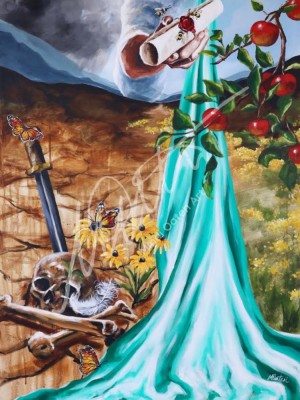
The Parable Of The Boiling Pot
Discover Jesus as: New David Ezekiel 24-26 Read on Bible Gateway (HCSB)
Lesson
Audio Only
Teaching Notes
INTRO
As we continue in our study of Ezekiel, remember that at this point the exiles did not know that Jerusalem had fallen.
MacArthur documented the events and periods of Ezekiel’s life:
- 622–621 BC: Ezekiel grew up during the period when King Josiah brought religious reforms to Judah (2 Kings 23).
- 612 BC: Nineveh/Assyria fell to Babylon. This ended the Assyrian empire.
- 609 BC: King Josiah was killed in battle.
- 605 BC: Babylon defeated Egypt in a fierce battle at Carchemish.
- 599–597 BC: At the age of eighteen, King Jehoiachin was taken in captivity by Babylon. Probably Ezekiel was taken into captivity and deported to Babylon at the same time (2 Kings 24:1).
- 593 BC: Ezekiel called to be God’s prophet at the age of thirty in Babylon (Ezekiel 1–3).
- 592 BC: Ezekiel given a vision of the idolatries being practiced in Jerusalem (Ezekiel 8).
- 588 BC: Final siege of the city of Jerusalem begun. Ezekiel was given a prophecy of a boiling pot to give (Ezekiel 24:1- 8). Ezekiel’s wife died, but he was not allowed to mourn aloud or demonstrate through mourning rituals and customs for her.
- 587 BC: Ezekiel prophesied that Pharaoh’s arm would be broken (Ezekiel 30:20-26).
- 573 BC: Ezekiel had a vision of the New Jerusalem and a new Temple (Ezekiel 40–48).
- 571 BC: Ezekiel prophesied the victory of Nebuchadnezzar against Tyre and Egypt (Ezekiel 29:17-21).1
TEACHING
Ezekiel 24:1-14: God told Ezekiel to write the date down (January 15, 588 B.C.), because Babylon had laid siege to Jerusalem on the same day (vv. 1-2). Then God gave Ezekiel specific instructions for showing another parable to the exiles. The instructions were to put on a pot of water to boil and add choice cuts of meat and bones (vv. 3-5). God then explained the parable (v. 6).
The pot represented the city of Jerusalem who had become “rusted” or diseased on the inside. MacArthur writes, “The city’s blood (a general symbol of sin) was blatantly open, not hidden, as depicted by exposure on top of a rock. When blood was not covered with dust, the law was violated (Leviticus 17:13). God’s vengeance would come by Babylon’s army.”2 (vv. 7-8)
Beginning in verse 9 God described His judgment to come. The huge fire represented that the people would die. Verses 10-13 tell us how after the fire the pot would be heated until the rust was consumed—purifying the evil and contamination from the city. (Leviticus 14:34-35.) Everything would be destroyed in Jerusalem (v. 14). Ezekiel was clearly releasing the word of the Lord.
Ezekiel 24:15-27: In the next section, God told Ezekiel He would take the “delight of your eyes away”—his wife. However, in her loss, Ezekiel would not be allowed to weep or cry for her (vv. 15-16). Ezekiel was told he could groan quietly but not demonstrate any rites or wear the ritual mourning clothing for the dead (v. 17). The next day Ezekiel spoke to the people in the morning, and his wife died that evening. And Ezekiel did as he had been instructed (v. 18). The other exiles saw his actions and asked him to explain what his actions meant (v. 19). MacArthur states, “Just as Ezekiel was not to mourn the death of his wife, so Israel was not to mourn the death of her families.”3
God explained that He was about to desecrate His own sanctuary, and those they loved would die by the sword (vv. 20-21). They were to handle their sorrow just as Ezekiel had done (vv. 22-24).
God then told Ezekiel that on the day the city of Jerusalem was captured and the people there had been killed, a fugitive would come to report the news (vv. 25-26). On that day Ezekiel’s mouth would be opened, and he would no longer be mute. Once again Ezekiel would be a visual sign that pointed the exiles to the Lord (v. 27).
Ezekiel wrote this down eighteen months after it happened in 586 B.C. Ezekiel then spent two years in muteness (Jeremiah 52: 1-16; Ezekiel 33:21). After two years Ezekiel could speak again, but there were no more messages to give because they were already under judgment.
CLOSING
Praise the Lord that Ezekiel was able later to paint a new picture from the doom he had preached as God’s prophet. He could announce that there would be a new Jerusalem and a new temple. Chapter 24 is covered under number 9 in MacArthur’s outline of Ezekiel’s life recorded above. Notice that Ezekiel had to wait from 593 B.C., when he was called to be a prophet and 588 B.C., when he was first told of the siege of Jerusalem, until 585 B.C. before he saw these prophecies come to fulfillment. His was an obedient life that God used to prepare an entire nation for the coming destruction and for the later coming of the new Jerusalem.
John MacArthur, The MacArthur Bible Commentary (Nashville: Thomas Nelson Publishers, 2005), p. 916.
MacArthur, p. 917.
MacArthur, p. 917.
Questions
-
In Ezekiel 24:16 God told Ezekiel that his wife would die, but he was instructed not to mourn for her. Why did God do this (Ezekiel 24:24)? Could you do something so drastic? Are you willing to do whatever God tells you to do no matter the cost?
-
Look at each nation mentioned in Ezekiel 25 and list why they were being judged. Do you believe that some of those same nations (with their current-day names), are still suffering the repercussions of their sin today? What can we learn from this? Note: Compare a biblical map to a modern map if needed, and pay attention to current events on the news to help you answer this question.
-
What did the Holy Spirit highlight to you in Ezekiel 24—26 through the reading or the teaching?
Daily Word
Laura Martin Ezekiel 24:13
“Because of the indecency of your uncleanness—since I tried to purify you, but you would not be purified from your uncleanness—you will not be pure again until I have satisfied My wrath on you."
The Lord instructed His prophet Ezekiel to share a parable about a boiling pot to those remaining in Jerusalem, the rebellious house. Ultimately the people chose not to purify themselves or cleanse themselves before the Lord; therefore, God brought judgment and wrath. Ezekiel prophesied with confidence from the Lord and in obedience, without holding back. It was the hard truth God’s people needed to hear.
Think of your life like a boiling pot. Are you willing to allow God’s “hot water” to cleanse and purify your heart, your mind, your body? Are you willing to let God’s love and grace clean you from the inside out? It means surrendering to Him all of whatever uncleanliness you have in your heart—pride, envy, outbursts of anger, selfish ambitions, or idolatry. Ask the Lord to have His way. He will forgive you. He will purify you. He will wipe you clean with His love. The first step is turning to Him, repenting of your sins, and walking away with His strength and power. You will step into His love and His great faithfulness.
“Because of the indecency of your uncleanness—since I tried to purify you, but you would not be purified from your uncleanness—you will not be pure again until I have satisfied My wrath on you.
— Ezekiel 24:13
FURTHER SCRIPTURE
- Psalm 51:10–13 — “God, create a clean heart for me and renew a steadfast spirit within me. Do not banish me from Your presence or take Your Holy Spirit from me. Restore the joy of Your salvation to me, and give me a willing spirit. Then I will teach the rebellious Your ways, and sinners will return to You.”
- 2 Corinthians 7:1 — “Therefore, dear friends, since we have such promises, let us cleanse ourselves from every impurity of the flesh and spirit, completing our sanctification in the fear of God.”
- 1 John 1:9 — “If we confess our sins, He is faithful and righteous to forgive us our sins and to cleanse us from all unrighteousness.”
Lesson and Daily Word
Each day has two parts: the Lesson and the Daily Word. Use these buttons to go from one to the other.
Teaching Notes and Questions
Next to the video, these tabs show the Teaching Notes and the Questions. Your answer to a question saves when you leave the answer box.
The Bible passage
This link opens the passage on Bible Gateway, and that gives the passage its tick. If you read it in your own Bible, tick it by hand in Progress.
Your progress on this lesson
A part ticks itself when you play the video or audio to the end, read the notes or the Daily Word to the end, or answer every question. You can also tick a part by hand here.
Downloads
Here you can save the video, the audio and the lesson as PDF files. Downloads do not count toward your progress.
Need help?
Use this button to send us a question or tell us about a problem. You can also take this tour again from there.