
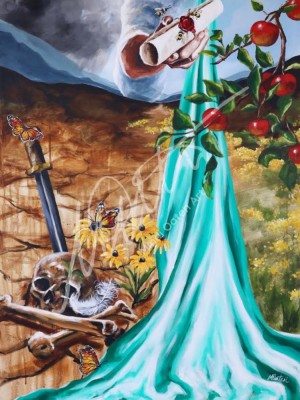
The Two Immoral Sisters
Discover Jesus as: New David Ezekiel 22-23 Read on Bible Gateway (HCSB)
Lesson
Audio Only
Teaching Notes
INTRO
Ezekiel’s ministry was to give the exiles a picture of what they were facing, even when they wouldn’t listen. J. Vernon McGee summarizes chapter 22: “The leaders were involved in apostasy and gross sins—princes [or kings] (vv. 6, 27), prophets [false teachers with false visions] (v. 25), and priests [or false priests] (v. 26). There was not a man to be found who would stand in the gap (v. 30).”1 MacArthur points out, “Ezekiel and Jeremiah were faithful, but apart from them, God sought a man capable of advocacy for Israel when its sin had gone so far.”2 Ezekiel 22:30 is one of the key verses in the entire book: “I searched for a man among them who would repair the wall and stand in the gap before me on behalf of the land that I might not destroy it, but I found no one.” Ultimately, we’re waiting for Christ—the New David (Isaiah 59:15-19, 63:5; Zechariah 12:10).
In chapter 23, we find “both Israel (the Northern Kingdom) and Judah (the Southern Kingdom) playing the harlot and looking for help from Assyria, Babylon, and Egypt, instead of trusting Jehovah God to guide them and rescue them.”3 Both nations were playing games, trying to find some outside power to save them. They were portrayed as prostitutes in Ezekiel 16 and 23 because they were willing to sell themselves out to other nations to get what they wanted. Constable explains:
“In chapter 16, Canaan is the mother of Israel who corrupted her daughter by teaching her spiritual adultery, namely, idolatry or trust in other gods. In chapter 23, Israel herself is responsible for pursuing mainly political adultery, by her trust in other nations, through alliances with foreign powers. In chapter 16, the beginnings of Israel’s unfaithful career receive most attention, whereas in chapter 23, the whole of Israel’s unfaithful career is in view. Chapter 16 deals with Judah alone, but chapter 23 focuses on both Israel and Judah with emphasis on Judah.”4
Ezekiel 23 will feel very repetitive after Ezekiel 16, but it’s also much more graphic.
TEACHING
Ezekiel 23:1-4: God’s word came to Ezekiel again with a parable about two women who were sisters. The sisters represented the time before Israel became a divided kingdom (vv. 1-2). Both women acted as prostitutes and behaved promiscuously in their youth in Egypt, where they would have been at the time (v. 3). “Oholah, meaning ‘Her own tabernacle,’ as she had her separate dwelling place apart from the temple, represents Samaria. Oholibah, meaning ‘My tabernacle is in her,’ represents Jerusalem, where God did establish worship.”5 (v. 4)
Ezekiel 23:5-10: In verses 5-10 Ezekiel outlined Israel’s prostitution with the Assyrians. Historically the Assyrians defeated Israel and took the people into exile. Verse 5 says, “She lusted after her lovers,” and then identifies them in verse 5b-6. Oholah (Israel) not only sold herself to them, but she worshipped their idols (vv. 7-8). Verse 9 points out that what she gave in to for pleasure actually destroyed her. The Assyrians put her to death, along with her sons and daughters (v.10). This happened in 722 B.C. Ezekiel was painting a picture of what had happened in the past that caused the death of the Northern Kingdom.
Ezekiel 23:11-21: Oholibah (Judah) saw what happened to her sister (Israel), but she was more depraved and more promiscuous than her sister (v. 11). She too lusted after the Assyrians (vv. 12-13).
Verses 14-15 are an unbelievable picture of pornography—Oholibah increased her promiscuity when she saw images of males carved into the walls. The pictures caused her to give in to more sin. The people of Judah had sinned more than the people of Israel. What the people saw seemed better to them than what they really had. Judah turned to the Babylonians and they came to her and defiled her. Afterwards she turned from them in disgust (vv. 16–17). God turned away from her in disgust, just as He had turned from Israel/Samaria (v. 18). In response Oholibah sinned even more and was pursued like donkeys and stallions (vv.19-21).
This is killing the church in America. Pornography is causing people to do things they have never done before and wouldn’t have done on their own.
Ezekiel 23:22-34: Therefore, the Southern Kingdom also faced God’s judgment. He would incite her “lovers” to come against her (vv. 22-24). The lovers would come against Judah in alliance against her and would destroy and dismember her (vv. 25-26). Through their swords God would put an end to Judah’s immorality (vv. 27-30). Verse 32 points out that because Judah had followed her sister’s path, Judah would “drink from her sister’s cup,” meaning the cup of wrath, and they too would be destroyed and devastated (vv. 32-34).
CLOSING
Because Judah had forgotten the Lord and turned away from Him, the people would face the consequences of that sin (v. 35). Their love affair with pagan gods would cause their beloved city to be destroyed. This was a prophetic word that judgment and destruction was coming to Jerusalem. It took place in 586 B.C.
J. Vernon McGee, Ezekiel: Notes & Outlines, n.p.; available at https://www.blueletterbible.org/Comm/mcgee_j_vernon/notes-outlines/ezekiel/ezekiel-outline.cfm.
John MacArthur, The MacArthur Bible Commentary (Nashville: Thomas Nelson Publishers, 2005), pp. 914–915.
Warren W. Wiersbe, The Exposition Bible Commentary (Colorado Springs: David C. Cook, 2002), p. 206.
Thomas Constable, Dr. Constable’s Exposition Bible Study Notes: Ezekiel, p. 180; available at https://planobiblechapel.org/tcon/notes/pdf/ezekiel.pdf.
MacArthur, p. 915.
Questions
-
In Ezekiel 22 what were some of the sins the people of Jerusalem were committing? Do you see any or all of these sins in present-day culture? Do you find yourself trapped in any of these sins?
-
Read Ezekiel 22:9-11. Do these particular sins offend you more than the others? Why or why not? What did God say about these sins (Leviticus 19:16, 20:18; Ezekiel 18:6, 11)? Do you believe God thinks sins against the body are worse than other sins (1 Corinthians 6:15-20)? Why or why not?
-
What was happening in Ezekiel 22:23-27? Had this been a problem in the past? Had God warned them against this before (2 Chronicles 28:22; Jeremiah 2:34; Hosea 9:8-9)? What are some of the ways you believe God warns His people today? Do we do any better at listening to God now?
-
In Ezekiel 23, who were the two sisters Ezekiel referred to as harlots? Who/what drew them away from God? Did the younger sister learn anything from the older sister?
-
Ezekiel 23:39 relates how the Israelites sacrificed their own children and then went into God’s house on the same day. Do you believe you can willfully sin and worship God at the same time? Why or why not?
-
What did the Holy Spirit highlight to you in Ezekiel 22—23 through the reading or the teaching?
Daily Word
Laura Martin Ezekiel 22:30
“I searched for a man among them who would repair the wall and stand in the gap before Me on behalf of the land so that I might not destroy it, but I found no one.”
The Lord searched for just one man to stand in the gap and stand before the Lord on behalf of all in the land. Just one righteous person. The Lord could not find even one. Therefore, God poured out His indignation and consumed Israel with the fire of His fury.
The Lord longs for His people to stand in the gap between the darkness and the light. He needs people to serve as watchmen and intercede for His children. He needs people to give warning and speak truth until Christ’s return. The Lord commands you to be strong and to stand firm, to fix your eyes on Him, to live with courage and bold- ness through the power of His Spirit. You are the one the Lord calls to intercede for His people. Cry out to the Lord on behalf of you family, your community, and your nation. Pray for people to turn back to Him as their one true God. Speak truth into this generation today. Be the one to stand in the gap.
“I searched for a man among them who would repair the wall and stand in the gap before Me on behalf of the land so that I might not destroy it, but I found no one.”
—Ezekiel 22:30
FURTHER SCRIPTURE
- Psalm 1:1 — “How happy is the man who does not follow the advice of the wicked or take the path of sinners or join a group of mockers!”
- Isaiah 59:16 — “He saw that there was no man—He was amazed that there was no one interceding; so His own arm brought salvation, and His own righteousness supported Him.”
- Ephesians 6:13 — “This is why you must take up the full armor of God, so that you may be able to resist in the evil day, and having prepared everything, to take your stand.”
Lesson and Daily Word
Each day has two parts: the Lesson and the Daily Word. Use these buttons to go from one to the other.
Teaching Notes and Questions
Next to the video, these tabs show the Teaching Notes and the Questions. Your answer to a question saves when you leave the answer box.
The Bible passage
This link opens the passage on Bible Gateway, and that gives the passage its tick. If you read it in your own Bible, tick it by hand in Progress.
Your progress on this lesson
A part ticks itself when you play the video or audio to the end, read the notes or the Daily Word to the end, or answer every question. You can also tick a part by hand here.
Downloads
Here you can save the video, the audio and the lesson as PDF files. Downloads do not count toward your progress.
Need help?
Use this button to send us a question or tell us about a problem. You can also take this tour again from there.