
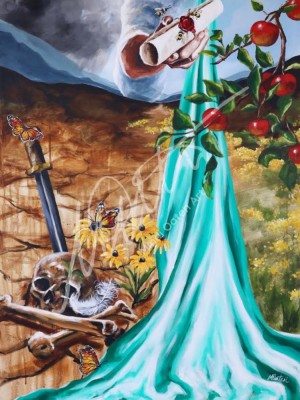
The Final Judgment
Discover Jesus as: New David Ezekiel 20-21 Read on Bible Gateway (HCSB)
Lesson
Audio Only
Teaching Notes
INTRO
As a prophet, Ezekiel was asked to dramatize many of His messages, which is something the other major prophets were not asked to do. It makes for interesting reading. Isaiah 1–39 is all doom and gloom. Ezekiel gives the same message, but he knew the hearts of the elders. Constable explains that in chapter 19, there are two sections to Ezekiel’s message: “The first part (vv. 1–9), uses the figure of a lion and her cubs to describe the Davidic line and two of its kings. The second part (vv. 10–14), uses the figure of a vine to describe Israel, including its final strong branch or king.”1 Ezekiel 19 has a unique picture of the Messiah.
TEACHING
Ezekiel 20:1-4: Verse 1 begins with a date: “In the seventh year, in the fifth month, on the tenth day of the month.” That date would be August 14, 591 B.C.2 On that day some of the elders came to Ezekiel to consult the Lord (v. 1b). They were probably trying to show to the others in exile that they were in charge and were playing the religious game. Wiersbe explains Ezekiel “knew that their hearts were not right with God and that they had no right to ask the Lord for instruction.”3 The word of the Lord came to Ezekiel (v. 2), and addressed Ezekiel as “son of man” (v. 3). That term was often used in the Old Testament about Christ and in the New Testament by Christ. Ezekiel was a foreshadowing of Christ and of what Christ would come to do.
God told Ezekiel to tell the elders that they would never be able to consult Him—“As I live, I will not be consulted by you” (v. 3b). Since God is eternal, there was no chance for a consultation. In chapter 18 the people had no repentance and there was no turning away from idols, so He knew they were still not willing to return to Him. In verse 4, God told Ezekiel to explain the past history to the people—“the detestable practices of their fathers.” Wiersbe explains God was not judging them for what their fathers had done (18:20), but was “judging the current generation because they were guilty of the same sins of unbelief and rebellion.”4 God wanted the people to see what had happened in the past so they would not make the same mistakes.
Ezekiel 20:5-8: The summary of their history begins in verse 5. God chose Israel and made a covenant with them. He brought them out of Egypt to the land He promised them, but they did not obey His command to throw away their idols (vv. 5-8). Wiersbe outlines the growth of Jacob’s family in Egypt. There were 66 family members when they entered Egypt and, with Joseph’s family, they numbered 70 (Genesis 46: 8-26). “But when the Jews left Egypt at the Exodus, the fighting men alone numbered over 600,000 (Numbers 1:46), so there may well have been over two million people in the nation.”5 God had blessed them greatly and only asked that they not take their idols before they left Egypt.
Ezekiel 20:9-10: Yet God remained faithful and led them out of Egypt and into the wilderness (Isaiah 66:5). Wiersbe emphasizes, “The Lord had every reason to pour out His wrath on Israel, but for His name’s sake, He rescued His people. God often worked on Israel’s behalf, not because they deserved it but for the glory of His own name.”6
Ezekiel 20:11-12: God led them to Sinai where He gave them His law and His expectations for them about how to live and keep His Sabbath (vv. 11-12). Wiersbe states, “Israel tarried about two years at Sinai where God revealed His glory and gave them His laws.”7
Ezekiel 20:13-26: Once the people had God’s law and statutes they left Sinai and went into the wilderness. But the people rebelled against Him in the wilderness, disobeying His laws and not keeping His Sabbaths (v. 13). Wiersbe explains, “After leaving Sinai, the Jews marched to Kadesh-barnea where the Lord told them to enter Canaan and claim their promised inheritance (Num 13–14).”8 There, 12 spies were sent into the land God had promised them, and all but two came back in fear of the people who were already there. God considered wiping them out because of their disobedience, but He acted to show His glory to all the nations who saw Him rescue Israel from Egypt (v. 14). God returned the Israelites to the wilderness and told them again to follow
His laws, not those of the pagan gods their fathers had worshipped (vv. 17-18). God told them to follow Him (v. 19). Yet even the children rebelled against the Lord (v. 21). God withheld His judgment because He would not have His name profaned before the nations (v. 22). The scattering of the people came because of rebellion (vv. 23-25). Verse 26 refers to false worship. At every stage God warned them to take their eyes off the idols and put them on Him.
Ezekiel 20:27-31a: Wiersbe summarizes these verses as “Israel in the Promised Land.”9 God gave Ezekiel more for the Israelites (v. 27). When the people entered the Promised Land they worshipped the idols at every tree and high place, and even offered their children as sacrifices (vv. 28-29, 31a).
Ezekiel 20:31-32: Wiersbe summarizes these verses as, “Israel in exile in Babylon.”10 Ezekiel left the past behind and pointed out that they were still in rebellion against God. This was the reason God refused to be consulted by them (v 31b). Wiersbe says, “They were living like their fathers!”11
Ezekiel 20:33-44: Ezekiel moved from the past and the present to the future. Wiersbe summarizes these verses as, “Israel’s future kingdom.”12 In verses 33-34, God says that in the future He would rule with a strong hand, an outstretched arm, and outpoured wrath, gathering the scattered people back together (2 Corinthians 6:17). God will bring the people together for judgment of their sins (v. 35). Through Christ’s return, judgment will come based on what each individual has done (v. 36). MacArthur explains by using the phrase, “pass under the rod” (v. 37), “God used a shepherd figure, being apt since He was their great Shepherd.”13 God will purge those who have rebelled against Him, and they will not be allowed into His kingdom (v. 38). MacArthur explains, “God will see that no rebel, no one without the renewing by His Spirit in salvation, will come back to Palestine to have a part in the Messianic kingdom.”14 One day everyone will serve God (vv. 39-44).
CLOSING
The Jews will not understand the bigger picture of being scattered, until Christ returns to gather the people to Him in a new covenant. Ezekiel 21:27 summarizes chapter 20: “A ruin, ruin, I will make it a ruin! Yet this will not happen until He comes; I have given the judgement to Him.”Hope does not come until Christ returns.
Thomas Constable, Dr. Constable’s Exposition Bible Study Notes: Ezekiel, p. 150; available at https://planobiblechapel.org/tcon/notes/pdf/ezekiel.pdf.
Warren W. Wiersbe, The Exposition Bible Commentary (Colorado Springs: David C. Cook, 2002), p. 199.
Wiersbe, p. 199.
Wiersbe, p. 199.
Wiersbe, p. 200.
Wiersbe, p. 200.
Wiersbe, p. 200.
Wiersbe, p. 200.
Wiersbe, p. 201.
Wiersbe, p. 201.
Wiersbe, p. 201.
Wiersbe, p. 201.
John MacArthur, The MacArthur Bible Commentary (Nashville: Thomas Nelson Publishers, 2005), p. 911.
MacArthur, pp. 911–912.
Questions
-
Look at Ezekiel 20:11. We know there are a total of 613 laws. According to this verse how many do you think someone needs to obey in order to live? How does James 2:10 reinforce this verse?
-
In Ezekiel 20:25 the Lord said that He gave the Israelites statutes that were not good and laws through which they could not live. Explain what this means. (Deuteronomy 28:15-68)
-
In Ezekiel 21:25-27 do you see a reference to the Messiah? What does verse 27 prophecy about the Messiah? (Luke 1:32)
-
W What did the Holy Spirit highlight to you in Ezekiel 20—21 through the reading or the teaching?
Daily Word
Laura Martin Ezekiel 20:31
“‘When you offer your gifts, making your children pass through the fire, you continue to defile yourselves with all your idols to this day. So should I be consulted by you, house of Israel? As I live’—this is the declaration of the Lord GOD—‘I will not be consulted by you!’”
The elders of Israel came to consult God. In response God brought to their attention all the ways they had turned away from Him and lived only for themselves. The Lord had such great plans and promises for His chosen people. When the elders inquired of God, He saw right into their rebellious hearts. They sought everything except the Lord, and now they wanted to inquire a fresh word from Him. He responded confidently through the prophet Ezekiel: “As I live, I will not be consulted by you!”
Like Israel’s elders, you may come to the Lord longing for Him to give you a fresh word. You may wonder why you don’t seem to hear or see Him. However, if you are living a double-sided life, attempting to walk one foot with Jesus and one foot caught up in the ways of the world, then you may stumble and fall down. God longs to have your whole heart turned toward Him, not just parts of it. It may be time to humble yourself and purify your heart so you can see and hear Him more clearly. With humility in your heart, walk worthy of God’s calling. He knows you, He sees you, and He loves all of you. He just wants your humble, honest, whole-hearted devotion as you come before Him.
“‘When you offer your gifts, making your children pass through the fire, you continue to defile yourselves with all your idols to this day. So should I be consulted by you, house of Israel? As I live’—this is the declaration of the Lord God—‘I will not be consulted by you!’”
Ezekiel 20:31
FURTHER SCRIPTURE
- Romans 13:11–14 — “Besides this, knowing the time, it is already the hour for you to wake up from sleep, for now our salvation is nearer than when we first believed. The night is nearly over, and the daylight is near, so let us discard the deeds of darkness and put on the armor of light. Let us walk with decency, as in the daylight: not in carousing and drunkenness; not in sexual impurity and promiscuity; not in quarreling and jealousy. But put on the Lord Jesus Christ, and make no plans to satisfy the fleshly desires.”
- Colossians 1:10–11 — “So that you may walk worthy of the Lord, fully pleasing to Him, bearing fruit in every good work and growing in the knowledge of God. May you be strengthened with all power, according to His glorious might, for all endurance and patience, with joy.”
- 1 Peter 5:5–6 — “In the same way, you younger men, be subject to the elders. And all of you clothe yourselves with humility toward one another, because God resists the proud but gives grace to the humble. Humble yourselves, therefore, under the mighty hand of God, so that He may exalt you at the proper time.”
Lesson and Daily Word
Each day has two parts: the Lesson and the Daily Word. Use these buttons to go from one to the other.
Teaching Notes and Questions
Next to the video, these tabs show the Teaching Notes and the Questions. Your answer to a question saves when you leave the answer box.
The Bible passage
This link opens the passage on Bible Gateway, and that gives the passage its tick. If you read it in your own Bible, tick it by hand in Progress.
Your progress on this lesson
A part ticks itself when you play the video or audio to the end, read the notes or the Daily Word to the end, or answer every question. You can also tick a part by hand here.
Downloads
Here you can save the video, the audio and the lesson as PDF files. Downloads do not count toward your progress.
Need help?
Use this button to send us a question or tell us about a problem. You can also take this tour again from there.