
Personal Responsibility For Sin
Discover Jesus as: New David Ezekiel 30-32 Read on Bible Gateway (HCSB)
Lesson
Audio Only
Teaching Notes
INTRO
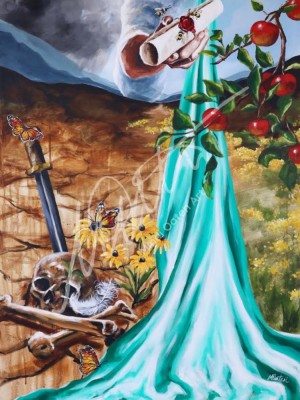
Before we dive into chapters 30—32, I want to give a little bit of a backdrop. The Lord began pouring out prophetic judgments to the nations while Ezekiel was in Babylonian captivity. There’s a sequence given in Ezekiel from chapters 25–32 showing all the wars that Nebuchadnezzar, the king of Babylon, had stirred up. The sword in Mindi’s painting represents the wrath of the Babylonian Empire. Nebuchadnezzar wasn’t finished when he defeated Jerusalem and Judah, but he went after all the other nations around him as well.
TEACHING
Ezekiel 25: God used Nebuchadnezzar’s army to destroy those nations who rejoiced when Israel and Judah fell. The Ammonites were eliminated for their actions against Israel (v. 6-7). Their destruction would let the world know that God is Lord (v. 7b). The judgment of the Moabites was pronounced—they too would be given over to the Babylonians so they would know God is Lord (v. 10-11). The punishment of Edom was given (v. 14), and the punishment of Philistia was given (v. 15).
Ezekiel 26: The punishment of Tyre was pronounced (vv. 2,7). The teaching on chapter 26 stated that there are questions on whether the entire chapter is about the king of Tyre or if part of it is about Satan. Or it could have been about Satan influencing the king’s thoughts and controlling him.
Ezekiel 28: God promised a plague, not the sword of Nebuchadnezzar, as Sidon’s punishment (v. 27).
Ezekiel 29: In verses 3-5 God pronounced his judgment of Egypt and its pharaoh, “the great monster lying in the middle of his Nile.” Some people say this description of the Pharaoh is of a reptilian monster lying in wait in the Nile. The Pharaoh took credit for creating the Nile himself. God promised He would put His hook into the reptile, pull him out along with all the fish (cohorts) attached to his scales, and leave them to be devoured in the desert. In verse 19, God said He would give the land of Egypt and its plunder over to Nebuchadnezzar. This seems strange, because Babylon was also an enemy of Israel. God used Israel’s enemy and turned it onto Israel’s other enemies.
Ezekiel 30: Ezekiel announced that the day belonging to the Lord was near (v. 3). “The day of the Lord” refers both to what would happen to Egypt as well as what was to come in the future when the nations gather together to battle the Son of God. Cush, Put, Lud, and Libya were the small nations—the little guys. Some have referred to them as the mingled people. Prophetic texts are like prisms. You hold it up to the light and see light shooting through it and then, turning it another way, the light shows a different perspective.
Babylon did, in fact, wipe out Egypt and the remnants of Assyria in 605 B.C. at the battle of Carchemish. It was a decisive Babylonian/Medo-Persian victory against Pharaoh Necho II. There were over 40,000 Egyptian and Assyrian soldiers against 18,000 Babylonians, and yet the casualties were massive for the Egyptians, and the Assyrians were wiped out.
Note that Ezekiel was prophesying about events that took place during that time frame. Possibly Ezekiel was getting a word from the Lord about something that was happening hundreds of miles away, and something he couldn’t possibly have known about.
There are eight characteristics of the Day of the Lord: with the Egyptians, and with the return of Christ to fight the nations against Him, from chapter 30:
- It’s a day of God’s wrath, a day of battle, and a day of woe (v. 2).
- It’s a day of darkness (vv. 3, 18-19; Amos 5:18-20; Acts 2:19-20).
- It’s a time of doom for the (heathen and gentile) nations (v. 3).
- The nations will come together to war against Yahweh (vv. 4-6).
- It’s a day of desolation (vv. 7-8).
- Idols will have been abundant and immorality rampant, and the idols will be destroyed on the day of the Lord (v. 13).
- The “arms” of the enemy will be broken (vv. 21-25).
- The nations will be scattered (v. 26).
CLOSING
1 Peter 4:17 says, “For the time has come for judgment to begin with God’s household, and if it begins with us, what will the outcome be for those who disobey the gospel of God?”
As we think about all these wicked kings and the people who warred against Yahweh, I wonder what God would say to the church today. The New Testament church has made peace with the world and the things of the world. I think God is calling us, the body of Christ, back to Him.
Revelation 3:14–22 states: “Write to the angel of the church in Laodicea: ‘The Amen, the faithful and true Witness, the Originator of God’s creation says: I know your works, that you are neither cold nor hot. I wish that you were cold or hot. So, because you are lukewarm, and neither hot nor cold, I am going to vomit you out of My mouth. Because you say, ‘I’m rich; I have become wealthy and need nothing,’ and you don’t know that you are wretched, pitiful, poor, blind, and naked, I advise you to buy from Me gold refined in the fire so that you may be rich, white clothes so that you may be dressed and your shameful nakedness not be exposed, and ointment to spread on your eyes so that you may see. As many as I love, I rebuke and discipline. So be committed and repent. Listen! I stand at the door and knock. If anyone hears My voice and opens the door, I will come in to him and have dinner with him, and he with Me. The victor: I will give him the right to sit with Me on My throne, just as I also won the victory and sat down with My Father on His throne. Anyone who has an ear should listen to what the Spirit says to the churches.’”
Throughout history, it has been God’s plan to show Himself to the nations. What things do you need to get out of your life today so the nations will see God’s glory in you.
Questions
-
Read Ezekiel 30:5. What does this tell you about countries that choose to align themselves with evil nations, even if they are not doing that same evil themselves?
-
Compare Ezekiel 31:13 to Revelation 19:17-18. Do you think these verses could be talking about the same thing? Another prophet who prophesied the same message was Isaiah (Isaiah 18:6). Name one or two other prophets who do this. Why do you believe God used different prophets to prophesy the same message?
-
Imagine yourself as Ezekiel, prophesying these violent, horrific things against nations and kings. What do you think the kings and people of the nations would think of you? Your family and friends? Meditate on what their daily lives would look like.
-
What did the Holy Spirit highlight to you in Ezekiel 30—32 through the reading or the teaching?
Daily Word
Laura Martin Ezekiel 30:21
“Son of man, I have broken the arm of Pharaoh king of Egypt. Look, it has not been bandaged—no medicine has been applied and no splint put on to bandage it so that it can grow strong enough to handle a sword.”
The word of the Lord came to Ezekiel saying Egypt would continue to grow weaker. If one arm was already broken, then God would break the other. They would not be bandaged or given medicine, allowing zero opportunity for Egypt to fight back. The Egyptians faced punishment because they had refused God and were an idolatrous, pagan nation that stood against His chosen people. The Egyptians would lose their strength completely, and the Babylonians would prevail against them.
Are there things falling apart around you? Perhaps your car, your house, or your health? Have you ever stopped and asked the Lord: Are You trying to communicate something to me? It takes humility to stop, listen, and lean into the Lord. The Lord may be trying to refine you. Or it could be because, like the Egyptians, you have completely rejected the Lord in an area in your life. In either situation, stop and ask the Lord to reveal His plan, His purposes, and what He wants for you in this season. Ask Him what He wants to show you or teach you. As you journey with the Lord, remember every season carries a reason.
“Son of man, I have broken the arm of Pharaoh king of Egypt. Look, it has not been bandaged—no medicine has been applied and no splint put on to bandage it so that it can grow strong enough to handle a sword.”
— Ezekiel 30:21
FURTHER SCRIPTURE
- Ecclesiastes 3:11 — “He has made everything appropriate in its time. He has also put eternity in their hearts, but man cannot discover the work God has done from beginning to end.”
- John 15:2 — “Every branch in Me that does not produce fruit He removes, and He prunes every branch that produces fruit so that it will produce more fruit.”
- John 16:13 — “When the Spirit of truth comes, He will guide you into all the truth. For He will not speak on His own, but He will speak whatever He hears. He will also declare to you what is to come.”
Lesson and Daily Word
Each day has two parts: the Lesson and the Daily Word. Use these buttons to go from one to the other.
Teaching Notes and Questions
Next to the video, these tabs show the Teaching Notes and the Questions. Your answer to a question saves when you leave the answer box.
The Bible passage
This link opens the passage on Bible Gateway, and that gives the passage its tick. If you read it in your own Bible, tick it by hand in Progress.
Your progress on this lesson
A part ticks itself when you play the video or audio to the end, read the notes or the Daily Word to the end, or answer every question. You can also tick a part by hand here.
Downloads
Here you can save the video, the audio and the lesson as PDF files. Downloads do not count toward your progress.
Need help?
Use this button to send us a question or tell us about a problem. You can also take this tour again from there.