
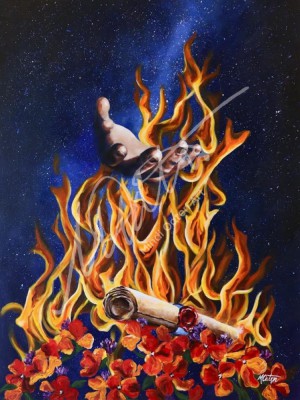
Interpretation of Daniel's Vision
Discover Jesus as: Stone Daniel 5-7 Read on Bible Gateway (HCSB)
Lesson
Audio Only
Teaching Notes
INTRO
The emphasis of this lesson will be on chapter 7. Daniel was a young man who had been taken from his land by the Chaldeans in the first wave of the deportation coming into Babylon. He was trained for over three years and was still a young man in chapter 7. Daniel actually lived 70 years in captivity. Even though Daniel would spend most of his life in captivity, he made the most of it. Daniel found favor with most of the people. He could interpret dreams because God spoke through him and told him what to say. And his friends, Shadrach, Meshach, and Abednego, were protected by God after being thrown into a fire. These four men were making a radical impact on their community even while they were in captivity.
At the end of chapter 4, King Nebuchadnezzar was praising and exalting God. He was glorifying the king of heaven. In chapter 5, however, a new king entered the picture—King Belshazzar, who couldn’t care less about anything that had to do with the Lord. Constable points out, “Nebuchadnezzar’s pride had led him to behave arrogantly, as Belshazzar was doing by drinking from the sacred vessels of Yahweh—the Most High God.”1 Belshazzar had taken and used the golden vessels of the temple in Jerusalem (Daniel 5:2-4). Then a heavenly hand appeared and wrote on the wall. Belshazzar trembled in fear. None of his wise counselors could interpret the writing. The king offered to make anyone who could interpret the writing the third highest-ranking official in the kingdom and would also be given purple clothing and a gold chain to wear around his neck (Daniel 5:5-7).
In Daniel 5:10–12 the queen told Belshazzar that Daniel, who had been made the chief of the magicians, enchanters, astrologers, and diviners by Nebuchadnezzar and who had been renamed Belteshazzar, could interpret the writing. The queen told Belshazzar to call for Daniel. Daniel’s response was that he would interpret the writing, but the king could keep the gifts. Daniel proceeded to tell Belshazzar that even though he knew all that had happened to Nebuchadnezzar when he refused to acknowledge the Lord God as sovereign, Belshazzar did not honor God. He had taken the goblets from the temple and drank from them (Daniel 5:13-23).
Mene, Tekel, and Parsin were the words that were written on the wall. 'Mene' meant the days of your reign are numbered; 'Tekel' meant you have been found wanting; and 'Peres' (the singular of Parsin) meant the kingdom would be divided and given to the Medes and Persians (Daniel 5:24-28). The king had Daniel clothed in purple and a gold chain put around his neck. He was proclaimed as the third-highest ruler in the kingdom. That night Belshazzar was killed. Darius the Meade became the next king (Daniel 5:29-31).
TEACHING
Daniel 6:1-9: Daniel was promoted again in the reign of Darius and was now one of the top-three administrators. Daniel was the third-highest official for Belshazzar, and now that the Medes had taken over, Daniel found himself as a leading administrator for the Medes and Persians. This chapter about Daniel in the lion’s den is well known. The administrators and satraps manipulated the king to sign a document that everyone was to worship the king. Anyone who worshipped and prayed to anyone or any god other than the king would be thrown in the lion’s den (vv. 1–9).
Daniel 6:11–18: Daniel continued to pray to God three times a day (v. 10). Then these men told the king about Daniel’s praying and reminded the king about the decree. They told the king Daniel was ignoring the decree. Even though the king cared for Daniel and was distraught over what had been decreed he had Daniel thrown in the lion’s den and sealed the den with a stone (vv. 11-17).
Daniel 6:19–28: The next morning the king ran to the lion’s den and called out to Daniel, asking, “Has your God… been able to recue you from the lions?” Daniel replied, “They haven’t hurt me, because I was found innocent before Him.”
Daniel was taken out of the den. In verse 24, the men who made these accusations and their families were thrown in the lions’ den where they were killed. In verses 25–28 Darius made a decree that everyone was to praise Yahweh. This is an account of an earthly king recognizing the living God whose kingdom will never be destroyed.
Daniel 7:1–12: Daniel had a dream in which he had a vison of four beasts. The first beast was like a lion with eagle’s wings. The wings were removed, and the lion was given a man’s mind. This image represented Babylon. The second beast was a bear with three ribs in his mouth, and it represented the Medes and the Persians. The third beast was a leopard with four wings and four heads. This represented Greece.
A fourth beast appeared with ten horns and was terrifying. There was no description of an animal that represented this beast. This beast represented the Roman Empire. In verse 8, there is reference to a little horn. This little horn reference in Scripture was always used as a symbol of the antichrist. This verse represents the kingdom of Satan. But verses 9 and 10 are about the kingdom of God being instituted.
By verse 11, the beast was killed, and its body was thrown into the fire. He was destroyed by the second coming of Christ. The other three beasts were allowed to live for now. MacArthur said, “Ultimate survival will not be possible for the final and revived phase of the fourth empire after Christ’s Second Coming, because catastrophic devastation (cf. 2:25) will utterly destroy it, and Christ’s kingdom will replace it.”2
Daniel 7:13–14: These verses have one of the most beautiful images of the Father and Son working together. The Son was given authority. The kingdom of God will never go away, unlike the kingdoms of the Babylonians, the Medes and Persians, the Greeks, and the Romans. The holy saints will receive the kingdom of God forever.
Daniel 7:21–28: The antichrist wages war against the saints until the Ancient of Days arrives (v. 22). The antichrist will rule for three-and-a-half years, but God will remove the antichrist and destroy him and his empire.
CLOSING
The saints will truly participate with the kingdom of God forever and ever.
Thomas Constable, Constable’s Expository (Bible Study Notes): Daniel, p. 104; available at https://planobiblechapel.org/tcon/notes/pdf/daniel.pdf.
John MacArthur, The MacArthur Bible Commentary (Nashville: Thomas Nelson Publishers, 2005), p. 957.
Questions
-
Imagine yourself as King Belshazzar. Would you act similar to the way he did in Daniel 5:5–6 when he saw the handwriting on the wall? Have you ever had a similar experience where the “handwriting was on the wall”? If so, did you heed it? Why or why not?
-
Who did the king first call in to interpret the handwriting? In your opinion, was this okay? Who do you think diviners/conjurors get their powers from? Who did the king call when they could not give meaning to the writing?
-
What was written on the wall, and what was its meaning? Why do you think King Belshazzar, hearing this warning and message of doom, still clothed Daniel in a robe of purple and chain of gold, making him the third ruler in the kingdom? What happened to King Belshazzar that very night?
-
After King Darius was made king, why did the other officials want to find fault with Daniel? What did they have to do to find any fault?
-
What happened to Daniel as a result of the law the king signed? Was the king happy about having to do this to Daniel? What did the king find in the morning in the lion’s den? What happened as a result? (Daniel 6:26–27)
-
Reflect on the two visions Daniel had in Daniel 7. Did they trouble Daniel? What did they mean? Who do you think could have been the one who interpreted Daniel’s visions?
-
What did the Holy Spirit highlight to you in Daniel 5—7 through the reading or the teaching?
Daily Word
Laura Martin Daniel 6:10
“When Daniel learned that the document had been signed, he went into his house. The windows in its upper room opened toward Jerusalem, and three times a day he got down on his knees, prayed, and gave thanks to his God, just as he had done before.”
King Darius enforced an edict stating anyone who worshipped a god beside the king would be thrown into a lion’s den. Upon hearing this Daniel opened a window facing Jerusalem, and three times a day, got down on his knees, prayed, and gave thanks to his God. He was found worshipping God and thrown into the lion’s den. During the night the Lord sent His angel to shut the lion’s mouths, protecting Daniel! The Lord delivered Daniel as he walked by faith, worshipping the one and only true God.
Although culture says to follow this way for safety, that way for assurance, and another way for an anxious-free life, God says: “If you love Me, then follow Me.” God promises to help you, guide you, deliver you, comfort you, and be your rock and refuge. Trust the Lord without compromising your faith. It may seem risky to take the road less traveled, but don’t compromise. Take the risk and follow Christ. He has plans and promises He wants to reveal to you. But first you need to take that step of faith and follow Him. Trust the Lord and worship Him above all else.
“When Daniel learned that the document had been signed, he went into his house. The windows in its upper room opened toward Jerusalem, and three times a day he got down on his knees, prayed, and gave thanks to his God, just as he had done before.”
— Daniel 6:10
FURTHER SCRIPTURE
- Daniel 6:16 — “So the king gave the order, and they brought Daniel and threw him into the lions’ den. The king said to Daniel, ‘May your God, whom you serve continually, rescue you!’”
- Daniel 6:21–23 — “Then Daniel spoke with the king: ‘May the king live forever. My God sent His angel and shut the lions’ mouths. They haven’t hurt me, for I was found innocent before Him. Also, I have not committed a crime against you my king.’ The king was overjoyed and gave orders to take Daniel out of the den. So Daniel was taken out of the den, uninjured, for he trusted in his God.”
Lesson and Daily Word
Each day has two parts: the Lesson and the Daily Word. Use these buttons to go from one to the other.
Teaching Notes and Questions
Next to the video, these tabs show the Teaching Notes and the Questions. Your answer to a question saves when you leave the answer box.
The Bible passage
This link opens the passage on Bible Gateway, and that gives the passage its tick. If you read it in your own Bible, tick it by hand in Progress.
Your progress on this lesson
A part ticks itself when you play the video or audio to the end, read the notes or the Daily Word to the end, or answer every question. You can also tick a part by hand here.
Downloads
Here you can save the video, the audio and the lesson as PDF files. Downloads do not count toward your progress.
Need help?
Use this button to send us a question or tell us about a problem. You can also take this tour again from there.