
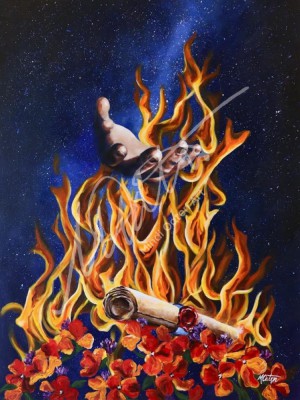
Daniel's Prayer, Daniel's Vision
Discover Jesus as: Stone Daniel 8-10 Read on Bible Gateway (HCSB)
Lesson
Audio Only
Teaching Notes
INTRO
Daniel 8 is very similar to Daniel 2 and 7. Daniel 2 and 7 are about earthly kingdoms and the beast. The little horn in chapter 7 represents the antichrist. Then the Son of Man will come and usher in the kingdom of God.
Daniel 8 included a vision about a ram and a goat. Daniel saw the image of a two-horned ram with one horn longer than the other. The image of the ram represented the Medes and Persians. The goat was symbolic of Greece and had one horn. The goat struck the ram. He shattered the ram’s horn and trampled him. In verse 9 the little horn was shattered, but four horns came up in its place. This picture was a foreshadowing of the Antichrist.
In verses 15–28 a human-sounding voice—the voice of Gabriel—spoke to Daniel. Gabriel told Daniel that the vision he was seeing represented the end of time. The end of the tribulation was then explained to Daniel. Finally, Gabriel offered an explanation of what Daniel’s vision represented.
The result of the vision was that Daniel became sick for days. Daniel was told he had to seal up the vision. The vision was of great kingdoms and great leaders falling.
TEACHING
Daniel 9:1-23: The ruling king at this time was King Darius, and it was the first year of his reign. Babylon had been conquered and destroyed, and now the Medes and the Persians were the main ruling power. Darius ruled over the Chaldeans (also referred to as the Babylonians). Daniel referenced the prophet Jeremiah’s words concerning the number of years the desolation of Jerusalem would last—seventy years. Therefore, Daniel would have assumed he would live in captivity for at least seventy years. Daniel was captured in 605 BC and, at the time of his writing, and based on the time of the reign of Darius, it would have been around 538 BC.
Daniel sought the Lord God. He prayed, petitioned, and fasted. Daniel was in exile and fervently asked God to honor His commands. In verse 5, Daniel acknowledged the sins of the people, and he owned those sins of their past. He lamented the disobedience of the people and confessed those sins in his prayers.
In 2 Chronicles 36:21, the seventy years were referred to and designated as a time for the land to rest. After sixty-seven years, the length of time of Daniel’s captivity, Daniel acknowledged that the people had still not appeased the Lord. Daniel stated the people had not obeyed God. Then he asked God for restoration in three areas: in the city of Jerusalem, on the holy mountain, and in the sanctuary. MacArthur stated, “Daniel prayed for restoration in three respects. In effect he asked God to bring back (1) ‘Your city’ (vv. 16, 18), (2) ‘Your sanctuary’ (v. 17), and (3) ‘Your people’ (v. 19). God’s answer embraced all three (vv. 24-27).”1 Daniel was continually asking for mercy.
Daniel 9:24–27: God heard Daniel’s prayers and sent the angel Gabriel to bring him an answer. Gabriel came to give Daniel an explanation and help give understanding to the timeline of the vision as well as to answer Daniel’s prayer. In verses 24–27, Gabriel explained that seventy weeks were decreed to fulfill God’s promises. These promises were in two sets of three accomplishments. MacArthur explains, “First, those related to sin are: to finish transgression, end sin and make reconciliation. Second, accomplishments related to righteousness are: to bring righteousness, seal up vision, and anoint the Most Holy.”2 In this answer to Daniel, a week’s timeframe represented seven years. Constable explains the breakdown of weeks and years from Daniel 9:27: One week represents seven years, so each half of a week equaled three-and-a-half years, and the seven-year period represents the tribulation. Sixty-nine weeks equaled 483 years, which would begin in year 444 BC. The decree to restore Jerusalem up until the time of the Messiah would be represented in 69 weeks. The 69-week breakdown includes seven weeks equaling 49 years and 62 weeks equaling 434 years. After the 62 weeks the Messiah will be cut off, which was interpreted as the death of Christ. This gets the timeline to year 33 AD, which was during the time of the decree of Artaxerxes for the death of the Messiah.3
.
The 70 weeks has no correlation and is not related to the 70 years of captivity. The current age is considered “The Church Age.”4 This Church Age is a period of waiting.
MacArthur gives an explanation of the period of the timeline that would take place from 445 BC to AD 33, which would go from “Artaxerxes decree authorizing Nehemiah to rebuild Jerusalem in 445 BC (Nehemiah 2:1–8)” to the Messiah’s kingdom.5 This would go up to the time when Christ entered Jerusalem on the donkey.
This time of 69 weeks would be followed by “The Church Age” when there is a time of waiting. That time frame will be followed by the one week, or seven years, of the reign of the antichrist. This will end with the second coming of Christ. Wiersbe explains, “We are now in the final seven years of the prophetic calendar that Gabriel gave Daniel, the period that we know as ‘the Tribulation’ or ‘the day of the Lord’. While the world as always knows wars and desolations (Matthew 24:3– 24), the end of the age will introduce a time of terrible suffering that will climax with the return of Jesus Christ (Revelation 6—19; Matthew 24:15–35).”6 This was the interpretation of the timeline, and it was the information Daniel had to use in communicating God’s plan.
Daniel 10: In chapter 10 Daniel mourned for weeks to prepare just so he would be able to receive clarity from God regarding the visions he had received. Michael, another angel, had to come to help interpret his visions.
CLOSING
Daniel had to constantly prepare himself to receive visions. As we struggle to understand, we need to take all this before the Lord and pray for the answer to the question of how we prepare for the end times.
John MacArthur, The MacArthur Bible Commentary (Nashville: Thomas Nelson Publishers, 2005), p. 962.
MacArthur, p. 962.
Thomas Constable, Constable’s Expository (Bible Study Notes): Daniel, pp. 179-180; available at https://planobiblechapel.org/tcon/notes/pdf/daniel.pdf.
Constable, p. 185.
MacArthur, p. 962.
Warren W. Wiersbe, The Exposition Bible Commentary (Colorado Springs: David C. Cook, 2002), p. 295.
Questions
-
W Where was Daniel talking about when he referred to the “beautiful land”? (Daniel 11:16, 41)
-
In Daniel 8 what time and who in history was Daniel’s vision referring to? (Revelation 6:10; 7:12-17; 11:2; 12:4; 13:3–9)
-
Who interpreted Daniel’s vision in Daniel 8? What was Daniel’s reaction when he first appeared? What do you think your reaction would have been?
-
In Daniel 8:13 what does the “rebellion that makes desolate” (abomination of desolation) mean? (Daniel 9:27; 11:31; 12:11; Matthew 24:15; Revelation 6:10; 11:2)
-
As you reflect on Daniel’s prayer for the people in Daniel 9, do you respond by humbling yourself when you cry out to God, or do you continually find fault in others and blame them for all the wrong in the world? How different do you think the world would look today if Christians would rise to the occasion and pray as Daniel did? (2 Chronicles 7:14)
-
Read Daniel 10:12–13. What does this tell you about prayer, angels, and the spiritual realm? (Daniel 10:20–21; 12:1; Jude 1:9; Revelation 12:7)
-
hat did the Holy Spirit highlight to you in Daniel 8—10 through the reading or the teaching?
Daily Word
Laura Martin Daniel 9:17–19
“Therefore, our God, hear the prayer and the petitions of Your servant. Show Your favor to Your desolate sanctuary for the Lord’s sake. Listen, my God, and hear. Open Your eyes and see our desolations and the city called by Your name. For we are not presenting our petitions before You based on our righteous acts, but based on Your abundant compassion. Lord, hear! Lord, forgive Lord, listen and act! My God, for Your own sake, do not delay, because Your city and Your people are called by Your name.”
As Daniel continued to follow the Lord, God delivered him and saved his life from the most impossible situations. He entrusted Daniel with visions foretelling the end of time and the last days. The visions over-whelmed Daniel, even caused him to lay sick for days. And yet Daniel sought the Lord in the midst of his distress with prayer and petition. He cried out to the Lord to show favor, to hear, to forgive, to listen, and to act. The Lord saw Daniel and heard his prayer. An angel confirmed that God heard Daniel’s prayers and that God treasured him. Because Daniel prayed, this angel helped Daniel understand the visions. He instructed Daniel to not be afraid but to have peace and be strong.
When you are in anguish over this world, remember to seek the Lord in prayer on behalf of yourself, your family, and your nation. Ask the Lord to show His favor, to hear, to forgive, to listen, and to act. The Lord will hear your prayers. You are a treasured child of God. He wants you to understand His peace abides in you. Be strong. Do not fear the end days. Rather stand firm. Trust the Lord. Seek the Lord in prayer, and He will hear you and answer you. Trust him today.
“Therefore, our God, hear the prayer and the petitions of Your servant. Show Your favor to Your desolate sanctuary for the Lord’s sake. Listen, my God, and hear. Open Your eyes and see our desolations and the city called by Your name. For we are not presenting our petitions before You based on our righteous acts, but based on Your abundant compassion. Lord, hear! Lord, forgive Lord, listen and act! My God, for Your own sake, do not delay, because Your city and Your people are called by Your name.”
— Daniel 9:17–19
FURTHER SCRIPTURE
- Deuteronomy 7:6 — “For you are a holy people belonging to the Lord your God. The Lord your God has chosen you to be His own possession out of all the peoples on the face of the earth.”
- Daniel 10:12 – “‘Don’t be afraid, Daniel,’ he said to me, ‘for from the first day that you purposed to understand and to humble yourself before your God, your prayers were heard. I have come because of your prayers.’”
- Daniel 10:19 – “He said, ‘Don’t be afraid, you who are treasured by God. Peace to you; be very strong!’ As he spoke to me, I was strengthened and said, ‘Let my lord speak, for you have strengthened me.’”
Lesson and Daily Word
Each day has two parts: the Lesson and the Daily Word. Use these buttons to go from one to the other.
Teaching Notes and Questions
Next to the video, these tabs show the Teaching Notes and the Questions. Your answer to a question saves when you leave the answer box.
The Bible passage
This link opens the passage on Bible Gateway, and that gives the passage its tick. If you read it in your own Bible, tick it by hand in Progress.
Your progress on this lesson
A part ticks itself when you play the video or audio to the end, read the notes or the Daily Word to the end, or answer every question. You can also tick a part by hand here.
Downloads
Here you can save the video, the audio and the lesson as PDF files. Downloads do not count toward your progress.
Need help?
Use this button to send us a question or tell us about a problem. You can also take this tour again from there.