
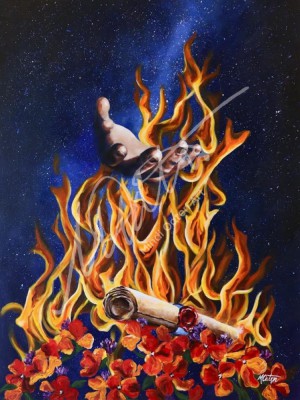
Nebuchadnezzar's Golden Statue
Discover Jesus as: Stone Daniel 3-4 Read on Bible Gateway (HCSB)
Lesson
Audio Only
Teaching Notes
INTRO
Yesterday we rushed through King Nebuchadnezzar’s dream at the end of Daniel 2. The king saw a statue in his dreams, which Daniel interpreted, explaining that the king had been given power and strength from the God of heaven. The parts of the statue represented world powers. Babylon was the golden head of the statue and had dominated its enemies. Other lesser kingdoms would rise up against and in place of Babylon, representing each of the other materials: Medo-Persians—silver; Greece—bronze; Roman Empire—iron. The clay/iron feet and toes would become a divided kingdom with some of the iron still in it and represented the Roman Empire. One part of the divided kingdom would be strong and the other would be brittle. The dream was of the downfall of kingdoms. In this dream, Daniel saw the word that represents Jesus: The Stone (Daniel 2:45).
Nebuchadnezzar fell down before Daniel when he heard the interpretation and then promoted Daniel to the third highest position in the kingdom. The king also gave Daniel royal clothes and a golden chain to wear. Daniel asked that his friends Shadrach, Meshach, and Abednego be given appointments as well, so Daniel was surrounded by faithful friends. At the end of chapter 2, Nebuchadnezzar was in awe of the Lord God, but that seems to change in chapter 3. Wiersbe explains, “We don’t know how much time elapsed between the night Nebuchadnezzar dreamed about the metallic image (Daniel 2) and the day he commanded the people to fall down before the golden image he had made. Some students believe the event described in chapter 3 might have occurred twenty years after the promotion of Daniel and his friends, about the time Jerusalem was finally destroyed (586 BC).”1
TEACHING
Daniel 3:1-7: Nebuchadnezzar built a huge statue and put it on the plain of Dura. It was probably covered from top to bottom in gold (v. 1). Wiersbe states, “There wasn’t enough gold in his entire kingdom to make a solid image ninety feet high and nine feet wide, so the image was probably made of wood overlaid with gold.”2 The king required all his appointed officers (eight different types) to attend the dedication of the statue (v. 2). The leaders/officers gathered before the statue (v. 3) and were commanded to fall down in worship of the statue when they heard the sound of musical instruments (vv. 4–5). Wiersbe said, “This was more than a political assembly; it was a religious service, complete with music, and it called for total commitment on the part of the worshipers.”3 However the leaders there had no choice—they would die if they chose not to obey (v. 6). Therefore, when the music sounded, everyone fell down before the statue to worship (v. 7).
Daniel 3:8–18: However, some Chaldeans accused the Jews of not obeying the command and refusing to worship the statue (vv. 8–12a). The Jews they named were Shadrach, Meshach, and Abednego (v. 12b). Nebuchadnezzar gave orders for the three Jews to be brought to him (v. 13). The king asked if what he had been told was true (v. 14) and then was ready to give them a second chance to worship the statue. The king asked, “Who is the god who can rescue you from my power?” (v. 15). The three Jews replied they did not need to answer the king, because, if their God exists, He could rescue them from the fiery furnace and from the king’s punishment (vv. 16–17). They also told the king that even if their God didn’t rescue them, they still wouldn’t serve the king’s golden statue (v. 18).
Daniel 3:19–30: Nebuchadnezzar was so angry at their disobedience that he had the temperature of the furnace increased. MacArthur explains the king “was not literally requiring the fire to be seven times hotter as a gauge would indicate or requiring seven times as long to heat, or seven times the amount of fuel. The angry king means ‘intensely hot,’ using ‘seven’ figuratively to denote completeness.”4 There was a door open at the bottom of the furnace to put in coal and a door in the wall in which the smelter would have been inserted to melt the gold. The king commanded men in his army to tie up the men, wrapping them up inside their clothes, and then carry the men up to the top of the furnace (v. 22). That means the three Jews were thrown down into the furnace. The furnace was so hot that the soldiers, who carried the three Jews to the top, were killed by the heat and the flames (vv. 20–22).
The king with his advisors watched the men fall into the furnace. The king jumped up when he saw four men in the furnace instead of three (vv. 23–25). Nebuchadnezzar described the fourth man as “a son of the gods.” The king could see the men inside the furnace were no longer bound and were walking around in the fire unharmed (v. 25).
This is a picture of the preincarnate Christ—meaning that before He was born on earth, He appeared at times in the Bible (Judges 6:11).
The king called the three Jews to come out of the furnace. The people were shocked when they emerged with no evidence of damage from the fire on their bodies or their clothes (vv. 26–27). Nebuchadnezzar then gave praise to the God of Shadrach, Meshach, and Abednego, who had sent His angel to rescue them (v. 28). The king gave a new decree that anyone who said anything against their God would be torn limb from limb and his house made into a garbage dump (v. 29). Then the king rewarded the three Jews (v. 30).
CLOSING
Shadrach, Meshach, and Abednego demonstrated true faith. In responses to their faith, Wiersbe emphasizes that “true faith truly confronts challenges,” “true faith confesses the Lord,” “true faith confronts the enemy,” and “true faith confirms the promises.”5
Warren W. Wiersbe, The Exposition Bible Commentary (Colorado Springs: David C. Cook, 2002), p. 262.
Wiersbe, p. 263.
Wiersbe, p. 263.
John MacArthur, The MacArthur Bible Commentary (Nashville: Thomas Nelson Publishers, 2005), p. 953.
Wiersbe, pp. 262–266.
Questions
-
Why do you think that even though Nebuchadnezzar declared the Lord to be a God of gods and a Lord of kings (Daniel 2:47), he still required all “people” to fall down and worship the golden image he had set up? (Daniel 3:4–6)
-
In Daniel 3:12 certain Chaldeans made what charges against Shadrach, Meshach, and Abednego? Were these false charges?
-
How would you explain Shadrach, Meshach, and Abednego’s trust in their God, that He was able to deliver them out of the king’s hand, since they had grown up in Babylon? Do you think they were familiar with the writings of Isaiah or any of their Scriptures (Isaiah 43:2)? How long was it from the end of Josiah’s reign to being carried away into Babylon in Daniel 1:1–4? (2 Kings 24:1–5; 2 Chronicles 36:1–6)
-
Nebuchadnezzar had both dreams and visions that are recorded in the book of Daniel. Who sent them (Daniel 2:28–29; 4:24)? Does this challenge your beliefs or understanding about dreams and visions? Have you read any New Testament Scripture that refers to them? (Matthew 1:20; 2:12; Acts 10:3; 11:5; 16:9)
-
What was the purpose of the dream and visions Nebuchadnezzar had in Daniel 4:5 (Daniel 4:17, 32, 37)? What did Daniel advise the king to do in Daniel 4:27? What precipitated the fulfillment of the dream? (Daniel 4:29–31)
-
Nebuchadnezzar used the term “Babylon the Great” in Daniel 4:30. Where else is this term used, and is it talking about the same place? (Revelation 17:5; 18:2)
-
What did the Holy Spirit highlight to you in Daniel 3—4 through the reading or the teaching?
Daily Word
Laura Martin Daniel 3:28, 29b
“Nebuchadnezzar exclaimed, ‘Praise to the God of Shadrach, Meshach, and Abednego! He sent His angel and rescued His servants who trusted in Him. They violated the King’s command and risked their lives rather than serve or worship any god except their own God . . . For there is no other god who is able to deliver like this.’”
King Nebuchadnezzar commanded people to worship a gold statue. If anyone refused, they would be thrown into a blazing, fiery furnace. In spite of this decree, Shadrach, Meshach, and Abednego took a stand for their God, refusing to bow down and worship this idol. Consequently, they were thrown into the furnace. However, their hope remained in the Lord as they declared that even if the Lord did not save them, they would not serve Nebuchadnezzar’s gods. After a night in the blazing furnace, these men walked out untouched and unharmed by the heat and fire! The Lord delivered them. When the king saw this miracle, he proclaimed the great deliverance of the one true God.”
When you face a fiery trial, does your confidence rest in the Lord to deliver you? Is your hope found in Him alone? Today, whatever trial you face, believe the Lord is mighty to save. He’s your deliverer. His presence is near. Trust the Lord will be your rock, your fortress, and your shield. Right now, call upon His name. Refuse to compromise your worship and your commitment to the Lord. Trust He will deliver you through this fire. And even if He does not, continue to worship the name of the Lord. He will be with you. Stand and praise His name right now in the middle of your “fire.”
“Nebuchadnezzar exclaimed, ‘Praise to the God of Shadrach, Meshach, and Abednego! He sent His angel and rescued His servants who trusted in Him. They violated the King’s command and risked their lives rather than serve or worship any god except their own God . . . For there is no other god who is able to deliver like this.’”
— Daniel 3:28, 29b
FURTHER SCRIPTURE
- Psalm 18:2 — “The Lord is my rock, my fortress, and my deliverer, my God, my mountain where I seek refuge, my shield and the horn of my salvation, my stronghold.”
- Isaiah 43:2 — “I will be with you when you pass through the waters, and when you pass through the rivers, they will not overwhelm you. You will not be scorched when you walk through the fire, and the flame will not burn you.”
- Daniel 3:18 — “But even if He does not rescue us, we want you as king to know that we will not serve your gods or worship the gold statue you set up.”
Lesson and Daily Word
Each day has two parts: the Lesson and the Daily Word. Use these buttons to go from one to the other.
Teaching Notes and Questions
Next to the video, these tabs show the Teaching Notes and the Questions. Your answer to a question saves when you leave the answer box.
The Bible passage
This link opens the passage on Bible Gateway, and that gives the passage its tick. If you read it in your own Bible, tick it by hand in Progress.
Your progress on this lesson
A part ticks itself when you play the video or audio to the end, read the notes or the Daily Word to the end, or answer every question. You can also tick a part by hand here.
Downloads
Here you can save the video, the audio and the lesson as PDF files. Downloads do not count toward your progress.
Need help?
Use this button to send us a question or tell us about a problem. You can also take this tour again from there.