
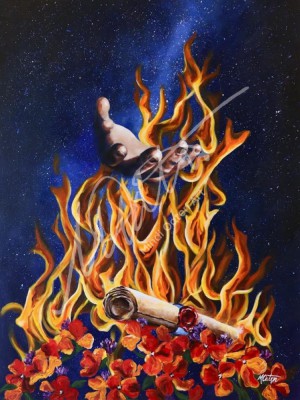
Nebuchadnezzar's Dream
Discover Jesus as: Stone Daniel 1-2 Read on Bible Gateway (HCSB)
Lesson
Audio Only
Teaching Notes
INTRO
The study we begin today of Daniel will wrap up our study of the major prophets. Every chapter in Daniel, which includes numerous pictures of Jesus, is important. The one we will focus on for the entire book is The Stone (Daniel 2:45).
MacArthur explains, “According to Hebrew custom, the title [of Daniel] is drawn from the prophet who throughout the book received revelations from God.”1 In fact “nine of the twelve chapters relate revelation through dreams and visions.”2 The book of Daniel actually covers the entire seventy-year period of Babylonian exile (Daniel 9:1–2). Daniel became “God’s mouthpiece to the Gentile and Jewish world, declaring God’s present and future plans.”3 Daniel’s name means 'God Is My Judge.'
Daniel was in the first wave of exiles to go into captivity. He was taken into captivity around the age of fifteen and sent to Babylon “to be brainwashed into Babylonian culture for the task of assisting with the imported Jews. There, he spent the remainder of a long life (eight-five years or more).”4 Daniel did well in Babylon, rising to prominence and serving as a spokesman for the Jews. Daniel lived beyond what was recorded in the book (Daniel 10:1). Daniel prophesized during the same period as Ezekiel, Habakkuk, Jeremiah, and Zephaniah.
The book of Daniel began in 605 BC when Babylon conquered Jerusalem and the first wave of exiles were sent to Babylon. Daniel continued to prophesize until Cyrus and the Medo-Persians conquered Babylon, and Cyrus freed the exiles in 539 BC. The prophet Jeremiah alluded to Daniel’s background by listing the final three kings of Judah (Jeremiah 1:1–3), and the prophet Ezekiel mentioned Daniel as wise and righteous (Ezekiel 14:14, 20; 28:3). Daniel is also referenced in Hebrews 11:32–33. MacArthur states, “Daniel was written to encourage the exiled Jews by revealing God’s program for them, both during and after the time of Gentile power in the world.”5 God used the Gentile power in the world to discipline the people for their disobedience.
TEACHING
Daniel 1: Babylon laid siege to Jerusalem, and the Lord handed over King Jehoiakim of Judah to Nebuchadnezzar, along with some of the vessels that belonged to God. Nebuchadnezzar instructed his officials to take young men of royal and noble families to Babylon, young men who were good-looking, strong, and capable of serving in the king’s palace. These young men were to be fed from the royal provisions and trained for three years to serve in the king’s court. The young men were even given Babylonian names: Belteshazzar (Daniel), Shadrach (Hananiah), Meshach (Mishael), and Abednego (Azariah) (vv. 1–7). In verses 8–16 Daniel and the others chose only to eat of what God had instructed them. They went through a period of testing, and in ten days they were stronger and healthier than those who had eaten the royal food. At the end of the training period, all the young men from Jerusalem were presented to the king. After interviewing them all, none were found equal to Daniel and his friends. When the king consulted them on different matters, he found the four better than all the diviner-priests and mediums in his kingdom (vv.17–21).
Daniel 2:1–26: Nebuchadnezzar had dreams that interrupted his sleep. He wanted his priests and mediums to tell him what the dream was before they interpreted the dream, but they asked for him to tell them the dream first. The king responded that if they couldn’t tell him the dream and its interpretation, they would be torn limb from limb. If they could do as he asked, they would be rewarded greatly (vv. 1–6). The king’s diviners stalled for time, but the king said his word was final. He wanted them to tell him the dream first so he could trust their interpretation of it (vv. 7–9). The king’s diviners replied that what the king wanted was impossible—only a god would be able to do that (vv. 10–11). The king was so angry he had all the diviners and priests taken to be executed and even looked for Daniel and his friends to execute them as well (vv. 12-13).
Daniel tactfully asked why the wise men were all to be executed and was told what happened. Daniel asked the king to give him time so he could do as the king had requested (vv. 14–16). Daniel told his three friends what happened and asked them to pray to God for mercy concerning this mystery so they would not be killed (vv. 17–18). The mystery was revealed to Daniel in a vision, and Daniel praised God for His wisdom and power (vv. 19–23). Daniel went to Arioch, who had the assignment to execute the wise men, and told him not to kill them because he had the interpretation the king wanted. Arioch took Daniel to the king and explained what Daniel, the Judean exile, could do. The king asked if Daniel knew the dream and its interpretation. Daniel said he did not, but that his God in heaven did and then explained the dream to the king. The king’s dream was of the future, and Daniel’s God had given him the knowledge and the wisdom to explain it (vv. 24–30).
Daniel said the dream was of a huge statue that was terrifying to look at. The head was pure gold, the chest and arms were silver, the stomach and thighs were bronze, the legs iron, and the feet were part iron and part clay. As the king watched on in the dream, a rock was cut out, landed on the feet of clay, and the statue shattered into tiny pieces that were carried away by the wind (vv. 31–35). Daniel then interpreted the dream. The king had been given power and strength from the God of heaven. Babylon was the golden head of the statue, and other lesser kingdoms would rise up, representing each of the other materials: Medo-Persians—silver; Greece—bronze. The legs of iron were the Roman Empire and the clay/iron feet and toes would become a divided kingdom with some of the iron still in it and they also represented the Roman Empire. One part of the divided kingdom would be strong and the other would be brittle. The dream was of the downfall of kingdoms. However, the God of heaven’s kingdom will never be destroyed and will crush all the other kingdoms (vv. 36–45). Christ is The Stone who will destroy all other nations that rise against Him.
The king fell down and paid homage to Daniel because Daniel’s God “is indeed God of gods, Lord of kings, and a revealer of mysteries” (vv. 46–47). The king then promoted Daniel, rewarded him, and placed him over the entire province of Babylon (v. 48).
CLOSING
Kingdoms come and go. But Christ, The Stone, will bring about the ultimate kingdom that cannot be destroyed.
John MacArthur, The MacArthur Bible Commentary (Nashville: Thomas Nelson Publishers, 2005), p. 947.
MacArthur, p. 947.
MacArthur, p. 947.
MacArthur, p. 947.
MacArthur, p. 947-948.
Questions
-
Who did the King of Babylon order his chief eunuch to bring to him? What was the purpose for these men? (Daniel 1:3-5)
-
In Daniel 1:8, why did Daniel not want to eat the king’s food or drink the wine? How did Daniel convince the chief eunuch to allow him to eat something else? What was to happen after ten days? (Daniel 1:9-14)
-
How did God reward the faithfulness of Daniel and his three friends? (Daniel 1:17) How have you seen God reward you for your obedience and faithfulness?
-
In Daniel 2, what were king Nebuchadnezzar’s dreams? What did the Chaldeans say to the king about his dreams (Daniel 2:10)? What was the king’s reaction? How did Daniel wind up being the one to interrupt the dreams? When did God reveal the mystery of the dream to Daniel? (Daniel 2:19)
-
In Daniel 2:27–28, who did Daniel say was the only One who could reveal the mystery that the king was asking about? What was the interpretation of the dream that Daniel gave and how did the king respond to it? (Daniel 2:31–49)
-
What did the Holy Spirit highlight to you in Daniel 1—2 through the reading or the teaching?
Daily Word
Laura Martin Daniel 1:8–9
“Daniel determined that he would not defile himself with the king’s food or with the wine he drank. So he asked permission from the chief official not to defile himself. God had granted Daniel favor and compassion from the chief official.”
King Nebuchadnezzar’s court officials chose Daniel, one of several young Israelite men, to train for three years in preparation for service to the king’s court in Babylon. The king assigned the men daily pro- visions from the royal table—food and wine that would compromise Daniel’s faith. Boldly, Daniel asked permission to receive a different diet of vegetables and water. God granted Daniel and three others favor from the chief official. At the end of training, Daniel and his friends not only excelled physically above the others but the Lord also gave them wisdom and knowledge tenfold!
The Lord honors a heart that does not fear man but rather fears the Lord. Jesus says that if anyone wants to come with Him, they must deny themselves, take up their cross, and follow Him. Like Daniel, this may mean making a choice different from the crowd and trusting the Lord will make a way when there seems to be no way. You must believe the Lord will be with you when you honor Him and walk in integrity. Today, make the right choice in God’s eyes, even if it seems foolish, risky, or lonely. He’s asking you to follow Him, walk in His ways, and not compromise your faith. Be a Daniel in your world today!
“Daniel determined that he would not defile himself with the king’s food or with the wine he drank. So he asked permission from the chief official not to defile himself. God had granted Daniel favor and compassion from the chief official.”
— Daniel 1:8–9
FURTHER SCRIPTURE
- Daniel 1:17, 20 — “God gave these four young men knowledge and understanding in every kind of literature and wisdom. Daniel also understood visions and dreams of every kind . . . In every matter of wisdom and understanding that the king consulted them about, he found them 10 times better than all the diviner-priests and mediums in his entire kingdom.”
- Matthew 16:24 — “Then Jesus said to His disciples, ‘If anyone wants to come with Me, he must deny himself, take up his cross, and follow Me.’”
- Luke 16:10 — “Whoever is faithful in very little is also faithful in much, and whoever is unrighteous in very little is also unrighteous in much.”
Lesson and Daily Word
Each day has two parts: the Lesson and the Daily Word. Use these buttons to go from one to the other.
Teaching Notes and Questions
Next to the video, these tabs show the Teaching Notes and the Questions. Your answer to a question saves when you leave the answer box.
The Bible passage
This link opens the passage on Bible Gateway, and that gives the passage its tick. If you read it in your own Bible, tick it by hand in Progress.
Your progress on this lesson
A part ticks itself when you play the video or audio to the end, read the notes or the Daily Word to the end, or answer every question. You can also tick a part by hand here.
Downloads
Here you can save the video, the audio and the lesson as PDF files. Downloads do not count toward your progress.
Need help?
Use this button to send us a question or tell us about a problem. You can also take this tour again from there.