
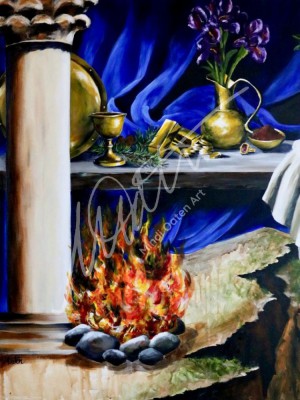
Hearing God's Whisper
Discover Jesus as: Something Greater 1 Kings 19-20 Read on Bible Gateway (HCSB)
Lesson
Audio Only
Teaching Notes
INTRO
We’re nearing the end of 1 Kings, and I love this passage on Elijah. We have all experienced that feeling of letdown after having had an amazing time in God’s presence. For example, after we finished 50 days of evangelizing in reviveTEXAS, there was mental and emotional fatigue. That is where Elijah was. He had just seen God rain fire down from heaven and then bring rain to Israel. But then, Ahab told Jezebel what Elijah had done, although we don’t know if everything he told her was truth. James 5:17 states Elijah had “a nature like ours.” Wiersbe points out the Bible “describes the warts and wrinkles of even the greatest,” and that in 1 Kings 18—19, “we see Elijah at his highest and at his lowest.”1This passage shows Elijah’s humanity after he’d poured himself out in ministry (Psalm 39:5).
TEACHING
Wiersbe divides chapter 19 into four sections, which we will follow in this study: “The enemy’s message of danger,” “The angel’s message of grace,” “The Creator’s message of power,” and “The Lord’s message of hope.”2
I Kings 19:1-4: The Enemy’s Message of Danger. Ahab told Jezebel everything and she sent a message to Elijah, promising she would take his life (vv. 1–2). It’s interesting that the message didn’t come from Ahab, the king, but the queen. Wiersbe suggests, “If Jezebel transformed the prophet into a martyr, he might influence people more by his death than by his life.”3Jezebel seemed to have had a plan, which is typical for “Jezebels.” They are looking for what any situation will do for them personally—not someone you want in your life or your ministry.
Elijah received Jezebel’s message and was afraid. He ran south to Beersheba and then left his servant there to go into the desert (vv. 3–4a). “Charles Spurgeon said that Elijah ‘retreated before a beaten enemy.’”4Elijah ran from the enemy he had already defeated. “God had answered [Elijah’s] prayer (1 Kings 18:36–37) and God’s hand had been upon him in the storm (1 Kings 18:46), but now he was walking by sight and not by faith.”5Elijah “was running ahead of the Lord in order to save his own life.”6Elijah journeyed an entire day into the wilderness and then sat under a broom tree and prayed God would take his life (v. 4b).
I Kings 19:5-8: The Angel’s Message of Grace. The tone of the passage changes in verse 5. While Elijah slept under the tree, an angel touched him and told him to get up and eat (v. 5). Vance Havner would say, “If we didn’t come apart and rest, we’d come apart.”7This was not the only time angels came to someone in the Old and New Testaments (Acts 12:7). When he looked, Elijah found bread that had been baked over hot stones and a jug of water (v. 6). Remember angels come to minister to us (Hebrews 1:14; Psalm 91:11). In verse 7, the angel is referred to as “the angel of the Lord,” which I believe indicates this was the preincarnate Christ (Genesis 16:10; Exodus 3:1–6; Judges 2:1–4). Christ showed up to one of the greatest prophets, woke him a second time, and fed him so Elijah could continue the journey. Elijah ate and drink and then, on the strength of that food, walked 40 days and nights, a distance of about 200 miles, to the mountain of God at Mount Horeb (or Mount Sinai) (v. 8).
I Kings 19:9-14: The Creator’s Message of Power. Elijah entered a cave and stayed the night (v. 9a). Nelson’s Commentarystates that the way “the cave” was written in Hebrew suggests “this was ‘the cave’ in which Moses had hidden when he experienced the presence of Yahweh on the mountain of God (Exodus 45).”8God asked why Elijah had come to the cave (v. 9b). Elijah explained that even with all he had done, the people had abandoned God and ignored His prophets (v. 10). The Lord told Elijah to stand outside the cave in God’s presence.
The Lord passed by, and a mighty wind whipped at the mountain and shattered the cliffs, and an earthquake rumbled, but the Lord was not found in either the wind or the quaking (v. 11). Although we see God show up in the wind in Acts 2:2–3 and in an earthquake in Zechariah 14:4–5, that was not the case with Elijah. Next came fire (Exodus 40:38), but God was not in the fire. Finally, there was a soft whisper, which was the voice of God (v. 12). Nelson’s Commentarypoints out that “Elijah had called for lightning, and he had called for fire and national revival. What Elijah did not see was that God was at work in the lives of many people.”9In the quiet and the stillness, God was working in the lives of everyday people. But Elijah was looking for the fire and the lightening and for revival.
Elijah recognized the voice, so he wrapped his face in his mantel and stood at the entrance of the cave (v. 13a). The voice asked again what Elijah was doing there (v. 13b). Nelson’s Commentary states that the Lord’s question implied “it is time to be elsewhere, serving God both in the normal routine of life and in accordance with His special commissions.”10At God’s question, Elijah repeated what he first said in verse 10, "…I alone am left, and they're looking for me to take my life" (v. 14).
I Kings 19:15-21: The Lord’s Message of Hope. The Lord sent Elijah back the way he came to anoint Hazael as king over Aram (v. 15). Notice God didn’t give up on Elijah, and he doesn’t give up on us, even when we are complaining or running from what He wants us to do. Instead, God sent Elijah in a new direction in which to walk out his anointing (Psalm 103:11-14). Then Elijah was to go anoint Jehu as king over Israel and Elisha as the prophet to take his place (v. 16). Jehu, Hazael, and Elisha would be used as God’s instruments (v. 17). God pointed out that there were 7,000 people who remained loyal to their God, Yahweh (v. 18). Nelson’s Commentarydescribes them as “a community of God among everyday people whose lives are not spectacular but who live faithfully for God.”11Elijah responded obediently and found Elisha in the fields working and threw his mantle over him (v. 19). Elijah overcame everything he had been thinking and feeling because God still had a purpose in his life. Elisha asked for time to say goodbye to his family, and then he obediently and faithfully followed Elijah (vv. 20–21).
CLOSING
Elijah experienced God, not through God’s power, but through God’s soft voice. It was not flashy or crazy, but was the whisper of the God Elijah heard in his everyday life. As a result, Elijah could pass on his mantle to Elisha. No matter what state you are in right now, there is hope for you—God can continue to work through your life!
Warren W. Wiersbe, The Exposition Bible Commentary: 1 Kings (Colorado Springs: David C. Cook, 2003), p. 475.
Wiersbe, pp. 475–480.
Wiersbe, p. 476.
Wiersbe, p. 476.
Wiersbe, p. 476.
Wiersbe, p. 476.
Wiersbe, p. 476.
Earl Radmacher, Ronald B. Allen, and H. Wayne House, eds., Nelson’s New Illustrated Bible Commentary: 1 Kings (Nashville: Thomas Nelson Publishers, 1999), p. 455.
Nelson’s Commentary, p. 455.
Nelson’s Commentary, p. 455.
Nelson’s Commentary, p. 455.
Questions
-
In 1 Kings 19:2, Jezebel vowed to take Elijah’s life by the next day. Why did Elijah become fearful and run for his life after such a demonstration of the Lord’s power? Does it remind you of Peter in Matthew 14:20–31? Why?
-
An angel had Elijah eat bread baked on hot stones and drink water. How do each of these elements (bread, stones, and water) point to Christ? (John 4:14, 6:35; 1 Corinthians 10:4)
-
God called Elijah to stand on the mountain before Him. What phenomena took place while the Lord was passing by (1 Kings 19:11–13)? When the Lord speaks throughout Scripture, how is it described? (1 Samuel 3:6; Psalms 29:3–8; 68:33; Jeremiah 10:13; Ezekiel 43:2; Revelation 1:10, 15)
-
What three charges did Elijah bring against the sons of Israel in 1 Kings 19:10, 14?
-
In 1 Kings 20, men came to Ahab several times with a message from the Lord in regard to fighting the Arameans. Why do you think Ahab listened, even though we know he was not serving the Lord and had no respect for Him (1 Kings 18:18)? Why did the Lord deliver Israel from the Arameans? (1 Kings 20:13, 28)
-
What did the Holy Spirit highlight to you in 1 Kings 19—20 through the reading or the teaching?

Daily Word
Laura Martin 1 Kings 19:4–5
“But he went on a day’s journey into the wilderness. He sat down under a broom tree and prayed that he might die. He said, ‘I have had enough! LORD, take my life, for I’m no better than my fathers.’ Then he lay down and slept under the broom tree. Suddenly, an angel touched him. The angel told him, ‘Get up and eat.’”
FURTHER SCRIPTURE
- Psalm 28:7 — “The Lord is my strength and my shield; my heart trusts in him, and I am helped. Therefore my heart rejoices, and I praise Him with my song.”
- Psalm 73:26 — “My flesh and my heart may fail, but God is the strength of my heart and my portion forever.”
- Isaiah 40:31 — “But those who trust in the Lord will renew their strength. They will soar on wings like eagles; they will run and not grow weary, they will walk and not be faint.”
Lesson and Daily Word
Each day has two parts: the Lesson and the Daily Word. Use these buttons to go from one to the other.
Teaching Notes and Questions
Next to the video, these tabs show the Teaching Notes and the Questions. Your answer to a question saves when you leave the answer box.
The Bible passage
This link opens the passage on Bible Gateway, and that gives the passage its tick. If you read it in your own Bible, tick it by hand in Progress.
Your progress on this lesson
A part ticks itself when you play the video or audio to the end, read the notes or the Daily Word to the end, or answer every question. You can also tick a part by hand here.
Downloads
Here you can save the video, the audio and the lesson as PDF files. Downloads do not count toward your progress.
Need help?
Use this button to send us a question or tell us about a problem. You can also take this tour again from there.