
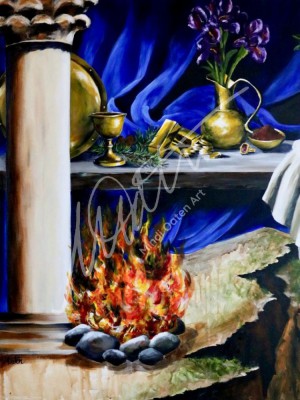
The Death of Ahab
Discover Jesus as: Something Greater 1 Kings 21-22 Read on Bible Gateway (HCSB)
Lesson
Audio Only
Teaching Notes
INTRO
Our phrase for the book of 1 Kings is Something Greater and was demonstrated clearly through the first 11 chapters about Solomon. The rest of the book feels more like a study of Judges as kings fight against kings and nations fight against each other. Solomon’s reign brought unification. After his death; however, Israel became the divided kingdom and was thrown into chaos.
In 1 Kings 21, Jezebel had Naboth the Jezreelite killed (vv. 1–14), Ahab took Naboth’s vineyard (vv. 15–16), and Elijah came in and pronounced God’s judgment on Ahab (vv. 17–29). That’s the backdrop to the last chapter of 1 Kings. Chapter 22 continues the story of Jezebel and Ahab, as well as King Jehoshaphat, another good king in Judah. Judah experienced a period of peace under Jehoshaphat. Nelson’s Commentarypoints out that, “Faced with the rising threat of Assyria, Ahab had failed to press his advantage of three years before. He had not reoccupied the strategic highlands of Ramoth in Gilead.”1As you read through these notes, watch for the italicized statements that emphasize He is Something Greater.
TEACHING
1 Kings 22:1–5: Wiersbe explains, “After three years, Ben-hadad hadn’t kept his agreement to give Israel back the cities his father took, [so] Ahab decided it was time to fight Syria and take them back.”2After three years of no war, Jehoshaphat, king of Judah, visited Ahab, king of Israel (vv. 1–2), who was also his son's father-in-law. Ahab asked Jehoshaphat to help him fight for Ramoth-gilead (v. 3). Jehoshaphat had fought with Ahab in the past, and he accepted Ahab’s request (v. 4). Jehoshaphat did stop to seek God’s will (v. 5). The problem with this is the order—Jehoshaphat made a decision first and then asked the Lord what he should do.
We must be careful who we align ourselves with! Jehoshaphat compromised what he knew should be done by allowing his son to marry Ahab’s daughter. We cannot become unequally yoked (Proverbs 4:14–17). Ahab and Jezebel were evil, and yet Jehoshaphat allowed his son to marry into the family and he chose to align himself and his nation as an ally of Israel. Things got complicated when he became unequally yoked by making alliance with those who had an evil heart.
1 Kings 22:6–12: Ahab called on his prophets, about 400 men, and asked if he should go to war. They all told Ahab what he wanted to hear and told him to go (v. 6). Jehoshaphat realized that none were prophets of Yahweh and asked where are Yahweh’s prophets (v. 7). Ahab responded there was one left that he hated because he never prophesied good things to him (v. 8). Jehoshaphat asked to see that prophet—Micaiah, son of Imiah. While Micaiah was sent for, Ahab’s other prophets promised him a great victory (vv. 11–12). We must listen to right counsel and seek God’s will!
1 Kings 22:13–28: The messenger told the prophet Micaiah that he should join the other prophets in declaring that Ahab’s war would be victorious (v. 13). Micaiah refused to say anything except what God told him to say (v. 14). We must not conform, but to seek to please God, not man! When asked, and prompted by the king to speak truthfully (2 Chronicles 18:14-15), Micaiah told King Ahab to go ahead in war, and Yahweh would hand over victory to “the king” (v. 15). The king asked Micaiah again, not trusting him, and Micaiah told him two visions. In the first vision, Micaiah said Israel would be scattered without a leader (vv. 16–17). Visions will happen until the Messiah returns, so we too can experience visions (Joel 2; Acts 2). This pointed to common imagery (Matthew 9:36) that people were everywhere and no one was taking care of them. Ahab understood the vision and complained that Micaiah only gave visions of defeat (v. 18). Micaiah responded with a second vision: God was on His throne surrounded by the heavenly host and asked who would trick Ahab into marching on Ramoth-gilead, and a spirit agreed to go as “a lying spirit in the mouth of all his prophets” (vv.19–22). Nelson’s Commentary shares, “These prophets prophesied under the influences of evil, but their false predictions were just what Ahab wanted to hear.”3Jehoshaphat explained God had put that lying spirit into Ahab’s prophets (v. 23). For other examples of God using evil (Job 1—2; John 13:21–30).
Zedekiah, one of Ahab’s prophets, hit Micaiah in the face and asked if the spirit of the Lord had left him to go to Micaiah (v. 24). We must expect opposition. Micaiah told Zedekiah that the day would come when he would know Micaiah had been right (v. 25). Ahab sent Micaiah back to prison with instructions he was only to be fed bread and water until his safe return (vv. 26–27). Micaiah replied that if Ahab returned safely, then God had not spoken to him (v. 28). Once we release God’s word, we must remain confident and stand firm!
1 Kings 22:29–40: The kings led their armies up Ramoth-gilead (v. 29). Ahab disguised himself but had Jehoshaphat wear his royal garments (v. 30). Ahab was trying to avoid Micaiah’s prophecy from coming true. The king of Aram ordered his 32 chariot commanders to only fight the king of Israel (v. 31). When they charged Jehoshaphat in his royal garments, they turned toward him, but Jehoshaphat cried out in fear (v. 32). The chariots turned away from Jehoshaphat (v. 33). Someone shot an arrow randomly into the air and it struck Ahab, the king of Israel, between the breastplate and his lower armor (v. 34). Ahab told his charioteer to take him from the battle (v. 35). Ahab was propped up in his chariot, and he watched the rest of the battle rage on while he bled to death (vv. 36). As the sun set, Micaiah’s prophecy came true, and each man was sent to his own city or land (v. 37). Ahab was buried in Samaria (v. 37). The chariot was washed at the pool of Samaria, the dogs licked up the blood that remained in it, and prostitutes bathed in it, as God has promised (v. 38). Ahab rested with his fathers, and his son Ahaziah became the next king of Israel (v. 40).
1 Kings 22:41–50: Jehoshaphat made three major compromises, each one outside God’s will:
- A bride compromise: He compromised when he chose his son’s bride and married him to the daughter of Ahab and Jezebel.
- A battle compromise: He became entangled in the affairs of his son’s father-in-law, King Ahab, when Israel attacked Aram, and he almost lost his own life.
- A boat compromise: He agreed to a commercial enterprise with Ahaziah, Ahab’s son and Jehoshaphat's sons' brother-in-law, which were destroyed through God’s displeasure.
CLOSING
What can we learn from this? Keep walking in the sweet spot of God's will. Be careful who you align yourself with. Seek God's will. Listen to the right counsel in the process. As you are listening, do not conform to false truth, do not give in to evil. You can expect opposition, but as you do this, one thing I want to learn myself is to stand firm and remain confident in what you've heard from the Lord. In Jude, it talks about all these seemingly 'truths' that will start coming at us, but they are false. We have the absolute truth and our job is to hold firm to this truth and inquire of the Lord as we go. We can hold on to the truth because Jesus is Something Greater than any of these kings we've talked about!
Earl Radmacher, Ronald B. Allen, and H. Wayne House, eds., Nelson’s New Illustrated Bible Commentary: 1 Kings (Nashville: Thomas Nelson Publishers, 1999), p. 458.
Warren W. Wiersbe, The Exposition Bible Commentary: 1 Kings (Colorado Springs: David C. Cook, 2003), p. 488.
Nelson’s Commentary, p. 458.
Questions
-
In Kings 21:3, what was the inheritance of their fathers, and why was it so important (Numbers 36:9–12)? What is our inheritance in the kingdom (Ephesians 1:14, 18; Hebrews 9:15; 1 Peter 1:4)? How can we hold on to it without “selling or trading” it?
-
Jezebel arranged for two men to falsely accuse Naboth in order to have him killed. How does this point to Christ? (Matthew 26:59; Mark 14:55)
-
Jezebel used the king’s authority to initiate Naboth’s death, and King Ahab allowed it to happen. Did the Lord hold him responsible (1 Kings 21:18–19)? Does this remind you of Adam in Genesis 3:6; 3:17?
-
Ahab humbled himself after hearing the Lord’s judgment on him and his family. How did the Lord respond (1 Kings 21:28–29)? What does this tell us about the character of the Lord? (Exodus 34:6–7; Ezekiel 18:23)
-
In 1 Kings 22, how many prophecies do you see fulfilled (1 Kings 22:34, 38)? Have you ever had a prophetic word spoken to you and experienced its fulfillment?
-
What did the Holy Spirit highlight to you in 1 Kings 21—22 through the reading or the teaching?

Daily Word
Laura Martin 1 Kings 22:8
“The king of Israel said to Jehoshaphat, ‘There is still one man who can ask Yahweh, but I hate him because he never prophesies good about me, but only disaster. He is Micaiah son of Imlah.’ ‘The king shouldn’t say that!’ Jehoshaphat replied.
Judah’s King Jehoshaphat walked in the ways of his father King Asa and did what was right in the eyes of the Lord. However there were times when Jehoshaphat would make a decision on his own and then include the Lord in His plan. When facing battle, King Jehoshaphat first aligned with King Ahab, who was not a man of God and then, afterwards, sought the Lord for direction. King Jehoshaphat lacked care in determining with whom to align himself, ultimately compromising what he believed.
As you walk with Christ, the enemy wants to distract you and entice you to walk away from the Lord. Be careful with whom you align yourself. When you align yourself with people who are not seeking the Lord, they can distract you and point you away from Christ. However, when you take the time and align yourself with like-minded believers, you sharpen one another. Today, take a minute to think about the people in your life you turn to for counsel. Are they walking with the Lord or walking in their own ways? If you are walking with Christ, be sure to hold on to His truth and His ways.
“The king of Israel said to Jehoshaphat, ‘There is still one man who can ask Yahweh, but I hate him because he never prophesies good about me, but only disaster. He is Micaiah son of Imlah.’ ‘The king shouldn’t say that!’ Jehoshaphat replied.
—1 Kings 22:8
FURTHER SCRIPTURE
- Proverbs 27:17 — “Iron sharpens iron, and one man sharpens another.”
- 2 Corinthians 6:14 — “Do not be mismatched with unbelievers. For what partnership is there between righteousness and lawlessness? Or what fellowship does light have with darkness?”
- 1 John 4:1 — “Dear friends, do not believe every spirit, but test the spirits to determine if they are from God, because many false prophets have gone out into the world.”
Lesson and Daily Word
Each day has two parts: the Lesson and the Daily Word. Use these buttons to go from one to the other.
Teaching Notes and Questions
Next to the video, these tabs show the Teaching Notes and the Questions. Your answer to a question saves when you leave the answer box.
The Bible passage
This link opens the passage on Bible Gateway, and that gives the passage its tick. If you read it in your own Bible, tick it by hand in Progress.
Your progress on this lesson
A part ticks itself when you play the video or audio to the end, read the notes or the Daily Word to the end, or answer every question. You can also tick a part by hand here.
Downloads
Here you can save the video, the audio and the lesson as PDF files. Downloads do not count toward your progress.
Need help?
Use this button to send us a question or tell us about a problem. You can also take this tour again from there.