
The Coming of Revival
Discover Jesus as: Something Greater 1 Kings 17-18 Read on Bible Gateway (HCSB)
Lesson
Audio Only
Teaching Notes
INTRO
1 Kings 18 takes me back to my time of study at Gordon Cornwall Theological Seminary under Dr. Robert Coleman, who, in my opinion, is one of the most gifted and insightful teachers on revival, outreach, and discipleship. After three years under Dr. Coleman, I had to write a doctoral dissertation on this passage. Walt Kaiser wrote a book titled, Revive Us Again, a book that shaped Time to Revive. Kaiser wrote about an incredible number of revivals in both the Old and New Testaments, including one based on today’s passage, which he called, “It’s Time to Let God Be God.” First Kings 18 could be called Time to Revive's chapter, because the heart within it is the need for national revival and for God to show up. We too have to give God space to be God—to direct how He wants to revive our nation and our lives.
In 1 Kings 17—18, Israel had become divided, and two new kingdoms, Israel in the north and Judah in the south, were created. Both kingdoms experienced several kings, and all but one was evil in God’s sight. At this point, 58 years had passed since the kingdoms were divided (931 B.C.). In the northern kingdom, the kings did evil that is documented in 1 Kings: Jeroboam created two golden calves for his people to worship (1 Kings 12:28–32); Nadab, his son, continued the idol worship his father started (1 Kings 15:26); Baasha murdered King Nadab to take the throne (1 Kings 15:27); Elah, Baasha’s son, was a drunkard and a murderer (1 Kings 16:8–9); Zimri committed treason against Elah and took the throne (1 Kings 16:20); Omri led his people into idol worship (1 Kings 16:25–26); and Ahab, son of Omri, married Jezebel and did more evil than any of the kings who had gone before him (1 Kings 16:30–31.
TEACHING
1 Kings 17: There was pure evilness in the northern kingdom. In this backdrop, God sent Elijah the Tishbite to announce the coming drought that God was going to hold over the land (v. 1). After his pronouncement, Elijah had to hide for three years in the Wadi Cherith (vv. 2–7) and then with a widow in Zarephath (vv. 8–24). As we walk through 1 Kings 18, I’m going to use three statements from Kaiser as we consider letting God be God.1
1 Kings 18:1-6: He Makes us Courageous. After three years of hiding from Ahab, God sent Elijah to appear before Ahab with the message that the rain was coming (vv. 1–2). We need to be courageous and step up to deliver God’s Word (Deuteronomy 31:6; Joshua 1:9; 1 Chronicles 28:20). Ahab called for Obadiah (not the prophet, but his name meant “servant of the Lord”), who was in charge of Ahab’s household and feared the Lord. Obadiah hid 100 of God’s prophets in two caves and provided them with food and water while Jezebel had all the other prophets slaughtered (vv. 3–4). Obadiah was sent one way throughout the land to feed the horses, mules and cattle to prevent them from dying of starvation, while King Ahab went the other direction (vv. 5–6).
1 Kings 18:7-20: While Obadiah was walking, Elijah “suddenly met him.” Obadiah recognized him immediately (v. 7) and Elijah sent Obadiah to tell Ahab he was back (v. 8). Obadiah asked Elijah why he would send him back to be killed by Ahab when he delivered his message, especially since he already risked his life taking care of God’s prophets (vv. 9–14). Obadiah obeyed and Ahab met Elijah, calling him a troubler (vv. 15–17). Elijah proclaimed that Ahab and his father had destroyed Israel by ignoring God’s commands and worshipping idols (v. 18). Elijah told Ahab to meet him on Mount Carmel along with all the prophets of Baal and Asherah (vv. 19–20).
The theological discussions about this Obadiah are fascinating. Many propose that Obadiah compromised his relationship with the Lord as a servant of Ahab. While Kaiser doesn’t accept this as a compromise, he does note inconsistencies in Obadiah’s behavior:
- He gave no evidence of delight in seeing a fellow follower of God.
- He resented being told to go tell Ahab that Elijah had returned.
- He was self-centered and concerned only for his own protection, not the welfare of God’s kingdom.
- He distrusted Yahweh’s words and didn’t fear the Lord.
- He was overly defensive about his actions from his youth.
1 Kings 18:21-29: He Shows Us His Power. Elijah asked the people how long they were going to go back and forth between Yahweh and the other gods. The people couldn’t even answer (Revelation 3:15–16). Elijah declared he was the only prophet of the Lord, even though there were other prophets at the time (v. 22). He was probably “focused on the fact that he alone stood ready to confront the 450 prophets of Baal.”2In verses 23-25, Elijah challenged the prophets of Baal to see whose God would reign down fire on a sacrificed bull (Psalm 71:18; 147:4–5; Jeremiah 10:12–13). The prophets of Baal did what Elijah told them, prepared the sacrifice, and then spent hours calling down their god Baal (v. 26). At noon, Elijah mocked them for their actions, and they worked even harder (vv. 27–29). No god answered.
1 Kings 18:30-39: Elijah drew the people before him, rebuilt the Lord’s altar that had been destroyed, took twelve stones, and made a trench around it that could hold four gallons of water (vv. 30–32). Next, Elijah prepared the sacrifice and then called for four full water pots to be poured over the offering and the wood that was to be burned (v. 33). Elijah directed them to do that two more times (v. 34) and fill the trench with water (v. 35). Elijah began the evening sacrifice and called on the God of Abraham, Isaac, and Israel (or Jacob), tapping into the history of God’s promises to the people of Israel (v. 36). Nelson’s Commentarybreaks up Elijah’s prayer (v. 37) into two parts: “First, he wished that the Lord would demonstrate clearly to the people that He alone is the living God. Second, he prayed for the full revival of God’s people.”3Yahweh’s fire fell and consumed the wood, the stones, the dust, and the water in the trench (v. 38). The people watching recognized the power had come from their God, Yahweh (v. 39).
1 Kings 18:40-46: He Answers Our Prayers. Elijah told the people of Israel to slaughter the prophets of Baal (v. 40), and he told Ahab to go eat and drink because rain was coming (v. 41). While Ahab ate, Elijah went atop Carmel and bowed in prayer (v. 42). Then, Elijah told his servant seven times to go look at the sea to see if rain was on its way (vv. 43–44a). On the seventh time, the servant saw a tiny cloud on the horizon, so Elijah told the servant to tell Ahab to get in his chariot and get off the mountain before the rains came (vv. 44b–45). As Ahab started down the mountain in the rain and headed to Jezreel, the power of the Lord was on Elijah. He ran ahead of Ahab the 13 miles to Jezreel (vv. 45–46).
CLOSING
God wants each of us to be courageous. He wants us to pray for “the rain to come down.” Do you have enough faith and courage to pray that kind of prayer (James 5:16–18)? We can pray like Elijah, and God wants to respond. Do you believe that? When you believe this, revival can actually come.
Walter C. Kaiser, Jr., Revive Us Again, rev. ed. (Geanies House Fearn, Tain Ross–shire IV20 1TW, Scotland, UK: Christian Focus Publications, 2013), pp. 77–87.
Earl Radmacher, Ronald B. Allen, and H. Wayne House, eds., Nelson’s New Illustrated Bible Commentary: 1 Kings (Nashville: Thomas Nelson Publishers, 1999), p. 454
Nelson’s Commentary, p. 454.
Questions
-
Elijah entered the story in 1 Kings 17:1 when he declared there would be no dew or rain except by his word. Who in the future will have this same power (Revelation 11:6)? What type of man does James 5:17 say Elijah was? How should this verse bolster our confidence in how the Lord sees us? (James 5:16)
-
The Lord instructed Elijah to go to Zarephath to be provided for by a widow there. What reason did Jesus give for Elijah being sent there in Luke 4:24–26?
-
When Elijah met the widow, why did she expect both herself and her son to die soon (1 Kings 17:12)? She saw the miraculous provision from the Lord. Why, then, did she say in 1 Kings 17:24, “Now I know that you are a man of God and that the word of the Lord in your mouth is truth”?
-
The fear Obadiah voiced in 1 Kings 18:12 seems to be based on the Spirit of the Lord doing something “unsafe.” Have you ever felt “unsafe” letting the Holy Spirit be in charge?
-
The prophets of Baal and Elijah started their prayer by asking their gods to answer (1 Kings 18:26, 37). How long did the prophets of Baal wait for an answer? What was the people’s immediate response when the Lord answered with fire?
-
What did the Holy Spirit highlight to you in 1 Kings 17—18 through the reading or the teaching?

Daily Word
Laura Martin 1 Kings 18:38–39
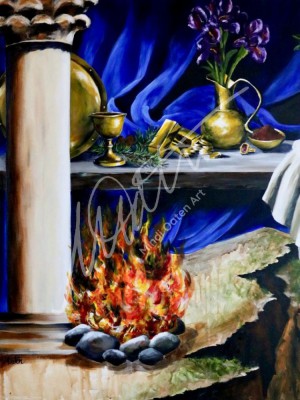
“Then Yahweh’s fire fell and consumed the burnt offering, the wood, the stones, and the dust, and it licked up the water that was in the trench. When all the people saw it, they fell facedown and said, ‘Yahweh, He is God! Yahweh, He is God!’”
After three years of hiding during a famine, the Lord sent Elijah to present himself to Ahab, saying God would finally send the rain. Before King Ahab and all the people of Israel, Elijah courageously prayed to the God of Abraham, Isaac, and Jacob to send rain so the people would know Yahweh was God. First the people prayed to Baal for it to rain, but Baal did not answer. The Lord, however, answered in a mighty way. Yahweh sent fire to fall and consume the burnt offering. When the people saw this, they exclaimed, “Yahweh, He is God! Yahweh, He is God!” And then, after Elijah bowed before the Lord on his knees, the Lord answered with a downpour of rain throughout the land! After three years, water returned, and the people witnessed a mighty act from Yahweh!
The Lord calls you to live courageously and boldly for Him. He desires for you to live with His power, not in your own strength, but instead fully relying on God. This begins with prayer. It begins with asking the Lord to show His power in your life. What are you praying boldly about today? You can ask God because you know God hears you. Be courageous and believe the Lord will answer your prayer. And when He answers your God-sized prayer, testify to others how great God is in your life! There is no other God like your God.
“Then Yahweh’s fire fell and consumed the burnt offering, the wood, the stones, and the dust, and it licked up the water that was in the trench. When all the people saw it, they fell facedown and said, ‘Yahweh, He is God! Yahweh, He is God!’”
—1 Kings 18:38–39
FURTHER SCRIPTURE
- Isaiah 45:5–6a — “I am Yahweh, and there is no other; there is no God but Me. I will strengthen you, though you do not know Me, so that all may know from the rising of the sun to its setting that there is no one but Me.”
- Micah 7:7 — “But I will look to the Lord; I will wait for the God of my salvation. My God will hear me.”
- 1 John 5:14–15 — “Now this is the confidence we have before Him: Whenever we ask anything according to His will, He hears us. And if we know that He hears whatever we ask, we know that we have what we have asked Him for.”
Lesson and Daily Word
Each day has two parts: the Lesson and the Daily Word. Use these buttons to go from one to the other.
Teaching Notes and Questions
Next to the video, these tabs show the Teaching Notes and the Questions. Your answer to a question saves when you leave the answer box.
The Bible passage
This link opens the passage on Bible Gateway, and that gives the passage its tick. If you read it in your own Bible, tick it by hand in Progress.
Your progress on this lesson
A part ticks itself when you play the video or audio to the end, read the notes or the Daily Word to the end, or answer every question. You can also tick a part by hand here.
Downloads
Here you can save the video, the audio and the lesson as PDF files. Downloads do not count toward your progress.
Need help?
Use this button to send us a question or tell us about a problem. You can also take this tour again from there.