
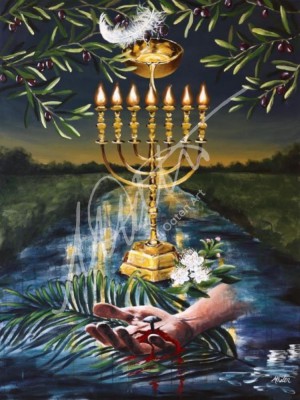
Zechariah's Vision
Discover Jesus as: Pierced One Zechariah 1-4 Read on Bible Gateway (HCSB)
Lesson
Audio Only
Teaching Notes
INTRO
Today we start our study in Zechariah. This is the fourth new book this week! Most scholars accept that the book is named after its author, the prophet Zechariah. The name Zechariah was used more than 29 times for people in the Old Testament, and it means “The Lord remembers.” MacArthur explains Zechariah “is second only to Isaiah in the breadth of the prophets’ writings about Messiah.”1 There is so much about the Messiah in Zechariah.
MacArthur points out that Zechariah was a priest just as Jeremiah and Ezekiel were: “According to tradition, he was a member of the Great Synagogue, a council of 120 originated by Nehemiah and presided over by Ezra. This council later developed into the ruling elders of the nation, called the Sanhedrin.”2 Zechariah was born in Babylon and returned to Jerusalem in the first group of exiles that included his grandfather. Some scholars suggest Zechariah’s father, Berechiah, died at a young age and never followed in his father’s place as a priest. The book of Zechariah is precisely dated in Zechariah 1:1 as 520 BC, the second year of Darius’s rule. Zechariah was a prophet during the same time as Haggai but was probably younger than Haggai (Zechariah 2:4). No information is known about how long Zechariah served as a prophet. His last prophecy that was dated (Zechariah 7:4) was given approximately two years later than his first. Therefore both of his prophecies were given at the same time as Haggai’s prophecies were given.
In 538 BC, under Cyrus the Persian’s reign, 50,000 captives were allowed to return to Israel from Babylon. Once there, the returned exiles began the work of rebuilding the temple in Jerusalem. The temple was completed in 516 BC. MacArthur explains, “Zechariah and Haggai were commissioned by the Lord to stir up the people to rebuild the temple.”3
MacArthur compared the two prophets:
“Haggai’s primary purpose was to rebuild the temple; his preaching has a tone of rebuke for the people’s indifference, sin, and lack of trust in God. He was used to start the revival, while Zechariah was used to keep them going strong with a more positive emphasis, calling the people to repentance and reassuring them regarding future blessings.”4
Zechariah is the most apocalyptic book in the Old Testament and had a message for the returning exiles as well as for the future.
TEACHING
Zechariah 1:1-6: The Lord came to the prophet Zechariah because He was extremely angry with Zechariah’s ancestors (vv. 1–2). God called for the people to return to Him so He could return to them (v. 3). God told the people not to be like their ancestors who did not heed the prophets’ warning to return to Him (v. 4). God asked where those ancestors were and where the prophets who had delivered the rejected messages were (v. 5). They had all died.
Zechariah 1:7–11: In verse 7, the language changes, and Zechariah began to describe eight visions he had in one night. Remember that visions happen while wide awake, while dreams happen while sleeping. Through visions, God showed Zechariah something that happened directly in front of him. These visions were supposed to bring comfort to the people. The first vision was of a man riding a red horse under the myrtle trees. Behind the man were red, sorrel, and white horses (vv. 7–8). MacArthur explains, “The colors may speak of the work of the riders: red speaking of bloodshed and judgment, white speaking of victory, and sorrel or a brownish color is possibly a combination of the others.”5 Zechariah asked about what he was seeing, and an angel said he would explain (v. 9). The man who had ridden the red horse said the horses had been sent by the Lord to patrol the earth (v. 10). MacArthur describes them as “a symbolic, military description of angelic movement patrolling and reconnoitering on a global scale. The purpose is to ascertain the state of the enemy and to respond to God’s will in engaging that enemy triumphantly.”6 They reported to the Angel of the Lord (probably the pre-incarnate Christ) that the whole earth was calm and quiet (v. 11). Through this vision, God promised prosperity for Israel.
Zechariah 1:12–17: The Angel of the Lord asked God how long He would continue to withhold His mercy from Judah (v. 12). God replied with words of comfort to the angel (v. 13). This is an interaction between Jesus, the pre-incarnate Christ, and God His Father (Romans 8:34; Hebrews 7:25). God explained He still loved Judah and Jerusalem and was extremely angry with the nations who went against them (vv. 14–15). Therefore God would bring prosperity back to Jerusalem and to His cities in Zion (vv. 16–17). Since myrtle trees were associated with the booths for the Festival of Booths, this vision pointed to God’s continued blessing and protection on His people. In Isaiah 41 and 55, myrtle trees were also connected to the Messianic blessing.7
Zechariah 1:18–20: The second vision was of four horns, which were “a symbol of power and pride.”8 Zechariah was told they were the horns that scattered all of Israel (vv. 18–19), probably referring to Babylon, Medo-Persia, Greece, and Rome. Then Zechariah was shown four craftsmen who had come to terrify the nations that had scattered Judah (vv. 20–21). In this, God promised to judge the nations who attacked Israel.
Zechariah 2: The third vision was of a man with a measuring line (vv. 1–3). This was to show God’s plan to rebuild and reestablish Jerusalem and God would dwell there again (vv. 10–16).
Zechariah 3: The fourth vision was of the high priest and a branch (vv. 1–7). This shows a cleansing that God would use with the high priest and the people of Israel as God rescued them (v. 8). McGee explains, “Neither Joshua nor Israel were contenders with Satan while clothed in their own righteousness. They must be clothed with the righteousness of Christ. Even a new patch on the old garment will not avail.”9 “My servant, the Branch” is another reference to Jesus (v. 8), and verse 10 points to the coming age.
Zechariah 4: The fifth vision was of the gold lampstand and two olive trees to show that God would rebuild the temple through Zerubbabel (vv. 1–7).
CLOSING
All of this will be reestablished in God’s plan. Zechariah 12:10 says: “Then I will pour out a spirit of grace and prayer on the house of David and the residents of Jerusalem, and they will look at Me whom they pierced.” We’ll unpack that as we move through the rest of the book of Zechariah.
John MacArthur, The MacArthur Bible Commentary (Nashville: Thomas Nelson Publishers, 2005), p. 1049.
MacArthur, p. 1049.
MacArthur, p. 1049-1050.
MacArthur, p. 1050.
MacArthur, p. 1053.
MacArthur, p. 1053.
MacArthur, p. 1052.
MacArthur, p. 1054.
J. Vernon McGee, “Outline of Nahum,” available at https://www.blueletterbible.org/Comm/mcgee_j_vernon/notes-outlines/nahum/nahum-outline.cfm.
Questions
-
What do you think the Lord means in Zechariah 2:5, “For I will be a wall of fire around Jerusalem, and I will be the glory in her midst”? (Revelation 21:23; 22:5)
-
Read Zechariah 2:8: “For he who touches you touches the apple of My eye.” Many people believe the church has replaced the Jews as God’s chosen people. Do you think what they believe is true?
-
In Zechariah 2:10–11, the Lord told His people He was coming and would dwell in their midst. Do you think this was a foretelling of the Messiah physically coming to His people? (Isaiah 7:14; 9:6; Matthew 1:23; John 1:1, 14)
-
As he was standing in front of an angel in Zechariah 3:3, Joshua, the high priest, was wearing filthy garments. Read Zechariah 3:4 and Isaiah 64:6. What do these filthy garments represent?
-
If Joshua, the high priest, and his friends were a symbol according to Zechariah 3:8, what were they a symbol of?
-
Who do you think the two anointed ones standing by the Lord in Zechariah 4:14 were? (Zechariah 4:2–3, 11–14; Revelation 11:1–4)
-
What did the Holy Spirit highlight to you in Zechariah 1—4 through the reading or the teaching?
Daily Word
Laura Martin Zechariah 3:5–7
“Then I said, ‘Let them put a clean turban on his head.’ So a clean turban was placed on his head, and they clothed him in garments while the Angel of the LORD was standing nearby. Then the Angel of the LORD charged Joshua: ‘This is what the LORD of Hosts says: If you walk in My ways and keep My instructions, you will both rule My house and take care of My courts; I will also grant you access among these who are standing here.’”
After Israel returned from exile, the word of the Lord came upon the prophet Zechariah through a series of dreams. He dreamt about Joshua, the high priest, standing before the people in filthy clothes, a symbol of Israel and their unclean sin. Then Joshua received clean clothes. Zechariah declared this symbol of hope and restoration for Israel if they walked in obedience to the Lord. He challenged the people to wholeheartedly seek the Lord as they rebuilt the Temple.
Jesus was pierced for your iniquities, and His grace washes away your filthy sin and guilt. Whoever believes in Jesus as Savior and humbly repents will be forgiven. Then the Lord will freely give you robes of righteousness. Therefore, confidently come before the Lord with a humble heart and receive His grace and mercy. The clean robe is not just put on over your old, dirty robe. Jesus completely removes the filthy robe of shame and guilt. You are a child of the King, a royal heir, and you have access to God the Father. He calls you worthy. He loves you. Picture a white robe neatly wrapped around you and receive His gift today.
“Then I said, ‘Let them put a clean turban on his head.’ So a clean turban was placed on his head, and they clothed him in garments while the Angel of the Lord was standing nearby. Then the Angel of the Lord charged Joshua: ‘This is what the Lord of Hosts says: If you walk in My ways and keep My instructions, you will both rule My house and take care of My courts; I will also grant you access among these who are standing here.’”
—Zechariah 3:5–7
FURTHER SCRIPTURE
- Zechariah 3:3–4 — “Now Joshua was dressed with filthy clothes as he stood before the Angel. So the Angel of the Lord spoke to those standing before Him, ‘Take off his filthy clothes!’ Then He said to him, ‘See, I have removed your guilt from you, and I will clothe you with splendid robes.’”
- Galatians 2:20 — “And I no longer live, but Christ lives in me. The life I now live in the body, I live by faith in the Son of God, who loved me and gave Himself for me.”
- Revelation 19:8 — “She was given fine linen to wear, bright and pure for the fine linen represents the righteous acts of the saints.”
Lesson and Daily Word
Each day has two parts: the Lesson and the Daily Word. Use these buttons to go from one to the other.
Teaching Notes and Questions
Next to the video, these tabs show the Teaching Notes and the Questions. Your answer to a question saves when you leave the answer box.
The Bible passage
This link opens the passage on Bible Gateway, and that gives the passage its tick. If you read it in your own Bible, tick it by hand in Progress.
Your progress on this lesson
A part ticks itself when you play the video or audio to the end, read the notes or the Daily Word to the end, or answer every question. You can also tick a part by hand here.
Downloads
Here you can save the video, the audio and the lesson as PDF files. Downloads do not count toward your progress.
Need help?
Use this button to send us a question or tell us about a problem. You can also take this tour again from there.