
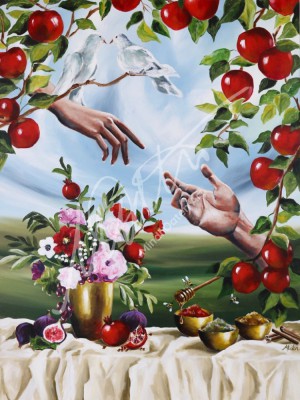
The Bridgegroom and the Bride
Discover Jesus as: Bridegroom Song of Songs 1-3 Read on Bible Gateway (HCSB)
Lesson
Audio Only
Teaching Notes
INTRO
This is the fifth and final book in the wisdom and poetry section of Scripture. This book is also known as Song of Solomon because Solomon wrote it. First Kings 4:32 says that, in addition to writing more than 3,000 proverbs, Solomon wrote 1,005 songs. David was a composer of songs, so it’s no wonder his son Solomon also wrote songs. With the title, “Song of Songs,” we can think of this song as the best of the best. Solomon wrote this as he ruled over a united kingdom for 40 years. The name “Solomon” appears at least seven times in the book, so there’s really no question that he was the author. The only question is when he wrote it. At the time it was written, it would have been viewed as one song, not a series of little love poems or songs.
There are two main characters in the song. One of them is Solomon. The other is the Shulammite woman. Who was she? First of all, she was from Shunem, a village located about three miles north of the Jezreel Valley. The Jezreel Valley will one day be the site of the battle of Armageddon. In this song, Solomon described his love for the Shulammite woman as well as the locations around where she lived. She could have been Pharaoh’s daughter (but there’s no evidence of this). Maybe she was Abishag, the Shunammite who cared for David in his final years. But most scholars say she was an unknown maiden from Shunem whose family lived in the area and was employed by Solomon. More than likely, she was the one of whom Solomon said, “Enjoy life with the wife you love all the days of your fleeting life” (Ecclesiastes 9:9). Most likely, she was his first wife, because Solomon married 699 other women (1 Kings 11:3). Although Solomon had seven hundred wives and three hundred concubines, there’s a really good chance this was his first love letter to his first wife.1
There are also a couple of minor players in the book. Some translations have the letters W or M before some of the verses. There are times when it’s very difficult to figure out who is talking in the Song. Sometimes it is Solomon or the Shulammite woman, but sometimes it is other minor characters. The daughters of Jerusalem, who might have been part of Solomon’s household staff, speak out. There’s also a small section that may contain God’s blessing on the couple. Then there were the Shulammite’s brothers. Before you start reading the Song, take time to distinguish (with lines or highlights) who is speaking in the different segments of the Song.2
- The courtship takes place in Song of Songs 1:2–3:5. Courtship involves an element of anticipation. What will it be like? How will it unfold?
- The wedding is described in Song of Songs 3:6–5:1. This includes the wedding and the consummation of the marriage.
- The marriage and celebration are described in Song of Songs 5:2–8:14. The song talks about the tough times the couple faced in their marriage. It’s important to remember that sex and marital relations were designed by God. But the enemy Satan has grabbed ahold of sex and used it for his purposes. From this song, we can see what it means to have a healthy sexual relationship with the person you’re married to.3
So how does the relationship between a man and a woman point to the Messiah? We will begin to see how the bridegroom and the bride interact. God’s plan of marriage includes sexual intimacy between two people, which is ultimately a picture of Christ and the church. Solomon is a type of bridegroom who points to the ultimate Bridegroom, Jesus Christ. In 2 Corinthians 11:2, Paul said the Church, the body of Christ, was promised to one Husband, Christ. Revelation 19:7 describes the marriage of the Lamb (Christ) to His wife, who has prepared herself in fine linen—the righteous acts of the saints. On the eighth day of Passover, the Jews read Song of Songs to remind themselves of God’s love for them and their love for Him. Song of Songs is about an actual relationship between Solomon and the Shulammite woman. It’s a picture of the Israelites and their relationship with the Lord. It’s also the ultimate picture of the Bridegroom and the bride, who needs to get ready because the Bridegroom is coming. The Bridegroom is Jesus.
TEACHING
Song of Songs 1:2-4: The Shulammite woman spoke. She longed for Solomon to kiss her. This is the anticipation of dating. She was attracted to his lips, love, lotion, and lifestyle.4 The daughters of Jerusalem appeared to be singing in the background: “We will rejoice and be glad for you” (v. 4b).
Song of Songs 1:5-7: The Shulammite woman kept talking. She was truly concerned about how weathered she looked because she had been working in the sun. Nelson’s Commentary explained the woman compared herself to the city maidens, and she was not sure if she was what Solomon wanted. 5 Just like in any dating relationship, the Shulammite woman was worried about whether she was good enough.
Song of Songs 1:8–11: When Solomon spoke, he assured her she was absolutely stunning. The comparison to one of Pharaoh’s chariot horses was a compliment. First Kings 10:26–29 revealed Solomon owned lots of horses. Surely as he interacted with his horses, he was trying to create a picture of her beauty. He also promised her gifts of gold and silver jewelry to highlight her beauty.
Song of Songs 1:12–14: The Shulammite woman responded with anticipation of the courtship. Scripture talks about different types of love, and verse 13 is talking about sexual love. The Shulammite intended to wear a fragrance that would truly draw Solomon to her. She refers to her love as “a cluster of henna blossoms. . . in the vineyards of En-gedi” (v. 14). En-gedi was a place where David found protection from Saul as well as refreshment and renewal. So there was something really refreshing about their time together.
Song of Songs 1:15: Solomon responded by calling her beautiful. The eyes of the dove pointed to her purity, innocence, and beauty.6 John MacArthur said these were the deep smoky grey eyes of the dove.7
Song of Songs 1:16–17: The Shulammite woman responded about how handsome Solomon was. At this point, they were still dating, so this is in the mindset of thinking about what their relationship would one day be like. God has provided everything they needed, and they wanted to be with one another.
CLOSING
Just to be clear, nothing has happened between Solomon and the Shulammite at this point. This is the period of their courtship. As we continue this study, we’ll tie together several more elements in these verses. It’s important to remember that the bridegroom and the bride in this song are a picture of the Bridegroom and the bride—Christ and the Church.
John MacArthur, The John MacArthur Bible Commentary (Nashville: Thomas Nelson Publishers, 2005), p. 743.
MacArthur, p. 743.
MacArthur, p. 744.
MacArthur, p. 745.
Earl Radmacher, Ronald B. Allen, and H. Wayne House, eds., Nelson’s New Illustrated Bible Commentary (Nashville: Thomas Nelson Publishers, 1999), p. 795.
Nelson’s Commentary, p. 797.
Nelson’s Commentary, p. 797.
Questions
-
Song of Songs 1:3 refers to ointment. Ointment has healing properties. Could this verse be referring to Christ? Why or why not?
-
In Revelation 19:9, an angel spoke of the marriage supper of the Lamb. How, if at all, does this relate to Song of Songs 2:4? What does “his banner over me was love” mean to you?
-
Could Song of Songs 3:1–4 be pointing to the church and/or Israel? In the days of the Great Tribulation, they will search for Jesus and not find Him? When Israel “accepts” Christ, then He will be “found” by them? Is there another way to look at this verse? If so, how?
-
What did the Holy Spirit highlight to you in Song of Songs 1—3 through the reading or the teaching?

Daily Word
Laura Martin Song of Songs 1:15–16
“How beautiful you are, my darling. How very beautiful! Your eyes are doves. How handsome you are, my love. How delightful! Our bed is lush with foliage.”
Song of Songs portrays the love between the church and the bride- groom, Jesus Christ, as Solomon communicated and demonstrated his love for his first wife, beginning with attraction to one another and courtship. In a similar way, the Lord sees you. He sees you as beautiful. He sees you as precious in His sight. He understands you. He knows your strengths and your weaknesses. He sought you out and pursued you. He longs to draw you into His great love. He desires for you to come to Him and be His belove.
Look at the Lord. Open your eyes to His great love for you. Allow His love to draw you in. He says He will hide you under the shadow of His wings. He will cover you with His protective feathers. He is your peace, your life, your helper. Today, may you be drawn into the intimate presence and love of Jesus. Believe you are desired and wanted. Believe you are loved with an everlasting love. Believe you are God’s beloved. You belong to Him.
“How beautiful you are, my darling. How very beautiful! Your eyes are doves. How handsome you are, my love. How delightful! Our bed is lush with foliage.”
— Song of Songs 1:15–16
FURTHER SCRIPTURE
- Song of Songs 2:4— “He brought me to the banquet hall, and he looked on me with love.”
- Jeremiah 31:3— “The Lord appeared to him from far away. I have loved you with an everlasting love; therefore, I have continued to extend faithful love to you.”
- Ephesians 5:25— “Husbands, love your wives, just as Christ loved the church and gave Himself for her.”
Lesson and Daily Word
Each day has two parts: the Lesson and the Daily Word. Use these buttons to go from one to the other.
Teaching Notes and Questions
Next to the video, these tabs show the Teaching Notes and the Questions. Your answer to a question saves when you leave the answer box.
The Bible passage
This link opens the passage on Bible Gateway, and that gives the passage its tick. If you read it in your own Bible, tick it by hand in Progress.
Your progress on this lesson
A part ticks itself when you play the video or audio to the end, read the notes or the Daily Word to the end, or answer every question. You can also tick a part by hand here.
Downloads
Here you can save the video, the audio and the lesson as PDF files. Downloads do not count toward your progress.
Need help?
Use this button to send us a question or tell us about a problem. You can also take this tour again from there.