
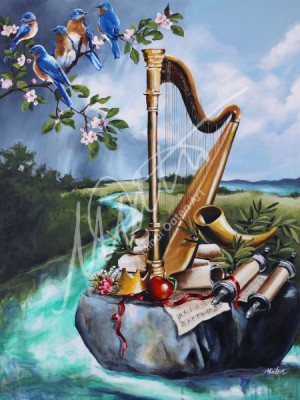
Revival With the God of Israel
Discover Jesus as: King of Glory Psalms 79-80 Read on Bible Gateway (HCSB)
Lesson
Audio Only
Teaching Notes
INTRO
Psalm 80 is another lament psalm. The people had been removed because of apostasy—they turned away from God and looked to false idols. Therefore, this psalm is a prayer request for restoration to God. MacArthur explains, “This psalm was probably written from Jerusalem in astonishment at the captivity of the ten northern tribes in 722 B.C.”1 This is another psalm by Asaph and was meant to be sung.
TEACHING
Psalm 80:1-3: Wiersbe outlines these verses as, “Save Your Flock.”2 Asaph called for God, the Shepherd of Israel, to rise up to save His flock (v. 1). Asaph described God as sitting on a cherub in the Holy of Holies. This is a psalm of revival. God’s presence was there, and Asaph wanted Him to make His presence known before the tribes of Ephraim, Benjamin, and Manasseh (v. 2). Asaph repeated his request that God save them by looking on them with favor (v. 3). “Look on them with favor” can also be translated as “face to shine” and referred to a king smiling on one who came before him with a request, showing the petitioner his request would be well received.”3 God is the Shepherd, He will take care of us and lack nothing (Psalm 23) and as God gathers His sheep, calling them forth, they will respond (John 10).
Psalm 80:4–7: Wiersbe outlines these verses as, “Pity Your People.”4 In verse 4, Asaph questioned how long God would remain angry because their prayers seem unanswered. Instead, they had received only manna of tears to eat and water of tears to drink (v. 5). They were quarreling with their neighbors and being mocked by their enemies (v. 6). Asaph asked again for God to save them (v. 7). The repetition of asking God to save is important to notice (Numbers 6:24).
Psalm 80:8–19: Wiersbe outlines these verses as, “Revive Your Vine.”5 Asaph moved from the image of a shepherd to a vine dresser. MacArthur explains, “The vine is a metaphor for Israel whom God delivered out of Egypt and nurtured into a powerful nation”6 (Isaiah 5:1–7). The boundaries of Israel had been “the hill country in the south to the mighty cedars of Lebanon in the north, from the Mediterranean Sea on the west to the Euphrates on the east—and beyond.”7 These boundaries are outlined in verses 10–11. However, the walls of Israel had been broken down (v. 12). They were being taken over by the beasts and the creatures of the field (their enemies) (v. 13). Asaph asked God again to take care of the vine God had planted (vv. 14–15). Asaph cried out in desperation because of the destruction that had taken place (v. 16). Psalm 80 is a last-ditch effort of seeking God’s help. MacArthur explains the phrase, “with the man at Your right hand,” as “a reference to Israel. In a secondary sense, the ‘son of man’ may allude to the Davidic dynasty and even extend to the Messiah, since He is so frequently called by that title in the New Testament”8 (Matthew 2:15). Asaph stated they would not turn away from God again and asked God again to revive them (v. 18). For a third time, Asaph asked that God would save them (v. 19). Nelson’s Commentary explains, “In response to God’s work of deliverance, the poet promises renewed praise centered on the name of God.”9 Verse 18 is based on verse 17. When that happens, revival takes place.
CLOSING
Revival can take place when we look to Him as the God of Israel who brought forth revival. If we don’t see God as the God of Israel, I question whether true revival can take place because there’s a lack of a complete picture of who God is.
9Earl Radmacher, Ronald B. Allen, and H. Wayne House, eds., Nelson’s New Illustrated Bible Commentary (Nashville: Thomas Nelson Publishers, 1999), p. 702.
John MacArthur, John MacArthur Bible Commentary (Nashville: Thomas Nelson Publishers, 2005), p. 649.
Warren W. Wiersbe, The Bible Exposition Commentary: Old Testament (Colorado Springs: David C. Cook, 2004), p. 236.
MacArthur, p. 642.
Wiersbe, p. 236.
Wiersbe, p. 237.
MacArthur, p. 650.
Wiersbe, p. 237.
MacArthur, p. 650.
Questions
-
When you read Psalm 79:5–6, do you think this could be a current cry from Israel today? Why?
-
In Psalm 80, the phrase, “Turn us again, O God, and cause Your face to shine, and we shall be saved,” is repeated three times. Why do you think the psalmist did this? Should this be a cry for today? Why or why not?
-
Meditate on Psalm 80:17. Was this speaking of Jesus the Messiah? Why or why not?
-
What did the Holy Spirit highlight to you in Psalms 79—80 through the reading or the teaching?
Daily Word
Laura Martin Psalm 80:2b–3
“Rally your power and come to save us. Restore us, God; look on us with favor, and we will be saved.”
Have you chosen to turn away from the Lord? Have you given in to temptation? Do you try and live life in your flesh by your own strength? Do you believe in God but don’t really include Him in your everyday life? Have you slipped further and further away from God? Do you realize you are in desperate need for the Lord to save you and restore you?
You are never too far gone. God is able to restore. He is able to save. God is all-powerful and loves you unconditionally. However, you must be willing to repent and turn back to Him. You are the only one who can make this decision. If you are ready, say, “Yes, Lord, I’m willing to turn to You.” Then, in faith, turn away from your sin and turn toward God. Receive His grace and mercy. Find refreshment and revival for your soul in His presence. Take steps by faith and believe He will bring you restoration and strength. Make that choice today as you trust God’s great love.
“Rally your power and come to save us. Restore us, God; look on us with favor, and we will be saved.”
— Psalm 80:2b–3
FURTHER SCRIPTURE
- Numbers 6:24–26 — “May Yahweh bless you and protect you; may Yahweh make His face shine on you and be gracious to you; may Yahweh look with favor on you and give you peace.”
- Amos 9:14 — “I will restore the fortunes of My people Israel. They will rebuild and occupy ruined cities, plant vineyards and drink their wine, make gardens and eat their produce.”
Lesson and Daily Word
Each day has two parts: the Lesson and the Daily Word. Use these buttons to go from one to the other.
Teaching Notes and Questions
Next to the video, these tabs show the Teaching Notes and the Questions. Your answer to a question saves when you leave the answer box.
The Bible passage
This link opens the passage on Bible Gateway, and that gives the passage its tick. If you read it in your own Bible, tick it by hand in Progress.
Your progress on this lesson
A part ticks itself when you play the video or audio to the end, read the notes or the Daily Word to the end, or answer every question. You can also tick a part by hand here.
Downloads
Here you can save the video, the audio and the lesson as PDF files. Downloads do not count toward your progress.
Need help?
Use this button to send us a question or tell us about a problem. You can also take this tour again from there.