
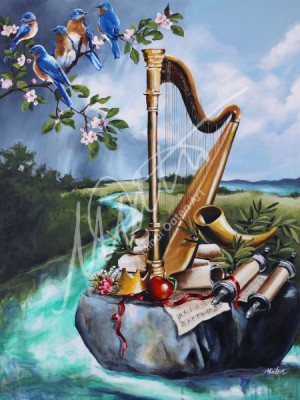
Remembering The Past, Present, And Future
Discover Jesus as: King of Glory Psalms 77-78 Read on Bible Gateway (HCSB)
Lesson
Audio Only
Teaching Notes
INTRO
Psalm 78 is long—72 verses long. It’s a challenge to cover that much material in 30 minutes, but this is the psalm God told me to teach. And, we have to get to the end of this psalm today! The text walks through the history of Israel—a historical psalm “written to teach the children how gracious God had been in the past in spite of their ancestors’ rebellion and ingratitude.”1 The point was to teach the children their past so they would not repeat the same mistakes (v. 8). However, as German philosopher Georg Hegel wrote that the one thing we learned from history is that we don’t learn from history.2 Wiersbe shares that when the writer Asaph reviewed Israel’s history, he “saw a sad record of forgetfulness, faithlessness, foolishness, and failure, and he sought to understand what it all meant.”3
TEACHING
Psalm 78:1-8: Wiersbe describes these verses as, “Protecting the Future.”4 Asaph told his readers to listen to these lessons (vv. 1–8). Making sure the children understood what had happened in the past was vital, so the history of their people could be passed down through the generations. We protect the future by knowing and understanding the past.
Psalm 78:9–64: Wiersbe describes these verses as, “Understanding the Past.”5 Verses 9–11 cover Ephraim’s apostasy when they turned away from battle and did not keep God’s covenant. Verses 12–39 recount Israel’s sins while they were in the wilderness. For example, the people were ungrateful for God’s provision of manna in the wilderness—they wanted more from God than just manna. This pattern was reflected throughout the entire psalm. God gave the people what they needed and deserved, but they were not satisfied by His provision.
Verses 40–53 recount what happened while the Hebrews were in Egypt and the lessons they were taught there. Asaph listed the plagues God called down on Egypt so His people could be freed. Verses 54–64 recount the more recent sins of the people while they were in the Promised Land. Throughout the psalm, God’s punishment was recorded against His people who kept turning away from Him in disobedience. Wiersbe points out that “sometimes God’s greatest judgment is to give us what we want (vv. 21, 31, 49–50, 58–59, 62).”6
Psalm 78:65–72: Wiersbe describes these verses as, “Appreciating the Present.”7 Asaph recounted how God had shown up for Israel—He had beaten back their enemies in shame, He chose the tribe of Judah to be the lineage for the Messiah, He chose David as king (1 Samuel 17:34), and He established His sanctuary forever in Jerusalem. King David shepherded God's chosen people, Israel, with a pure heart and guided them with skillful hands (v. 72).
CLOSING
There are two really unique things found in David. His loyalty, and pure heart to serve the Lord is one and found in 1 Samuel 13:14, "…The Lord has found a man [David] loyal to Him, and the Lord has appointed him as ruler over His people, because you [Saul] have not done what the Lord commanded." The second is when David went to fight Goliath, he put on man's idea of equipping to fight (uniform of Saul), but then David realized God gave him the skill to be who he is as he functions with a pure heart, guess what? The 'Goliaths' are going to die. God will give us the skillful hands and a pure heart if we keep our eyes on Him and remember what God has did in the past in order to protect the future.
John MacArthur, John MacArthur Bible Commentary (Nashville: Thomas Nelson Publishers, 2005), p. 648.
Warren W. Wiersbe, The Bible Exposition Commentary: Old Testament (Colorado Springs: David C. Cook, 2004), p. 231.
Wiersbe, p. 231.
Wiersbe, p. 231.
Wiersbe, p. 231.
Wiersbe, p. 232.
Wiersbe, p. 233.
Questions
-
In Psalm 77:9 Asaph questioned whether God had forgotten to be gracious or had withdrawn His compassion in anger. Would that be consistent with His character? When has the enemy caused you to question the character or actions of God due to fear or other lies?
-
Psalm 77 is about remembering the deeds of the Lord. Why would it be important to remember what He has done in our past?
-
What happened when the sons of Ephraim forgot God’s deeds and the miracles that He showed them? (Psalm 78:9b–10)
-
Psalm 78 recounts many of God’s mighty deeds and wondrous works. What did Asaph recount about the Israelites? Where can you see the principle in 2 Timothy 2:13 throughout this chapter? How about in your own life? When have you been faithless and yet seen the faithfulness of God?
-
What did the Holy Spirit highlight to you in Psalms 77—78 through the reading or the teaching?

Daily Word
Laura Martin Psalm 78:2–4
“I will declare wise sayings; I will speak mysteries from the past—things we have heard and known and that our fathers have passed down to us. We must not hide them from their children, but must tell a future generation the praises of the LORD, His might, and the wonderful works He has performed.”
FURTHER SCRIPTURE
- Deuteronomy 6:5–7 — “Love the Lord your God with all your heart, with all your soul, and with all your strength. These words that I am giving you today are to be in your heart. Repeat them to your children. Talk about them when you sit in your house and when you walk along the road, when you lie down and when you get up.”
- Psalm 78:6–7 — “So that a future generation—children yet to be born—might know. They were to rise and tell their children so that they might put their confidence in God and not forget God’s works, but keep His commands.”
- 1 Corinthians 10:11-12 — “Now these things happened to them as examples, and they were written as a warning to us, on whom the ends of the ages have come. So, whoever thinks he stands must be careful not to fall.”
Lesson and Daily Word
Each day has two parts: the Lesson and the Daily Word. Use these buttons to go from one to the other.
Teaching Notes and Questions
Next to the video, these tabs show the Teaching Notes and the Questions. Your answer to a question saves when you leave the answer box.
The Bible passage
This link opens the passage on Bible Gateway, and that gives the passage its tick. If you read it in your own Bible, tick it by hand in Progress.
Your progress on this lesson
A part ticks itself when you play the video or audio to the end, read the notes or the Daily Word to the end, or answer every question. You can also tick a part by hand here.
Downloads
Here you can save the video, the audio and the lesson as PDF files. Downloads do not count toward your progress.
Need help?
Use this button to send us a question or tell us about a problem. You can also take this tour again from there.