
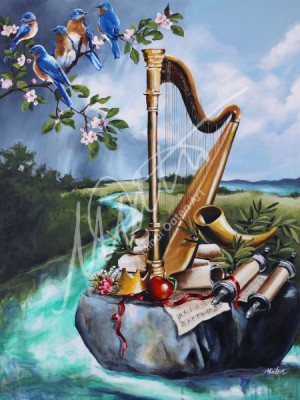
David's Request To Be Saved
Discover Jesus as: King of Glory Psalms 69 Read on Bible Gateway (HCSB)
Lesson
Audio Only
Teaching Notes
INTRO
After Psalms 22 and 110, Psalm 69 is the third most-recited psalm in the Bible. That doesn’t mean Psalm 69 is more important than other psalms, but it does mean it speaks strongly to what we feel and face. Psalm 69 is a prayer of desperation and is a Messianic psalm. Nelson’s Commentary explains that both Psalms 22 and 69 “begin with the sufferings of David but have their full meaning in the sufferings of Jesus.”1 Both psalms were written 1,000 years before Christ’s birth, death, and resurrection. However, while Psalm 22 focuses on Jesus’ physical sufferings, Psalm 69 “focuses more on His emotional and spiritual suffering.”2
At the end of this lesson, we’ll look at all of the Messianic psalms throughout the book of Psalms. In a Messianic psalm, David would describe his own experiences and sufferings, but these would also foretell of what Jesus the Messiah would experience. In Acts 2:30–31 is a description of how David did this: “Since [David] was a prophet, he knew that God had sworn an oath to him to seat one of his descendants on his throne. Seeing this in advance, he spoke concerning the resurrection of the Messiah.” David understood he would speak prophetically (2 Samuel 7:12–16), and that the Messiah would come through his own house.
The subtitle states the psalm was to be sung to the tune of “The Lilies.” Four times, David asked to be saved, beginning in verse 1 as well as in verses 14, 16–17, and 18. MacArthur divides the psalm into two sections: “(1) The Prayer of Desperation (vv. 1–28), and (2) The Promise of Salvation (vv. 29–36).”3
TEACHING
Psalm 69;1-3: MacArthur describes verses 1–3 as “the description of [David’s] situation.”4 David asked God to save him because he felt like he was drowning (v. 1). He felt mired in deep mud and stranded in flood waters (v. 2). David was physically exhausted from crying and looking for God (v. 3).
Psalm 69:4–12: MacArthur describes verses 4–12 as “the reason for [David’s] situation.”5 David stated the people who hated him without cause numbered more than the hairs on his head (v. 4). Jesus quoted David in John 15:25 as the fulfillment of what David said would take place (Matthew 5:17). David knew God understood he was not guilty in this case (v. 5). MacArthur points out David “fears that his dismal situation may be a stumbling block to other believers,” and that David worried they could become ashamed of what he was going through (v. 6).6 David had already been shamed by the reproach or insults of others to the point he was a stranger to his brothers (vv. 7–8). This is another Messianic reference. Jesus experienced that as well (Matthew 12:46–50; John 7:3–5). For verse 9, Constable explains, “It was David’s preoccupation with building the temple that had turned popular opinion against him.”7 Jesus had the same mentality with God’s house when He cleansed the temple of the money changers (Matthew 21:12–13; Mark 11:15–18). Both John 2:17 and Romans 15:3 speak to the truth in Psalm 69 that foretold what Christ would experience. Paul reminded believers that the insults fell on the Lord, not on us. No matter what David did in his worship, people mocked him (vv. 10–12).
Psalm 69:13–18: MacArthur describes verses 13–18 as “the hope for [David’s] situation.”8 David asked God for His favor, His salvation, and His abundant and faithful love (v. 13). He asked for rescue from the mud, the deep waters that could sweep him away, and from those who hated him (v. 14). He begged God not to let the Pit (death) close over him (v. 15). David asked God to answer him because he was in great distress and needed to be ransomed from his enemies (vv. 16–18).
Psalm 69:19–21: MacArthur describes verses 19–21 as “the reproach of [David’s] situation.”9 David knew God was already aware of all he was facing (vv. 19–20). In Matthew 26:37, Jesus experienced the loneliness and sorrow in the garden of Gethsemane that was like what David described in these verses. In verse 21, David was given gall to eat and vinegar to drink—a strong Messianic reference, just as Jesus was given on the cross (Matthew 27:34).
Psalm 69:22–28: MacArthur describes verses 22–28 as “the revenge for [David’s] situation.”10 David asked that his enemies be trapped, and God’s rage poured out on them (vv. 22–24). David asked that their fortification be made desolate and no one be allowed to live in their tents (v. 25). Verse 25 is quoted in Acts 1:20 referring to Judas, showing another Messianic reference.11 The suffering of the Messiah was clearly a part of God’s plan (Isaiah 53:10). David asked God to cut the lives short of those who had attacked him (vv. 26–28).
Psalm 69:29–36: Wiersbe suggests, “David’s original psalm ended at verse 29 and the Holy Spirit directed the prophet Jeremiah to add verses 30–36 after the fall of Judah and Jerusalem to the Babylonians.”12 The question about these verses is how did David know what was happening in those verses? Verses 30–36 speak to praising God with thanksgiving because the Lord heard them and did not despise them when they were captives. Wiersbe states David “saw a day coming when the land would be united and healed and the cities populated again.”13
CLOSING
MacArthur provides an outline of Messianic psalms and their fulfillment. His outline includes 20 psalms. Psalm 69:8 states David became a stranger to his own family because of his passion for building the temple for the Lord (v. 9). The more we become consumed with passion to be in the presence of the Lord, more people will question what you’re doing, throw insults at you, and even disown you. When that happens, you’ll be in good company! You’ll be looking more like David and a whole lot more like Christ.
Earl Radmacher, Ronald B. Allen, and H. Wayne House, eds., Nelson’s New Illustrated Bible Commentary (Nashville: Thomas Nelson Publishers, 1999), p. 693.
Nelson’s Commentary, p. 693.
John MacArthur, John MacArthur Bible Commentary (Nashville: Thomas Nelson Publishers, 2005), p. 643.
MacArthur, p. 643.
MacArthur, p. 643.
MacArthur, p. 643.
Thomas Constable, Dr. Constable’s Expository Bible Study Notes: Psalms, p. 269; available at https://planobiblechapel.org/tcon/notes/pdf/psalms.pdf.
MacArthur, p. 643.
MacArthur, p. 643.
MacArthur, p. 643.
MacArthur, p. 643.
Warren W. Wiersbe, The Bible Exposition Commentary: Old Testament (Colorado Springs: David C. Cook, 2004), p. 215
Wiersbe, p. 217
Questions
-
Psalm 69:3 talks about how weary the psalmist was, how parched his throat was, and how blurry his eyes were from crying out to God. Was there ever a time in your life when you cried out to God so desperately as David did here? If so, what was the outcome? Did it take away the situation? Was it easier to get through because of your cries?
-
What do you think David was referring to when he said in Psalm 69:21, “And for my thirst they gave me vinegar to drink”? Do you believe he was, at some time, given vinegar to drink? Where else in Scripture is vinegar mentioned (Ruth 2:14; Matthew 27:34), and who drank it?
-
Where else is the book of life (v. 28) mentioned in Scripture (Philippians 4:3; Revelation 3:5; 13:8; 20:15; 21:27)? What is “the book of life”? How can you be sure your name is in it?
-
According to Psalm 69:30–31, what does the Lord desire from you more than sacrifices?
-
What did the Holy Spirit highlight to you in Psalm 69 through the reading or the teaching?

Daily Word
Laura Martin Psalm 69:19–21
“You know the insults I endure—my shame and disgrace. You are aware of all my adversaries. Insults have broken my heart, and I am in despair. I waited for sympathy, but there was none; for comforters, but found no one. Instead, they gave me gall for my food, and for my thirst they gave me vinegar to drink.”
David endured persecution. Christ endured persecution. They both endured lies, insults, and even felt like strangers around their brothers and sisters—all because of their zeal and devotion to God Almighty. As you follow Christ, He promises that you, too, will endure hardship and persecution. When you cry out for help, you may receive silence in return. When you cry out for help, you may receive sour-tasting advice that doesn’t satisfy, just as Christ received vinegar and gall. Even so, endurance will come as you find hope in Christ and through His Scriptures. He gives power and strength to His people.
If you are enduring hardship or persecution today, remember you are not alone. The world, your enemies, and the devil do not like the sovereign, mighty, majestic God of your salvation. However, when you draw near to the Lord, He will redeem your life. He will rescue you. Do not fear. The Lord is near to those who love His name. Allow praise and worship to rise up within you and praise His name—Yahweh, Elohim, Adonai, Lord God, God of our Salvation. Praise His holy name!
“You know the insults I endure—my shame and disgrace. You are aware of all my adversaries. Insults have broken my heart, and I am in despair. I waited for sympathy, but there was none; for comforters, but found no one. Instead, they gave me gall for my food, and for my thirst they gave me vinegar to drink.”
— Psalm 69:19–21
FURTHER SCRIPTURE
- Psalm 69:9 – “Because zeal for Your house has consumed me, and the insults of those who insult You have fallen on me.”
- Matthew 27:33–34 — “When they came to a place called Golgotha (which means Skull Place), they gave Him wine mixed with gall to drink. But when He tasted it, He would not drink it.”
- Romans 15:3–4 — “For even the Messiah did not please Himself. On the contrary, as it is written, ‘The insults of those who insult You have fallen on Me.’ For whatever was written in the past was written for our instruction, so that we may have hope through endurance and through the encouragement from the Scriptures.”
Lesson and Daily Word
Each day has two parts: the Lesson and the Daily Word. Use these buttons to go from one to the other.
Teaching Notes and Questions
Next to the video, these tabs show the Teaching Notes and the Questions. Your answer to a question saves when you leave the answer box.
The Bible passage
This link opens the passage on Bible Gateway, and that gives the passage its tick. If you read it in your own Bible, tick it by hand in Progress.
Your progress on this lesson
A part ticks itself when you play the video or audio to the end, read the notes or the Daily Word to the end, or answer every question. You can also tick a part by hand here.
Downloads
Here you can save the video, the audio and the lesson as PDF files. Downloads do not count toward your progress.
Need help?
Use this button to send us a question or tell us about a problem. You can also take this tour again from there.