
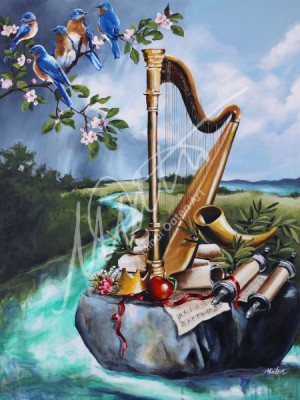
God's Majestic Power
Discover Jesus as: King of Glory Psalms 68 Read on Bible Gateway (HCSB)
Lesson
Audio Only
Teaching Notes
INTRO
Psalm 68 is a Messianic psalm of “prayer, praise, thanksgiving, historical reminder, and imprecation,”1 and it points to the King of Glory. This psalm is one of David’s and was written for the choir director, to be sung. This psalm was probably written out of David’s excitement about the restoration of the ark to Jerusalem.2
TEACHING
Psalm 68:1-6: Wiersbe outlines this psalm and writes that verses 1–6 show “our God is coming to us.”3 In verse 1, God’s power causes His enemies to scatter and flee (Numbers 10:33–35). The coming presence of the Lord referred to the ark. God’s enemies will disappear before God (v. 2) while the righteous rejoice before the Lord (v. 3). God’s people would sing praises to Him, exalting His name and remembering who He is and who is important to Him: the fatherless, the widows, the deserted, and the prisoners (vv. 4–6). God is in the business of setting people free and watching over them. Constable describes how God is presented as “a majestic warrior riding His chariot through the desert wilderness.”4
This psalm uses a variety of names and descriptors for God:
- Verse 1: “Yahweh” can be translated as “The Lord” (Exodus 3:15).
- Verse 1: “God” can be translated as “Elohim.”
- Verse 11: “Adonai” is translated as “The Lord.”
- Verse 14: God is the “Almighty.”
- Verse 18: Refers to the “Lord God.”
- Verse 20: Describes God as the “God of Salvation.”
- Verse 24: Describes God as the “King.
Psalm 68:7–18: Wiersbe writes that verses 7–18 show “our God is marching before us.”5 David referred back to the exodus when God led the Israelites through the desert (v. 7). They were given abundant rain, and even manna, in God’s blessing (vv. 8–9). God has taken us all through the deserts in our lives. He has gone before us and provided us with sustenance (Judges 5:4–5)! God provided for their needs (v. 10). Verses 11–12 refers back to the exodus, women singing praises about the promises of God (Exodus 15:20–21; 1 Samuel 18:6). Verse 13 refers to sitting in the presence of God.
In verse 14, Zalmon means Black Mountain and, while it could have been “a figurative description of God’s blessings, David may have been referring to Abimelech’s victory on Mount Zalmon near Shechem (Judges 9:48).”6 In verses 15-16, David wrote that even the towering mountain of Bashan was jealous of where God chose to dwell (Jeremiah 22:20–21). David described God as being surrounded by thousands of chariots (v. 17). God ascended the heights, taking captives, so the Lord God could live in Jerusalem (v. 18). This is the Messianic reference in this psalm. Jesus ascended the heights in His resurrection/ascension and provided freedom to the captives. Paul quoted this as God gave gifts to people, rather than received gifts from people (Ephesians 4:8).
Psalms 68:19–35: Wiersbe writes that verses 9–35 show that “our God is dwelling with us.”7 David praised God for daily bearing his burdens and being his salvation (vv. 19–20). Through His power, God crushed His enemies (v. 21). In verses 22-23, MacArthur states, “Whether the enemy tries to escape by land (Bashan) or by sea, God will bring them back to be destroyed by His people (Amos 9:2–4).”8 God’s presence was known in the sanctuary, and singers led His procession while musicians followed (vv. 24–26). The tribes listed in verse 27 all reference the Christ. God will receive universal tributes from all nations (vv. 28–29). When the King of Glory returns, everyone will recognize who He is. Verses 29–35 provide another clear Messianic prophecy!
CLOSING
David paints an incredible picture of how God moved in the past, how He is moving now, and how He is going to move; He is coming for us and marching before us and dwelling with us. Wiersbe concludes his commentary on Psalm 68 with “our God receives universal tribute.”9 May we continue to focus on the King of Glory!
John MacArthur, John MacArthur Bible Commentary (Nashville: Thomas Nelson Publishers, 2005), p. 642.
MacArthur, p. 643.
Warren W. Wiersbe, The Bible Exposition Commentary: Old Testament (Colorado Springs: David C. Cook, 2004), p. 213.
Thomas Constable, Dr. Constable’s Expository Bible Study Notes: Psalms, p. 262; available at https://planobiblechapel.org/tcon/notes/pdf/psalms.pdf.
Wiersbe, p. 214.
Constable, p. 263.
Wiersbe, p. 214.
MacArthur, p. 643.
Wiersbe, p. 214.
Questions
-
What time in the Bible does Psalm 68:7 refer to (Exodus 13:21–22; 14:19; Nehemiah 9:19)? How do we know today that God is with us?
-
In Psalm 68:13, David referred to the wings of a dove. Where are some of the other places in Scripture that doves are mentioned, and what do they represent? (Genesis 8:9–12; 15:9; Leviticus 5:7; Mark 1:10; John 1:32)
-
The mountains of Bashan are mentioned in Psalm 68:15. What are these mountains known for, and why do you suppose David referred to them as God’s abode or dwelling place? (Numbers 21:33–35; Joshua 21:27; Ezekiel 27:6; 39:18)
-
Psalm 68:29 says, “Because of Your temple at Jerusalem, kings will bring presents to You.” Is it possible this verse may be a foreshadowing of Jesus’ birth? (Matthew 2:11)
-
What did the Holy Spirit highlight to you in Psalm 68 through the reading or the teaching?

Daily Word
Laura Martin Psalm 68:1
“God arises. His enemies scatter, and those who hate Him flee from His presence.”
FURTHER SCRIPTURE
- Numbers 10:35 — “Whenever the ark set out, Moses would say: ‘Arise, Lord! Let Your enemies be scattered, and those who hate You flee from Your presence.’”
- Matthew 28:20 — “Teaching them to observe everything I have commanded you. And remember, I am with you always, to the end of the age.”
- James 4:7 — “Therefore, submit to God. But resist the Devil, and he will flee from you.”
Lesson and Daily Word
Each day has two parts: the Lesson and the Daily Word. Use these buttons to go from one to the other.
Teaching Notes and Questions
Next to the video, these tabs show the Teaching Notes and the Questions. Your answer to a question saves when you leave the answer box.
The Bible passage
This link opens the passage on Bible Gateway, and that gives the passage its tick. If you read it in your own Bible, tick it by hand in Progress.
Your progress on this lesson
A part ticks itself when you play the video or audio to the end, read the notes or the Daily Word to the end, or answer every question. You can also tick a part by hand here.
Downloads
Here you can save the video, the audio and the lesson as PDF files. Downloads do not count toward your progress.
Need help?
Use this button to send us a question or tell us about a problem. You can also take this tour again from there.