
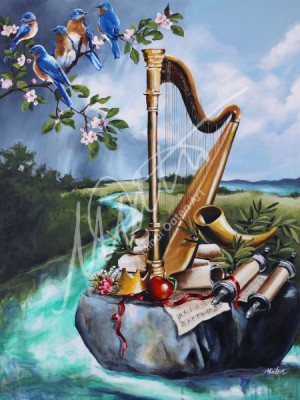
Hallelujah!
Discover Jesus as: King of Glory Psalms 146-147 Read on Bible Gateway (HCSB)
Lesson
Audio Only
Teaching Notes
INTRO
Psalms 146 and 147 build upon one another. The reciprocity between the two psalms points to a Divine Architect who ordered the placement of these works within the canon of Scripture.
TEACHING
Psalm 146:1; Psalm 147:1: Both psalms begin with a declaration of praise to God: “Hallelujah!” Psalm 147 describes our worship as “pleasant and lovely” to God. Psalm 146 calls on “my soul” to praise the Lord. The soul can be summarized as the entirety of our being. This is a call to have all of our being engaged in praise to the Lord.
Psalm 147:2–5: The major theme of Psalm 147 is the rebuilding of Israel. Isaiah 61 uses similar language: “They will rebuild the ancient ruins; they will restore the former devastations; they will renew the ruined cities, the devastations of many generations” (Isaiah 61:4). Part of the rebuilding of Jerusalem would see that the Lord “heals the brokenhearted and binds up their wounds” (v. 3). Again, this paralleled the language of Isaiah 61:1, “The Spirit of the Lord God is on Me, because the Lord has anointed Me to bring good news to the poor. He has sent Me to heal the brokenhearted, to proclaim liberty to the captives and freedom to the prisoners.”
The psalmist praised the Lord for His knowledge. Specifically, the Lord not only knows the number of stars in the sky, He also has named each one. Because of this, the Lord “is great, vast in power; His understanding is infinite” (v. 5). Theologian A. W. Tozer listed 18 attributes of God:
- All-wise
- Infinite
- Sovereign
- Holy
- Triune
- Omniscient
- Faithful
- Immutable (Unchanging)
- Eternal
- Self-sufficient
- Self-existent
- Omnipresent
- Omnipotent
- Good
- Just
- Merciful
- Loving
- Transcendent1
Psalm 146:8-9; Psalm 147:6: The psalmist continued to declare the Lord’s help for “the afflicted” and contrasted this desire with his opposition to the wicked (147:6). Again, this paralleled Isaiah 61:2-3: “to proclaim the year of the Lord’s favor, and the day of our God’s vengeance; to comfort all who mourn, to provide for those who mourn in Zion; to give them a crown of beauty instead of ashes, festive oil instead of mourning, and splendid clothes instead of despair. And they will be called righteous trees, planted by the Lord to glorify Him.”
Psalm 147:7–9: According to the Jewish encyclopedia, a lyre was like a smaller version of a harp that would have been used in personal worship.2 The psalmist praised the Lord for providing for and sustaining the creatures of the earth. Psalm 136:25 similarly says, “He gives food to every creature. His love is eternal.”
Psalm 147:10-11: The psalmist declared that the Lord values “those who fear Him” and who hope in Him, not powerful horses or people, “Now I know that the Lord gives victory to His anointed; He will answer him from His holy heaven with mighty victories from His right hand. Some take pride in chariots, and others in horses, but we take pride in the name of Yahweh our God” (Psalm 20:6–7). Instead of taking pride in things of the world, the psalmist exhorted us to cling to the Lord above all else. “For everything that belongs to the world—the lust of the flesh, the lust of the eyes, and the pride in one’s lifestyle—is not from the Father but is from the world” (1 John 2:16).
Psalm 147:12-20: The Lord was responsible for the prosperity and fortune of Israel (vv. 12–14). His sovereign power extended even to controlling the weather, specifically in His bringing snow and then clearing it from the land (vv. 15–18). The Lord gave “His word to Jacob” (v. 19). The psalmist wrote that “He has not done this for any other nation” (v. 20). Barnes noted, “He has favored Israel more than any other people by giving them his revealed truth. This was so. There was no nation in the ancient world so favored as the Hebrew people in this respect. There is no nation now so favored as the nation that has the revealed will of God—the Bible. The possession of that book gives a nation a vast superiority in all respects over all others. In laws, customs, morals, intelligence, social life, purity, charity, prosperity.”3
CLOSING
The simple fact that the Lord gave Israel His Word was enough for the psalmist to end this psalm with a “Hallelujah!”
A.W. Tozer, The Knowledge of the Holy: The Attributes of God, (San Francisco: Harper Collins, 1961).
Emilil G. Hirsch and Immanuel Benzinger, “Harp and Lyre,” Jewish Encyclopedia; available online at http://www.jewishencyclopedia.com/articles/7266-harp-and-lyre..
Albert Barnes, Albert Barnes’ Notes on the Whole Bible; available at https://www.studylight.org/commentaries/bnb/psalms-147.html.
Questions
-
How does Psalm 146 compare to the conviction that Paul spoke about in Philippians 1:21 and Colossians 3:4?
-
What does it mean to live a life of praise? (Romans 8:28; Ephesians 5:20; Philippians 4:6; 1 Thessalonians 5:18)
-
Why did the psalmist say not to put our trust in a person in Psalm 146 (Genesis 12:10–13)? Who did the Israelites put their trust in instead of the Lord (Exodus 14:10–14; 16:1–3; Numbers 14:1–10)? In whom or what are you tempted to place your trust in rather than the Lord?
-
According to Psalm 147:6 and 11, who does the Lord lift up and who does He take pleasure in? (1 Samuel 2:30; Matthew 23:12; Luke 1:50; James 4:10)
-
To whom did God first give His Word (Psalm 147:19–20)? What were they supposed to do with that Word (Deuteronomy 4:7–8; 6:4–9; Romans 9:4)? We are privileged to have the Word of God so accessible to us. What does the Lord desire us to do with His Word? (James 2:14–26)
-
What did the Holy Spirit highlight to you in Psalms 146—147 through the reading or the teaching?

Daily Word
Laura Martin Psalm 147:10–11
“He is not impressed by the strength of a horse; He does not value the power of a man. The LORD values those who fear Him, those who put their hope in His faithful love.”
What do you place your hope in? Is it in the things of this world? Your financial investments? A powerful boat or fast car? Perhaps a remodeled home or an amazing vacation? Maybe even the success of your children? Keep in mind, the things of this world will come and go. Yes, the Lord gives you good gifts to enjoy, but when these good things from the Lord begin to identify who you are, God is not pleased. You will never be truly satisfied or strengthened in the things of this world. Eventually they will collapse and fade away.
Instead, put your hope in the Lord. He remains faithful forever. Fear the Lord more than you place value on the things of this world. These earthly things will fall and vanish. You don’t even know what tomorrow will hold, so why trust in something that may not be here tomorrow? But—Hallelujah!—with the Lord you can stand firm. With the Lord you can have freedom and victory. You can place your confidence in the Lord because He will be with you forever. Seek the Lord for help daily. Fear the Lord, then you will be blessed. Hallelujah!
“He is not impressed by the strength of a horse; He does not value the power of a man. The Lord values those who fear Him, those who put their hope in His faithful love.”
— Psalm 147:10–11
FURTHER SCRIPTURE
- Psalm 20:7–8 — “Some take pride in chariots, and others in horses, but we take pride in the name of Yahweh our God. They collapse and fall, but we rise and stand firm.”
- Psalm 146:5–6 — “Happy is the one whose help is the God of Jacob, whose hope is in the Lord his God, the Maker of heaven and earth, the sea and everything in them. He remains faithful forever.”
- James 4:13–14 — “Come now, you who say, ‘Today or tomorrow we will travel to such and such a city and spend a year there and do business and make a profit.’ You don’t even know what tomorrow will bring—what your life will be! For you are like smoke that appears for a little while, then vanishes.”
Lesson and Daily Word
Each day has two parts: the Lesson and the Daily Word. Use these buttons to go from one to the other.
Teaching Notes and Questions
Next to the video, these tabs show the Teaching Notes and the Questions. Your answer to a question saves when you leave the answer box.
The Bible passage
This link opens the passage on Bible Gateway, and that gives the passage its tick. If you read it in your own Bible, tick it by hand in Progress.
Your progress on this lesson
A part ticks itself when you play the video or audio to the end, read the notes or the Daily Word to the end, or answer every question. You can also tick a part by hand here.
Downloads
Here you can save the video, the audio and the lesson as PDF files. Downloads do not count toward your progress.
Need help?
Use this button to send us a question or tell us about a problem. You can also take this tour again from there.