
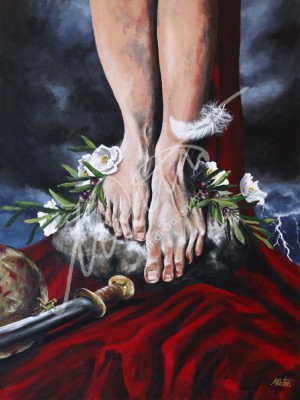
The Burden Bearer
Discover Jesus as: Burden Bearer Nahum 1-3 Read on Bible Gateway (HCSB)
Lesson
Audio Only
Teaching Notes
INTRO
If you’re like me, you haven’t really studied the book of Nahum before. The book is named after the prophet Nahum who took a warning to Nineveh. The prophet Jonah didn’t want to go to Nineveh so he actually ran away. However, when Jonah finally obeyed and delivered God’s message, the people repented and turned back to God. Nahum brought a message years later that God’s destruction was coming and could not be aborted. The name Nahum means “’comfort’ or ‘consolation’” and was a shortened form of Nehemiah.1 Nahum 1:15 gives a picture of what was to come: “The wicked one will never again march through you; he will be entirely wiped out.”
Nahum was an Elkoshite, either by birth or in ministry. MacArthur states that the exact location of Elkosh is unknown, but could “include Al Qosh, situated in the northern Iraq (thus Nahum would have been a descendant of the exiles taken to Assyria in 722 B.C.), Capernaum (“town of Nahum”), or a location in southern Judah.”2 The date of the book is not certain. Since Nineveh was described as a world power, Nahum must have written it before her fall in 612 B.C., and probably before the death of Ashurbanipal in 626 B.C., since the nation began losing power after his death. Since Nahum mentioned the fall of No Amon, or Thebes, it can probably be dated in “the mid-seventh century during the reign of Manasseh (c. 695-642 B.C.).”3
One hundred years after Nineveh repented, “She returned to idolatry, violence, and arrogance. She was at the height of her power” at the time.4 God used the Babylonian army under King Nabopolassar and his son Nebuchadnezzar to bring about the fall of Assyria/Nineveh in 612 B.C.5
The book of Nahum is actually a sequel to the book of Jonah. There’s a lesson for evangelists in this. The people truly repented under Jonah, but later generations did not. We can lead people to the Lord, but we cannot make them have a true walk with the Lord.
MacArthur explains that “Nineveh was proud of her reputed invulnerable city, her walls reaching 100 feet high and with a moat 150 feet wide and 60 feet deep.”6 However, Nahum 1:8 states that Nineveh would be destroyed with an overwhelming flood, and according to Nahum 3:11, the city would be lost from sight. “After its destruction in 612 B.C., the site was not rediscovered until 1842 A.D.”7
TEACHING
Nahum 1:2-6: Nahum described God as jealous, avenging, and fierce in His wrath. Through God’s power, the clouds are just dust beneath His feet. He can rebuke the sea and it will dry up and He can make all rivers run dry. Even the great cedars (flowers) of Lebanon wither, the mountains quake, and the hills melt before Him (vv. 2-6).
Nahum 1:7-13: Our phrase for how Jesus is seen in the book of Nahum is Burden Bearer, and it is found in verse 7––“He cares for those who take refuge in Him” (Psalm 46:1; Isaiah 33:2-4; 37:3-7, 29-38). God would destroy Nineveh and it would not rise again (vv. 8-10). The “wicked counselor” in verse 11 “suggests satanic influence on the leadership, identified as the king of Assyria,” possibly Sennacherib “who invaded Judah in 701 B.C. and of whom Isaiah speaks in similar language (Isaiah 10:7).”8 Despite their great power and huge armies, Assyria would no longer threaten or imprison Judah (vv. 12-13). Jesus displayed this same picture of taking on the burdens of the people (Isaiah 61; Matthew 11:28-30; Luke 4:18; 2 Corinthians 5:21). Christ took on the sin burden that was meant for us, and He carries it.
Nahum 1:14-15: Nahum described God’s coming judgment. First, there would be no one left to carry on the name of the
king or his people. Second, the carved idols and images of the Assyrian gods would be destroyed. And third, the king would be put to death (v. 14). However, there was One to come who would bring good news and proclaim peace (v. 15).
This was a good news/bad news prophecy. The bad news was that the Assyrians would be wiped off the face of the earth. The good news was that Judah would be freed from the chains of the Assyrians and given peace. The crazy thing about all of this is that it would be the Babylonians who put it in motion and set God’s people free from Assyria. Sadly, God’s people would then face captivity again through the Babylonians.
Nahum 2:1-13: God explained that He was justified in the destruction of Nineveh because they had committed so many crimes.
Nahum 3:1-19: God explained the internal condition of the city and the external condition of the city. They were making and selling slaves, fighting and killing people without end, and engaging in prostitution, sorcery, and witchcraft. What happened in the downfall of Thebes would happen to Assyria. There would be no remedy for them. McGee compares the messages of Jonah and Nahum this way. The message of Jonah was “God will save today,” and the message of Nahum was “God will destroy tomorrow.”9 McGee concludes, “God does not change; men do.”10
CLOSING
God told the people to celebrate their festivals and to fulfill their covenant vows. In other words, He told them to walk out their relationship with Him. They were to proclaim the peace that could only come through the Lord, and they were to wait for the One who would bring the good news. There’s evidence for this in the New Testament as well:
Matthew 28:18-20: “Then Jesus came near and said to them, ‘All authority has been given to Me in heaven and on earth. Go, therefore, and make disciples of all nations, baptizing them in the name of the Father and of the Son and of the Holy Spirit, teaching them to observe everything I have commanded you. And remember, I am with you always, to the end of the age.’”
Romans 10:15: “And how can they preach unless they are sent? As it is written: How beautiful are the feet of those who announce the gospel of good things!”
Ephesians 2:17: “When the Messiah came, He proclaimed the good news of peace to you who were far away and peace to those who were near.”
Ephesians 6:15: “And your feet sandaled with readiness for the gospel of peace.”
Because of what Jesus did on the cross, He is our Burden Bearer and we have peace.
John MacArthur, The MacArthur Bible Commentary (Nashville: Thomas Nelson Publishers, 2005), p. 1022.
MacArthur, p. 1022.
MacArthur, p. 1022.
MacArthur, p. 1022.
MacArthur, p. 1022.
MacArthur, p. 1023-1024.
MacArthur, p. 1023.
MacArthur, p. 1024.
J. Vernon McGee, “Outline of Nahum,” available at https://www.blueletterbible.org/Comm/mcgee_j_vernon/notes-outlines/nahum/nahum-outline.cfm.
McGee.
Questions
-
To whom was the book of Nahum written, and what does it have in common with the book of Jonah?
-
Unlike the prophet Jonah who preached in the streets of Nineveh about 100 years earlier, what was the prophet Nahum sent to do?
-
What does Nahum 2:8 compare Nineveh to? What made Nineveh turn back to their old ways?
-
What does Nahum 3 say of the fate of Nineveh? How do some of the evil things Nineveh was doing compare to some of the evil that goes on in the world today? Should we fear God’s wrath?
-
What did the Holy Spirit highlight to you in Nahum 1—3 through the reading or the teaching?
Daily Word
Laura Martin Nahum 1:7–8
“The LORD is good, a stronghold in a day of distress; He cares for those who take refuge in Him. But He will completely destroy Nineveh with an overwhelming flood, and He will chase His enemies into darkness.”
FURTHER SCRIPTURE
- •Nahum 1:13 — “For I will now break off his yoke from you and tear off your shackles.”
- Nahum 1:15 — “Look to the mountains—the feet of one bringing good news and proclaiming peace! Celebrate your festivals, Judah; fulfill your vows. For the wicked one will never again march through you; he will be entirely wiped out.”
- Matthew 11:30 — “For My yoke is easy and My burden is light.”
Lesson and Daily Word
Each day has two parts: the Lesson and the Daily Word. Use these buttons to go from one to the other.
Teaching Notes and Questions
Next to the video, these tabs show the Teaching Notes and the Questions. Your answer to a question saves when you leave the answer box.
The Bible passage
This link opens the passage on Bible Gateway, and that gives the passage its tick. If you read it in your own Bible, tick it by hand in Progress.
Your progress on this lesson
A part ticks itself when you play the video or audio to the end, read the notes or the Daily Word to the end, or answer every question. You can also tick a part by hand here.
Downloads
Here you can save the video, the audio and the lesson as PDF files. Downloads do not count toward your progress.
Need help?
Use this button to send us a question or tell us about a problem. You can also take this tour again from there.