
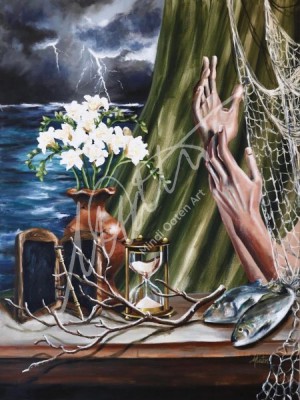
Habakkuk's Prophecy
Discover Jesus as: Coming Salvation Habakkuk 1-3 Read on Bible Gateway (HCSB)
Lesson
Audio Only
Teaching Notes
INTRO
This week, we not only finish up our study of the Minor Prophets, but we finish up the Old Testament books as well. The study of the Old Testament has been life-changing. So far in the Minor Prophets, we’ve studied Hosea, Joel, Amos, Obadiah, Jonah, Micah, and Nahum. The eighth Minor Prophet is Habakkuk.
The book of Habakkuk is named for its author, and the name means “one who embraces.” MacArthur states, “By the end of the prophecy, this name becomes appropriate as the prophet clings to God regardless of his confusion about God’s plans for His people.”1 Nothing is known about the prophet except what’s provided within the book. Because even that information was given sparingly, some scholars suggest Habakkuk didn’t need more information because he was already known at the time. Habakkuk was also a contemporary of (lived at the same time as) Jeremiah, Ezekiel, Daniel, and Zephaniah, and his message was for the southern kingdom of Judah. Habakkuk 1:6 mentions the Chaldeans (Babylonians), which suggests dating it to the late seventh century BC. MacArthur explains this would have been “shortly before Nebuchadnezzar began his military march through Nineveh (612 BC)”2 and “Habakkuk’s bitter lament (Habakkuk 1:2–4) may reflect a time period shortly after the death of Josiah (609 BC), days in which the godly king’s reforms (2 Kings 23) were quickly overturned by his successor, Jehoiakim (Jeremiah 22:13–19).”3 Habakkuk therefore covered this shift in world power from the Assyrians to the Babylonians.
Habakkuk prophesied during the end of the Assyrian Empire and the beginning of the Babylonian Empire. These and other world powers will all fall before God’s kingdom. The Babylonian empire under King Nabopolassar and then his son Nebuchadnezzar attacked the Assyrians, overthrowing their capital city of Nineveh in 612 BC and finally defeating them in Carchemish in 605 BC. While Necho the Egyptian king traveled through Judah to assist Assyria, he came against King Josiah and the king’s army. In the battle, King Josiah was killed. King Josiah had led reforms in Judah that found the mission book of the Law in the temple. Through the Law, Josiah led the people to renew their covenant with the Lord in 622 BC. However, under the leadership of his sons, Judah moved away from the Lord and back to its worship of idols and pagan gods.4
Our phrase for Habakkuk for where we can see Jesus is Coming Salvation. This can be seen in Habakkuk 2:3 and 3:18. (Hebrews 10:37.)
- Habakkuk 2:3: “For the vision is yet for the appointed time; it testifies about the end and will not lie. Though it delays, wait for it, since it will certainly come and not be late.”
- Habakkuk 3:18: “Yet, I will triumph in Yahweh; I will rejoice in the God of my salvation!”
TEACHING
Habakkuk 1:1-17: Habakkuk explained that he had seen God’s vision of what was to come (v. 1a) and questioned why God wasn’t listening to his prayers (vv. 1b–4). God responded that Habakkuk should be utterly astounded at what was happening in the world (vv. 5–8). God was raising up the Babylonians to take over His own people through violence (vv. 9–11). Habakkuk then questioned God again (vv. 12–17). Habakkuk said the Babylonians were so wicked that they would draw the Judeans into their net as well.
Habakkuk 2:1–5: Habakkuk said he would stand at his post until he heard from God (v. 1). God replied in verses 2–5 and told Habakkuk to write His response so everyone could see it. MacArthur noted, “Habakkuk was to record the vision to preserve it for posterity, so that all who read it would know of the certainty of its fulfillment.”5 This was so the vision would testify about the end times (v. 3a). It would happen in God’s timing (v. 3b). In verse 4, God described Babylon as having an inflated ego with no integrity, who would be conquered by the righteous one (Romans 1:17; Galatians 3:11; Hebrews 10:37–38). We are to live like the righteous one without drawing back from the world. On the other hand, the arrogant man is never satisfied and always wants more for himself (v. 5).
Habakkuk 2:6–20: In verse 6 God began to outline the five woes that the arrogant would face:
First, woe to the arrogantwho would amass great wealth that would not belong to him permanently. This continued the picture of Babylon’s aggressiveness against other nations, even taking things that belonged to others. Verse 7 describes these as Babylon’s “creditors” who would one day collect against them (v. 7). Babylon would fall to all the nations that they had captured (v. 8).
Second, woe to the dishonest man who thinks wealth would save him (v. 9). His dishonesty will be shouted out by the stones in the wall and the rafters in the ceiling (vv. 10–11).
Third, woe to the one who builds a city through bloodshed, for their efforts would come to nothing (vv. 12–14). Only the millennial kingdom will bring back God’s glory into the world.
Fourth, woe to him who makes his neighbors drunk so he could take advantage against them (vv. 15–17).
Fifth, woe to him who crafted idols from wood or iron that could not speak or have any power (vv. 18–19).
Verse 20 concludes, “But the Lord is in His holy temple; let everyone on earth be silent in His presence.” MacArthur explains the use of “silence” here: “In contrast to the silence of the idols, the living, sovereign ruler of the universe calls all the earth to be silent before Him. None can assert his independence from Him; all the earth must worship in humble submission (Psalm 46:20; Isaiah 53:15).”6
Habakkuk 3:2-16: In chapter 3, Habakkuk offered another prayer. He asked God to revive His work in this time (v. 2). Habakkuk described God’s splendor covering the heavens and the earth as full of His praise. Even the mountains shudder before the Lord, and the sun and moon stand still in His presence (vv. 3–15). Habakkuk responded in praise and his willingness to “quietly wait for the day of distress to come against” those who invaded them (v. 16).
CLOSING
That creates a serious question for all of us. In this time of waiting on the Lord, do we wait patiently? Or do we complain while we wait upon the Lord? Do you believe that God is coming? Habakkuk believed God was going to show up, even though the Babylonians were already on their way. Habakkuk concluded with this statement of trust with these words (Habakkuk 3:19): “Yahweh, my Lord is my strength; He makes my feet like those of a deer and enables me to walk on mountain heights!”
John MacArthur, The MacArthur Bible Commentary (Nashville: Thomas Nelson Publishers, 2005), p. 1028.
MacArthur, p. 1028.
MacArthur, p. 1028.
MacArthur, p. 1028.
MacArthur, p. 1031.
MacArthur, p. 1031.
Questions
-
Habakkuk 1:3 asks, “Why do You make me see iniquity, and cause me to look on wickedness?” Do you ever feel like this toward God? Do you ever wonder why He is not doing anything to stop sin and wickedness in the world?
-
Habakkuk 1:5 says, “Look among the nations! Observe! Be astonished! Wonder! Because I am doing something in your days. You would not believe if you were told.” Who was talking here, and what do you think He was referring to?
-
God told Habakkuk that He was raising up the Chaldeans to bring judgment upon the Jews. Name some other places in Scripture where God used wicked people to discipline His own people (Judges 3:1–4; Jeremiah 21:12). Do you think He still does this today? If so, name some situations or times in history when this has happened.
-
What have we made with our own hands that could be considered idols today? What idols do you need to lay down and quit depending on to make you happy in your own life? (Habakkuk 2:18)
-
Habakkuk 3:3 states, “God comes from Teman, and the Holy One from Mount Paran. His glory covered the heavens, and the earth was full of His praise.” What do you think Teman and Mount Paran meant or were referring to, since God doesn’t come from anything and He made everything?
-
Habakkuk 3:13 states, “You went forth for the salvation of Your people, for the salvation of Your anointed. You struck the head of the house of evil to lay him open from thigh to neck. Selah.” How does this verse point to Jesus?
-
What did the Holy Spirit highlight to you in Habakkuk 1—3 through the reading or the teaching?
Daily Word
Laura Martin Habakkuk 3:18–19
“Yet I will triumph in Yahweh; I will rejoice in the God of my salvation! Yahweh my LORD is my strength; He makes my feet like those of a deer and enables me to walk on mountain heights!”
The prophet Habakkuk lamented to the Lord about the injustice and violence in the world. As He faced the dilemma of understanding God’s ways, he asked: “How long, Lord must I call for help and you do not listen or cry out to You about violence and you do not save? Why do you tolerate those who are treacherous?” After God answered, Habakkuk displayed faith in the midst of not understanding. He demonstrated trust in the midst of trials. He found hope in the Lord in the midst of despair. How? By faith, Habakkuk believed in the God of his salvation.
What do you do when God isn’t showing up the way you asked Him to? What do you do when you don’t understand the injustice around you? Yes, you have questions for God. But right now, today, pause for just a minute. By faith, choose to declare: “Yet I will triumph in Yahweh; I will rejoice in the God of my salvation! Yahweh my Lord is my strength; He makes my feet like those of a deer and enables me to walk on mountain heights!” Fix your eyes on Jesus, rather than on the problem. As you turn to the Lord, give Him thanks. Choose to trust, even in the midst of not understanding. Rejoice always.
“Yet I will triumph in Yahweh; I will rejoice in the God of my salvation! Yahweh my Lord is my strength; He makes my feet like those of a deer and enables me to walk on mountain heights!”
— Habakkuk 3:18–19
FURTHER SCRIPTURE
- Habakkuk 1:2–3 — “How long, Lord, must I call for help and You do not listen or cry out to You about violence and You do not save? Why do You force me to look at injustice? Why do You tolerate wrongdoing? Oppression and violence are right in front of me. Strife is ongoing, and conflict escalates.”
•
Philippians 4:6–7 — “Don’t worry about anything, but in everything, through prayer and petition with thanksgiving, let your requests be made known to God. And the peace of God, which surpasses every thought, will guard your hearts and minds in Christ Jesus.”
Hebrews 4:16 — “Therefore let us approach the throne of grace with boldness, so that we may receive mercy and find grace to help us at the proper time.”
Lesson and Daily Word
Each day has two parts: the Lesson and the Daily Word. Use these buttons to go from one to the other.
Teaching Notes and Questions
Next to the video, these tabs show the Teaching Notes and the Questions. Your answer to a question saves when you leave the answer box.
The Bible passage
This link opens the passage on Bible Gateway, and that gives the passage its tick. If you read it in your own Bible, tick it by hand in Progress.
Your progress on this lesson
A part ticks itself when you play the video or audio to the end, read the notes or the Daily Word to the end, or answer every question. You can also tick a part by hand here.
Downloads
Here you can save the video, the audio and the lesson as PDF files. Downloads do not count toward your progress.
Need help?
Use this button to send us a question or tell us about a problem. You can also take this tour again from there.