
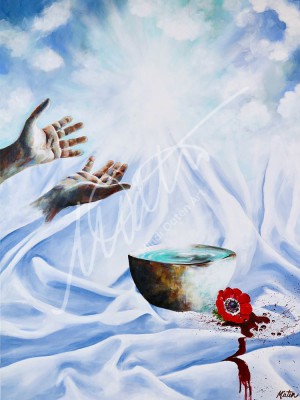
The Burnt Offering
Discover Jesus as: Atonement Leviticus 1-3 Read on Bible Gateway (HCSB)
Lesson
Audio Only
Teaching Notes
INTRO
Our goal through the entire Bible is to identify one word in each book that points to the Messiah. Our word for Genesis is Seed (Genesis 3:15). Our word for Exodus is Deliverer (Jude 5). Now we’re in Leviticus. Leviticus means, “He called” or “He names.”
Our word for Jesus, in the book of Leviticus, is Atonement. The entire Old Covenant points to Yeshua, the Messiah. Leviticus relates to the Levites - the priests, and contains the requirements of the Mosaic covenant. Gordon Wenham wrote, “It would be wrong, however, to describe Leviticus as a manual for priests. It is equally concerned with the part the laity should play in worship.”1It’s for everyday people.
The Israelites had the tabernacle in the wilderness, and God said He was going to give them more regulations like: When to go to the sanctuary? What to bring? What did the priests need to do? How were they supposed to dress? Only a few chapters in the book were given directly to the Levites. The rest was directed to everyday people for instructions on how to approach the presence of God. Mark F. Rooker wrote, “This is one of the books they teach Jewish children.”2
Sailhamer says one of the central themes of Leviticus is holiness.3God identified the Israelites as: (1) a special possession, (2) a kingdom of priests, and (3) a holy nation (Exodus 19:5–6). In Leviticus, God gave them a manual for how this would happen. The Israelites were in the wilderness, and they didn’t know how to interact with the tabernacle. They needed instruction.
TEACHING
Leviticus 1:1–2: Moses’s audience was the Israelites. Nelson wrote that “offering” means “to bring near that which one brings near to God.”4Remember, the Israelites didn’t know how to approach God. God was teaching them how to approach the throne. All the Israelites had, at that point, were their flocks and herds.
Leviticus 1:3: Noah offered burnt offerings on the altar (Genesis 8:20). Abraham was to offer his own son Isaac as a burnt offering (Genesis 22:1). Jethro, Moses’ father-in-law, brought a burnt offering to God (Exodus 18:11–12). Even though they didn’t have the tabernacle in place, the idea of a burnt offering was not foreign to them. The requirements were an unblemished male from the herd or flock. They had to bring an acceptable offering. Over the course of time, this was going to become a weight. They will eventually be given 613 rules and regulations.
Leviticus 1:3-9: The process for burnt offerings:
- Present the offering (v. 3).
- Lay hands on the animal’s head (v. 4).
- Slaughter the sacrifice (v. 5). The offeror did the killing here, not the priest, though the priest supervised.
- Collect the blood and sprinkle it on the altar (v. 5b). The priests did this. It’s all about the blood, because without the blood there was no atonement.
- The offeror skinned the burnt offering and cut it in pieces (v. 6). To experience the presence of God, the one with the offering had to do the work.
- The priests prepared a fire (v. 7).
- Then they arranged the pieces of the sacrifice on the fire (v. 8).
- The offeror washed its entrails with water (v. 9a). The people needed direction, a focus.
- The priests then burned it all (v. 9b). Purification was by fire. This was what the Israelites were to do in order to approach God in his presence.
Leviticus 1:10: The exact same process used for offering a bull (see above) was used for offering a sheep or goat. Loving the Lord and loving your neighbor is more important than all the burnt offerings and sacrifices (Mark 12:33). But these components all pointed to the perfect atonement of Christ.
The one word for all of Leviticus is Atonement. I want to give you a quick backdrop on the word atonement:
When the Israelite put his hand on the head (of the animal) it was so he could be accepted, “to make atonement for him” (Leviticus 1:4).
Atonement means “to cover.”
Constable describes three meanings of “atonement”5:
Substitution – The animal served in place of the offerer. The perfect animal’s blood atoned for the sin of the offerer.
Imputation – God transferred the guilt of the Israelites and put it onto the animal (when the offerer put his hands on the head of the animal).
Death – It was required in order for atonement to work. Bloodshed brought atonement.
They had to go through this whole process in order to be acceptable to God
Leviticus 2: The meal/grain offering. Leviticus 3: The fellowship/peace offering.
CLOSING
Leviticus constantly points to Christ, our Atonement.
Gordon J. Wenham, The Book of Leviticus (Grand Rapids, MI: Wm. B. Eerdmans, 1979), p. 3.
See the discussion and critique of the Documentary Hypothesis in Mark F. Rooker, Leviticus, pp. 23–38.
John H. Sailhamer, The Pentateuch as Narrative (Grand Rapids, MI: Zondervan), p. 323
Earl D. Radmacher, Ronald B. Allen, and H. Wayne House, eds., Nelson’s New Illustrated Bible Commentary (Nashville, TN: Thomas Nelson), p.153.
Thomas L. Constable, Dr. Constable’s Expository (Bible Study) Notes; available online at https://planobiblechapel.org/tcon/notes/pdf/leviticus.pdf, p. 13.
Questions
-
Men were to bring a burnt offering and lay hands on the head of the animal, thus transferring their guilt onto the animal. According to Leviticus 1:4, what was the purpose of this? Can you see this reality in Isaiah 53:12b?
-
“An offering by fire of a soothing aroma to the Lord,” is repeated in Leviticus 1—3. (Leviticus 1:9,13,17, etc.) A similar phrase is found in Ephesians 5:2. Do you see a connection? If so, what is it?
-
The Lord instructed the people through Moses in Leviticus 2:13 that the grain offerings be seasoned with salt, and in fact, all offerings were to be offered with salt. How does Mark 9:49–50 relate to this system of offering?
-
How would you define atonement? In Kyle’s teaching, he talks about three things that take place during an atoning sacrifice. Name and describe them.
-
What did the Holy Spirit highlight to you in Leviticus 1—3 through the reading or the teaching?

Daily Word
Laura Martin Leviticus 1:1-2, 3b
“Then the LORD summoned Moses and spoke to him from the tent of meeting: ‘Speak to the Israelites and tell them: When any of you brings an offering to the LORD from the livestock, you may bring your offering from the herd or the flock....He must bring it to the entrance to the tent of meeting so that he may be accepted by the LORD.’”
Exodus is like a design manual for the Tabernacle, whereas Leviticus is a user manual. It’s a codebook for the Law. It begins by describing the burnt offerings, grain offerings, and peace or fellowship offerings. The people sacrificed their most costly possessions or livelihood at the altar as an offering to the Lord. The sacrifices were a soothing aroma to God and allowed the people to be found acceptable by Him. This alone was reason enough to make the sacrifice at the altar.
Disciples who give up everything to follow Christ also make this sacrifice. It too is pleasing to God. As you worship God, you are called to present yourself as a living sacrifice. You are to hold nothing back. Is there anything you are holding back today that needs to be presented to God as a sacrifice in worship to Him? As you lay it down before Him, remember, it will please the Lord.
“Then the LORD summoned Moses and spoke to him from the tent of meeting: ‘Speak to the Israelites and tell them: When any of you brings an offering to the LORD from the livestock, you may bring your offering from the herd or the flock. . . .
He must bring it to the entrance to the tent of meeting so that he may be accepted by the LORD.’”
— Leviticus 1:1–2, 3b
FURTHER SCRIPTURE
- Mark 8:34 — “Summoning the crowd along with His disciples, He said to them, ‘If anyone wants to be My follower, he must deny himself, take up his cross, and follow Me.’”
- John 12:3 — “Then Mary took a pound of fragrant oil—pure and expensive nard—anointed Jesus’ feet, and wiped His feet with her hair. So the house was filled with the fragrance of the oil.”
- Romans 12:1 — “Therefore, brothers, by the mercies of God, I urge you to present your bodies as a living sacrifice, holy and pleasing to God; this is your spiritual worship.”
Lesson and Daily Word
Each day has two parts: the Lesson and the Daily Word. Use these buttons to go from one to the other.
Teaching Notes and Questions
Next to the video, these tabs show the Teaching Notes and the Questions. Your answer to a question saves when you leave the answer box.
The Bible passage
This link opens the passage on Bible Gateway, and that gives the passage its tick. If you read it in your own Bible, tick it by hand in Progress.
Your progress on this lesson
A part ticks itself when you play the video or audio to the end, read the notes or the Daily Word to the end, or answer every question. You can also tick a part by hand here.
Downloads
Here you can save the video, the audio and the lesson as PDF files. Downloads do not count toward your progress.
Need help?
Use this button to send us a question or tell us about a problem. You can also take this tour again from there.