

Curses Or Blessings: Disobedience Or Obedience
Discover Jesus as: New Covenant Jeremiah 9-11 Read on Bible Gateway (HCSB)
Lesson
Audio Only
Teaching Notes
INTRO
Yesterday, we heard about God’s plan for taking care of Israel’s enemies by coming in and cleaning house (chapter 6). However, the people didn’t listen (chapters 7—8). Jeremiah 8:20–22 says, “Harvest has passed, summer has ended,
but we have not been saved … Is there no balm in Gilead? Is there no physician there? So why has the healing of my dear
people not come about?”
Today, we’ll be looking at Jeremiah 9—11. The transition is found at the end of verse 9:3: “This is the Lord’s declaration” (vv. 6, 9, 13, 15, 22). The emphasis is on the Word of God.
TEACHING
Jeremiah 9: The statement, “I would weep day and night over the slain of my dear people,” presents the picture of the weeping prophet (v. 1). When you have a heart for evangelism and repentance, it’s hard not to weep when the people hear God’s message and yet reject it still. This is an incredible picture of Christ, weeping over Jerusalem. Jeremiah longed for a place in the wilderness where he could withdraw from these treacherous, adulterous people (v. 2). However, Jeremiah didn’t withdraw from the people; he kept delivering God’s message that they would be scattered among the nations under the sword (v. 16).
Jeremiah told them not to boast in the things they have but only in the Lord’s faithful love, justice, and righteousness on the earth (vv. 23–24).
Jeremiah 10: Chapter 10 moves to the subject of God’s house: “Yahweh, there is no one like you. You are great; Your name is great in power” (v. 6). Nothing can compare with who God is. God created the world by His own power. We can never predict our own future.
Jeremiah 11: Constable describes verses 1–7 as “the broken covenant.”1 Jeremiah was called to tell the people to “listen to the words of this covenant.” Nelson’s Commentary explains, “A covenant is a legal treaty or relationship between individuals, between nations, or—in the case of Israel—between a nation and its God.”2 This covenant was specifically for Judah and Jerusalem (v. 2).
Nelson’s Commentary also states, “The term rendered “words” is the Hebrew name of the book of Deuteronomy; it is also used to refer to the terms of the “covenant”.”3 In verse 3, “Cursed” suggests the negative provisions of the covenant as summarized in Deuteronomy 27:26 (Deuteronomy 27—28).”4 Obedience to the covenant brought blessings.5
This curses/blessings relationship was established when God brought the Hebrews out of Egypt (“the iron furnace”) and away from all the hardships they faced there (vv. 4–5). This reminder of the hardships in Egypt is a foreshadowing of the coming bondage to the Babylonians.6 God told Jeremiah to proclaim throughout Judah and Jerusalem that His warning was the same as when He brought their ancestors out of Egypt—obey God! (vv. 6–7) God instructed Jeremiah to walk through all the cities of Judah, proclaiming to all the people God’s call to obedience. God likewise used Jonah to walk through the streets proclaiming His warning to the people of Nineveh (Jonah 3:1–6).
Jeremiah’s message was one of hope, and yet the people refused to listen. (Matthew 10:5–15; 28:18–20; Luke 8:1; Romans 10:15). Jesus also sent His disciples out to proclaim God’s call of obedience to the people. I believe that as followers of Christ we constantly hear from the Spirit of God, but we tend to convince ourselves that we only heard our own voice.
Jeremiah 11:8–10: Instead the people “followed the stubbornness” of their own “evil heart[s]” (v. 8). God told Jeremiah about the conspiracy among the people of Judah and Jerusalem; they had returned to other gods for worship and had broken their covenant with God (vv. 9–10).
Jeremiah 11:11–14: God declared He would bring disaster on these disobedient and rebellious people who would cry out to God, but He would not hear them (v. 11). Then they would turn to the false gods they had been worshipping, but they would receive no help (v. 12). The gods they worshipped were as numerous as the cities of Judah and the streets of Jerusalem (v. 13). MacArthur explains, “Judah was so filled with idolatry that there were false deities for every city and a polluted altar on every street.”7 God told Jeremiah that when all this happened, he was not to waste his time praying for them or calling to God on their account because He would not be listening (v. 14).
Jeremiah 11:15–17: God went on to describe how His people, His beloved, had turned from Him (v. 15) and how they would face His judgment (vv. 16–17; Jeremiah 2:21).
Jeremiah 11:18–23: Jeremiah was hated for delivering God’s message, and God warned him of the plots against him (vv. 18– 20). The people of Anathoth even warned Jeremiah not to prophesize in their city with the word of Yahweh or they would kill him (v. 21). However, God declared that He was about to punish them and they would have no remnant left living (vv. 22–23).
CLOSING
The reality is that if we are walking out our faith and proclaiming God’s message, we too will be despised and rejected, just as Christ was despised and rejected.
Thomas Constable, Dr. Constable’s Bible Expository Study Notes, p. 364; available online at https://planobiblechapel.org/tcon/notes/pdf/jeremiah.pdf.
Earl Radmacher, Ronald B. Allen, and H. Wayne House, eds., Nelson’s New Illustrated Bible Commentary (Nashville: Thomas Nelson Publishers, 1999), p. 897.
Nelson’s Commentary, p. 897.
Nelson’s Commentary, p. 897..
John MacArthur, The MacArthur Bible Commentary (Nashville: Thomas Nelson Publishers, 2005), p. 854.
Warren W. Wiersbe, The Bible Exposition Commentary: Jeremiah (Nashville: Thomas Nelson Publishers, 2002), p. 93.
MacArthur, p. 854.
Questions
-
In your opinion, what does Jeremiah 9:1 tell you about how Jeremiah was feeling for his people? Have you ever felt that overwhelmed with grief and compassion for someone?
-
As you read Jeremiah 9:2–6, what kind of sins were the people caught up in? What did the Lord say He was going to do as a result of those sins (Jeremiah 9: 7–11, 15–16)? Specifically, why did He punish them? (Jeremiah 9:13–14)
-
In Jeremiah 9:23, what three things did the Lord say people tended to admire? What was God’s desire for His people (Jeremiah 9:24)? What do you want people to admire about you?
-
Jeremiah 10 talks about some things that the people were putting their trust in rather than God. What were some of these things (Jeremiah 10:2–5, 8–9)? What do you sometimes find yourself putting trust in, rather than God? Do you need to destroy any “idols” in your life?
-
Meditate on Jeremiah 10:12–13. Where else in Scripture does it talk about God’s mighty power in creation this way? (Job 9:8; 38:4–7; Psalm 29:3–9; Jeremiah 51:15)
-
Read Jeremiah 11:19. Jeremiah’s life was threatened because of the message he delivered to the people. How does this verse point to the Messiah (Isaiah 53:7)? Would you be willing to give a harsh word from the Lord if you knew it would put your life in danger?
-
What did the Holy Spirit highlight to you in Jeremiah 9—11 through the reading or the teaching?
Daily Word
Laura Martin Jeremiah 9:23–24
“This is what the LORD says: The wise man must not boast in his wisdom; the strong man must not boast in his strength; the wealthy man must not boast in his wealth. But the one who boasts should boast in this, that he understands and knows Me—that I am Yahweh, showing faithful love, justice, and righteousness on the earth, for I delight in these things. This is the LORD’s declaration.”
The Lord used Jeremiah’s voice as an instrument to draw the people back to His love and obedience to His ways. Jeremiah reminded them to boast in the Lord alone. He told the wise man, the strong man, and the wealthy man not to boast in their own wisdom, strength, or wealth but rather to boast in the Lord. Boast in the Lord’s faithful love, understanding, justice, and righteousness. The Lord created the heaven and earth. There is no one like Yahweh.
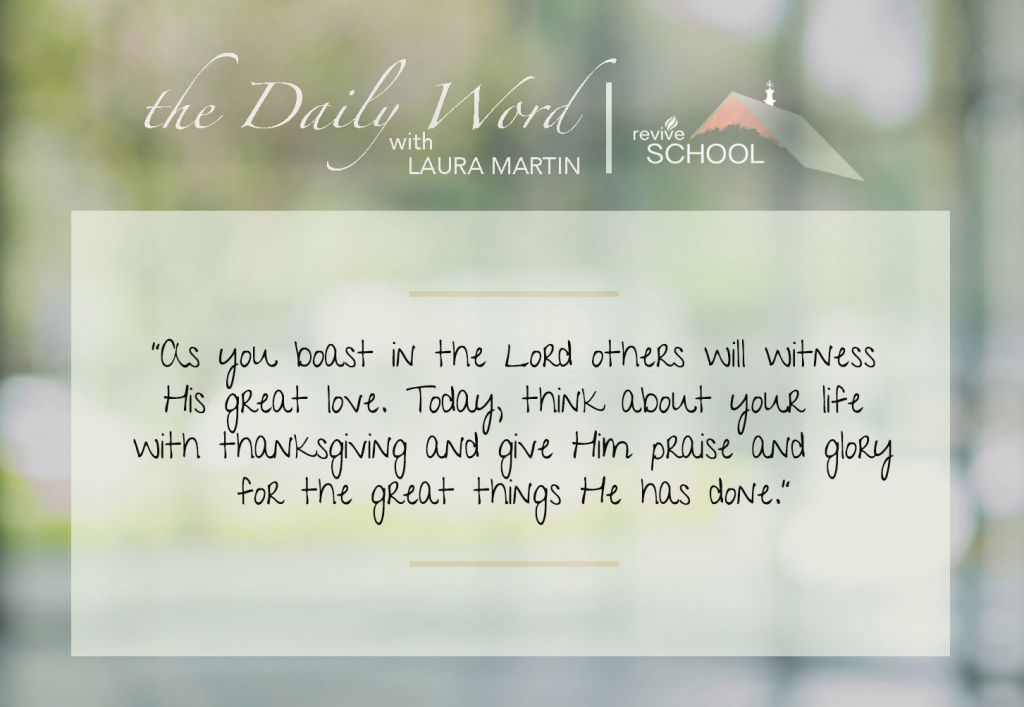
As you grow in wisdom, strength, or wealth, who do you boast in? Do you give the Lord praise and glory for His work in your life? Remember, He is your rock and your power. Apart from God, you can do nothing. He is your creator. He has plans for you. He is in all things and above all things. He is the author of your faith. He alone is worthy of your praise. Don’t boast in yourself but boast in the Lord. As you boast in the Lord, others will witness His great love. Today, think about your life with thanksgiving, and give Him praise and glory for the great things He has done.
“This is what the Lord says: The wise man must not boast in his wisdom; the strong man must not boast in his strength; the wealthy man must not boast in his wealth. But the one who boasts should boast in this, that he understands and knows Me—that I am Yahweh, showing faithful love, justice, and righteousness on the earth, for I delight in these things. This is the Lord’s declaration.”
— Jeremiah 9:23–24
FURTHER SCRIPTURE
- Psalm 20:7 — “Some take pride in chariots, and others in horses, but we take pride in the name of Yahweh our God.”
- Jeremiah 10:6–7 — “Yahweh, there is no one like You. You are great; Your name is great in power. Who should not fear You, King of the nations? It is what You deserve. For among all the wise people of the nations and among all their kingdoms, there is no one like You.”
- 1 Corinthians 1:30–31 — “But it is from Him that you are in Christ Jesus, who became God-given wisdom for us—our righteousness, sanctification, and redemption, in order that, as it is written: The one who boasts must boast in the Lord.”
Lesson and Daily Word
Each day has two parts: the Lesson and the Daily Word. Use these buttons to go from one to the other.
Teaching Notes and Questions
Next to the video, these tabs show the Teaching Notes and the Questions. Your answer to a question saves when you leave the answer box.
The Bible passage
This link opens the passage on Bible Gateway, and that gives the passage its tick. If you read it in your own Bible, tick it by hand in Progress.
Your progress on this lesson
A part ticks itself when you play the video or audio to the end, read the notes or the Daily Word to the end, or answer every question. You can also tick a part by hand here.
Downloads
Here you can save the video, the audio and the lesson as PDF files. Downloads do not count toward your progress.
Need help?
Use this button to send us a question or tell us about a problem. You can also take this tour again from there.