

Prophecies Against Egypt
Discover Jesus as: New Covenant Jeremiah 46-47 Read on Bible Gateway (HCSB)
Lesson
Audio Only
Teaching Notes
INTRO
The major prophets offer a perspective on the end times. Matthew 5:17 states Christ came to fulfill the prophecy included in Scripture. The study of Scripture offers a complete portrait of the Messiah, which asks where we see Jesus in every single book of the Bible. Such a perspective weaves together the judgment and the deliverance as all this comes together. The Word of God was alive and active, and the major prophets were essential. They included the first coming of Christ, the return of Christ, and the Millennium.
Jeremiah had been preaching to the people for 40 years. Jeremiah’s message had mostly been targeting the southern kingdom of Judah. In chapter 46, Jeremiah began to preach to the nations. God had broadened Jeremiah’s message. God was handing him the cup.
TEACHING
Jeremiah 46:1-7: The God of the Old Testament does pour out His wrath when it was needed. The cup mentioned in chapter 46 was the cup of God’s wrath. Chapters 46—51 are about God’s judgment. Nelson’s Commentary explains,
“Jeremiah announces specific judgments that the Lord vowed to bring on nine nations (chs. 46—51). In reading these sobering words, it is important to remember the two truths:
- God’s wrath was not without cause. There was definite justification for God’s wrath: every single one of the nations listed had turned away from their Creator to worship and serve false gods. Every one of them was guilty, and God’s holy nature required judgment on their sin.
- God’s wrath was not without remedy. Even as the Lord had called Judah to repent of its sins throughout the years of Jeremiah’s ministry, so He had called the nations to turn to Him and be saved. Tragically, they had refused God’s gracious offer. Now they faced His wrath.”1
Jeremiah reiterated God’s call in his life. The call of God could not be rushed; it required waiting. Verses 2–28 begin to address the judgment against Egypt and unfolds with Pharaoh Neco (aka. Pharaoh Necho) confronting Nebuchadnezzar. Wiersbe states, “Pharaoh Necho had defeated Judah and killed King Josiah at Megiddo in 609 BC (2 Chronicles 35:20–27), but then Nebuchadnezzar defeated Necho at the famous Battle of Carchemish in 605 BC, the fourth year of Jehoiakim. That defeat broke the power of Egypt and made Babylon supreme in the Near East.”2 Carchemish brought the Egyptians down. The Babylonians were the powerhouse for the entire region. Wiersbe described this as “Egypt’s shameful defeat.”3 The battle took place by the river.
The Egyptians had prepared for battle with small shields and large shields. They had prepared with horses and lances ready for battle, but they fled in terror. The Babylonians overpowered the Egyptians. Nelson’s Commentary explains, “The strong Egyptian army was overpowered suddenly by the mightier Babylonians. Fear . . . all around: This expression was also the name given to Pashhur by Jeremiah in 20:3, 4, and to Jeremiah’s persecutors in 20:10.”4
Jeremiah 46:8–2: Although Egypt was ready to fight (v. 8), Wiersbe explains, “‘That day belongs to the Lord, the Lord Almighty’ (v. 10 NIV). It was a ‘holy war’ in that God offered Egypt as a sacrifice (v. 10). Egypt’s wounds were incurable and her shame was inevitable (vv. 11–12).”5
Why the wrath and why the judgment are questions to be considered. One possible reason for Egypt’s defeat would be the death of Josiah. Nelson’s Commentary states, “The day of the Lord is described here as a day of vengeance in which Egypt is punished for the death of Josiah. The imagery of a devouring sword is also found in 2:30. Egypt’s demise is pictured as a sacrificial feast. As there was no healing balm for sinful Judah, so now Egypt was mortally wounded, stumbling to its death.”6
Jeremiah 46:13: When Jeremiah was speaking, this had not yet happened. In verse 13 Jeremiah talks about the invasion that would take place. Up until this verse he had not said exactly who would come to defeat Egypt. However, in verse 13 he identifies the Babylonians as the army that would conquer Egypt. Jeremiah was clear that only the Lord could have communicated all the details of this event to Jeremiah.
Jeremiah 46:14: In verse 14 and following Jeremiah describes how the Babylonians would overrun the Egyptians. Wiersbe explains, “The Babylonian soldiers called Pharaoh Necho a ‘big noise.’”7
Jeremiah 46:15–27: The Egyptian city of Memphis, as was prophesied by Jeremiah, would be totally destroyed. Egypt was compared to a fatted calf that was to be destroyed. Wiersbe writes, “Look at the graphic images Jeremiah used. Egypt was like a heifer (v. 20). The mercenaries in Pharaoh’s army were like fatted calves that stampeded (v. 21), and the Egyptian soldiers fled like hissing serpents (v. 22) and fell before the Babylonians like trees before woodcutters (v. 23).”8
Wiersbe also described the Babylonians, stating, “The invading army was like a swarm of locusts that couldn’t be avoided (v. 23).”9 Verse 26 states the Egyptians would be handed over to the Babylonians, but God would not wipe out the Egyptians. There was still some hope that God would reestablish Egypt as in ancient times. In verses 25–26 God stated He would be with Israel. When all was said and done there was still a chance to turn to God.
CLOSING
In Isaiah multiple countries are identified that God would give a future to. One of those countries was Egypt. Judgment was coming against Egypt. However, in the big picture of God’s plan, they actually would turn to worship God. God still gave them a remedy.
Earl Radmacher, Ronald B. Allen, and H. Wayne House, eds., Nelson’s New Illustrated Bible Commentary (Nashville: Thomas Nelson Publishers, 1999), p. 938.
Warren W. Wiersbe, The Bible Exposition Commentary: New Testament (Colorado Springs, David C. Cook, 1989), p. 136.
Wiersbe, p. 136.
Nelson’s Commentary, p. 939.
Wiersbe, p. 136.
Nelson’s Commentary, p. 93.
Wiersbe, p. 136.
Wiersbe, p. 136.
Wiersbe, p. 136.
Questions
-
In Jeremiah 46, he began giving prophecies about specific foreign nations. As you start to read these warnings toward the nations, do you see any similarities in the modern-day nations? Do you believe God is fair and just in His judgments toward the nations even though there are many innocent people who suffer because of the evil done by the political rulers of these nations?
-
What “good” king died in the battle of Carchemish (2 Kings 23:29)? What later happened to King Nebuchadnezzar (Daniel 4:33)? What did Nebuchadnezzar do as a result of this (Daniel 4:34)? What does this teach you?
-
In Jeremiah 46 who did God promise to preserve from these harsh judgments?
-
Jeremiah spoke against Philistia in Jeremiah 47. What other prophets spoke against this nation? (Isaiah 14:28–32; Ezekiel 25:15–17; Amos 1:6–8; Zephaniah 2:4–7)
-
In those days, did the people listen to the warnings God spoke to Jeremiah? Do you believe God still warns His people today about impending judgment? If so, how and through whom?
-
What did the Holy Spirit highlight to you in Jeremiah 46—47 through the reading or the teaching?
Daily Word
Laura Martin Jeremiah 46:25–26
“The LORD of Hosts, the God of Israel, says: ‘I am about to punish Amon, god of Thebes, along with Pharaoh, Egypt, her gods, and her kings—Pharaoh and those trusting in him. I will hand them over to those who want to take their lives—to Nebuchadnezzar king of Babylon and his officers. But after this, it will be inhabited again as in ancient times.’ This is the LORD’s declaration.”
The Egyptians sinned and turned away from the Lord, and so the Lord handed them over to the Babylonians. But even after this time of war and punishment, the Lord declared through Jeremiah that people would one day inhabit the land again. In the same way the Lord would bring punishment and discipline to the people of Israel, if they turned back to Him, He would save them.
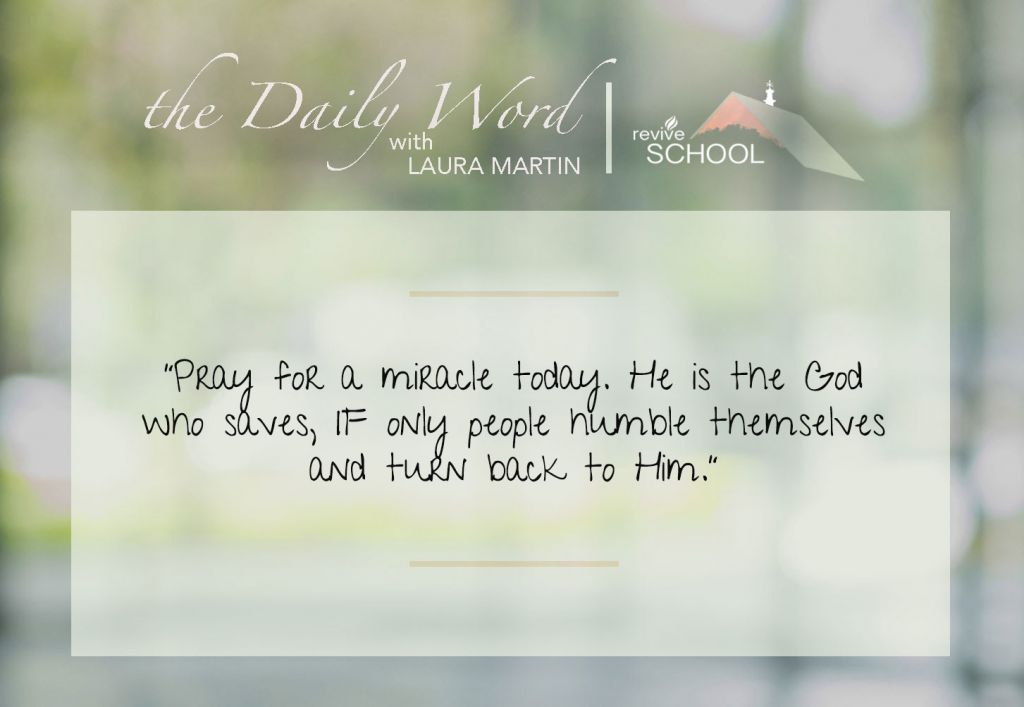
The Lord forgives, offering grace and mercy every single day. God loves you with unconditional love, which means His love is not determined by what you do or who you are. God simply and powerfully loves you. If you sin, wander away, or mess up, He never leaves you. God will wait for you to repent and turn away from your evil ways. Therefore, humble yourself and turn back to Him. Today, pray for that person who needs to turn back to the Lord. He is the God of hope, the God of healing, and the God of miracles. Pray for a miracle today. He is the God who saves, if only people humble themselves and turn back to Him.
“The Lord of Hosts, the God of Israel, says: ‘I am about to punish Amon, god of Thebes, along with Pharaoh, Egypt, her gods, and her kings—Pharaoh and those trusting in him. I will hand them over to those who want to take their lives—to Nebuchadnezzar king of Babylon and his officers. But after this, it will be inhabited again as in ancient times.’ This is the Lord’s declaration.”
— Jeremiah 46:25–26
FURTHER SCRIPTURE
- 2 Chronicles 7:14–15 — “And My people who are called by My name humble themselves, pray and seek My face, and turn from their evil ways, then I will hear from heaven, forgive their sin, and heal their land. My eyes will now be open and My ears attentive to prayer from this place.”
- Jeremiah 46:28 — “And you, My servant Jacob, do not be afraid—this is the Lord’s declaration—for I will be with you. I will bring destruction on all the nations where I have banished you, but I will not bring destruction on you. I will discipline you with justice, and I will by no means leave you unpunished.”
- Luke 17:3-4 — “Be on your guard. If your brother sins, rebuke him, and if he repents, forgive him. And if he sins against you seven times in a day, and comes back to you seven times, saying, ‘I repent,’ you must forgive him.”
Lesson and Daily Word
Each day has two parts: the Lesson and the Daily Word. Use these buttons to go from one to the other.
Teaching Notes and Questions
Next to the video, these tabs show the Teaching Notes and the Questions. Your answer to a question saves when you leave the answer box.
The Bible passage
This link opens the passage on Bible Gateway, and that gives the passage its tick. If you read it in your own Bible, tick it by hand in Progress.
Your progress on this lesson
A part ticks itself when you play the video or audio to the end, read the notes or the Daily Word to the end, or answer every question. You can also tick a part by hand here.
Downloads
Here you can save the video, the audio and the lesson as PDF files. Downloads do not count toward your progress.
Need help?
Use this button to send us a question or tell us about a problem. You can also take this tour again from there.