

The Fourth Servant's Song
Discover Jesus as: Immanuel Isaiah 53-55 Read on Bible Gateway (HCSB)
Lesson
Audio Only
Teaching Notes
INTRO
Isaiah has a total of 66 chapters, the same number of books the Bible has. Isaiah 53 can be seen as the heart of the entire book of Isaiah’s prophecies and possibly the entire Bible. We’ll first look at Isaiah 52:13-15 because these verses are connected to Isaiah 53. It’s tough to study the book of Isaiah and its picture of doom and gloom, but the book is really about the foreshadowing of hope, deliverance, and salvation through the birth of the Messiah. While the people would one day be freed from Babylonian captivity, the truth is they would also be freed from the bondage of their sin through Jesus Christ. The picture of Isaiah 53 is of God taking on human form to come and be with His people—our Immanuel.
Many Jews today look at Isaiah 53 and interpret it to point to the nation of Israel rather than the Messiah. While that interpretation is correct to a point—the prophecy did refer to the end of Babylonian captivity for the nation of Israel—it also and more importantly refers to the coming of Christ as a baby in human form who will redeem the world. Many Jews today will not even read Isaiah 53. MacArthur states, “The details are so minute that no human could have predicted them by accident and no imposter could have fulfilled them by cunning.”1 Isaiah 53 is also the final of the four servant songs, and it is the most memorable of the four.
TEACHING
Isaiah 52:13-15: Studying this passage intimidated me because the text is the turning point for the Jewish people. If the Jews would embrace this text, that the prophet Isaiah wrote about the coming Messiah, they would see who Jesus is and that He is coming back. Verse 13 explains, “Ultimately, when the Servant rules over His kingdom, He will receive international recognition for the effectiveness of His reign”2 (Colossians 2:15). Verses 14-15 describe the Servant would be so inhumanely treated that “He no longer looks like a human being. His appearance is so awful that people look at Him in astonishment.”3 “Sprinkle many nations” refers to the Servant/Priest’s work at cleansing Israel and the people of Israel.4 Even the kings of the world will recognize the Messiah.
Isaiah 53:1-3: Isaiah 53 gives a graphic picture of what the Suffering Servant/Messiah will endure. He will be despised and rejected by His own people (vv. 1-3). “We” and “His own” both refer to the Jewish people. (Matthew 27:1-2; John 1:10-11; 12:37-38). In verse 2 “He” (Jesus) grew up before “Him” (God) “who ordered every minute circumstance of His life.”5 He would grow up “like a root out of dry ground,” which seems to have a lot to do with the Jewish people—He brought them life that they refused. His rejection by the Jewish people seemed to be complete—they didn’t value Him (v. 3).
Isaiah 53:4-6: In verses 4-5, the Suffering Servant suffered not for His own sins but for ours (Luke 13:34). The fulfillment of these verses is found in the New Testament: Matthew 8:17; Romans 4:25; 1 Peter 2:24. Jesus suffered horrifically on our behalf. While we all turned away, the Suffering Servant was punished on the cross for us (v. 6).
Isaiah 53:7-8: Explaining verse 7, Tom Constable says, “In spite of God’s punishment for sin, the Servant would bear it without defending Himself.”6 David Clines states, “The servant . . . does nothing and says nothing but lets everything happen to him”7 (Matthew 26:62-64; 27:12-14). His life was “cut off”—killed for people’s rebellion against God (v. 8). “The Servant lost His life to be the substitute object of wrath in the place of the Jews”8 (Daniel 9:26).
Isaiah 53:9-10: The Suffering Servant would have been buried with the wicked because He was crucified with two thieves, but He instead was buried in a wealthy man’s tomb (v. 9). Matthew 27:57-60 states the wealthy man was Joseph of Arimathea, a follower of Christ. “Yet the Lord was pleased to crush Him severely” (v. 10). God wanted to set His people free from bondage, and He willingly gave His Son to make that happen. Jesus came as the sacrificial lamb, the one who would be sacrificed on the
7 David J. A. Clines, “I, He, We and They: A Literary Approach to Isaiah 53,” Journal for the Study of the Old Testament, Supplementary Vol. 1 (Sheffield, Eng.: JSOT Press, 1976), pp. 64-65; quoted in Constable, p. 367.
cross for our transgressions. Note that Jesus didn’t want to go through this suffering, but He was obedient to the will of God, even to the point of His own death (Matthew 26:39).
Isaiah 53:11-12: God will be satisfied with the death of His Son because it will justify (make right before Him) His people (v. 11). The sin issue is taken care of through Christ’s death. The Son would be crucified and counted among the rebels (the two thieves) (v. 12).
CLOSING
What do you do with Isaiah’s prophecy? Do you take seriously the prophecy of the Suffering Servant who would be sent to take upon Himself your sin? Or do you choose to ignore chapter 53 altogether? I challenge you to embrace Isaiah’s prophecy, which could only be fulfilled through the life, death, and resurrection of Jesus Christ (John 17:3). Immanuel is God with us. Jesus was sent by God to be with us and to die for us.
John MacArthur, The MacArthur Bible Commentary (Nashville: Thomas Nelson Publishers, 2005), p. 824.
MacArthur, p. 824.
MacArthur, p. 824.
MacArthur, p. 824.
MacArthur, p. 824.
Thomas Constable, Dr. Constable’s Bible Expository Study Notes, p. 373; available online at https://planobiblechapel.org/tcon/notes/pdf/isaiah.pdf.
MacArthur, p. 826.
Questions
-
How and when did the anticipation of Isaiah 53:1 come to fulfillment in Christ? (John 1:9-11; 12:37-38) How did Paul apply this same prophecy to the world? (Romans 10:16)
-
Isaiah used past-tense verbs to describe the servant. How did they predict future happenings from Isaiah’s time (Isaiah 53:4-5, 11-12)? Find the fulfillment of these prophecies about Jesus in the New Testament. (Matthew 8:16-17; 1 Peter 2:24)
-
Do a study on Isaiah 53. Go through the chapter and find the direct prophecies that Jesus fulfilled. Is there a prophecy you haven’t noticed before?
-
What are some benefits obtained by the suffering servant in Isaiah 54 that Isaiah describes and invites his readers to participate in?
-
How was salvation, grace, and mercy available to those in the Old Testament (Deuteronomy 4:29; 2 Chronicles 15:4; Isaiah 55:6-7)? What will accompany true, seeking faith? (2 Corinthians 7:10; 2 Peter 3:9)
-
What did the Holy Spirit highlight to you in Isaiah 53—55 through the reading or the teaching?
Daily Word
Laura Martin Isaiah 53:5–6
“But He was pierced because of our transgressions, crushed because of our iniquities; punishment for our peace was on Him, and we are healed by His wounds. We all went astray like sheep; we all have turned to our own way; and the LORD has punished Him for the iniquity of us all.”
Generations before Mary gave birth to Jesus, Isaiah prophesied God would send Immanuel—God with us. This Immanuel would be the suffering servant. Immanuel, Jesus, bears your sickness and carries your pain. He was struck down and afflicted, pierced for your transgressions, and crushed for your iniquities. His wounds healed you. Ultimately, Jesus came to the earth to live and die for you. He suffered for you.
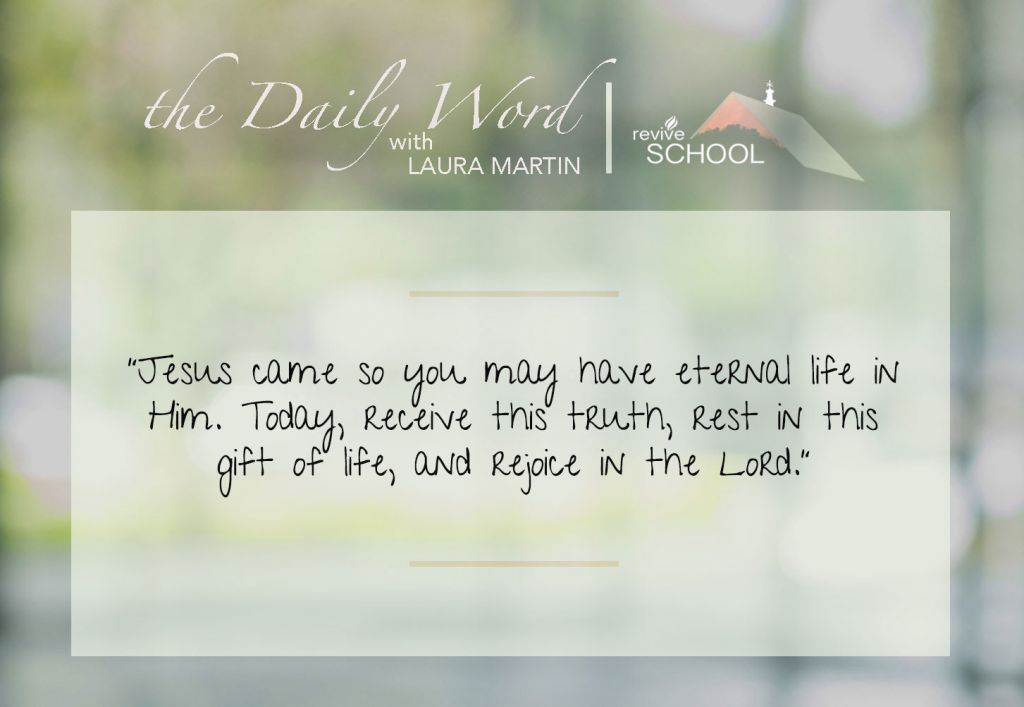
Jesus called Himself a shepherd and you the sheep of His pasture. Yes, as God’s sheep, you wandered away. Therefore, God sent Jesus to suffer and die as a sacrifice for you so you wouldn’t have to bear the pain and death of your sin. Jesus came so you may have eternal life in Him. Today, receive this truth, rest in this gift of life, and rejoice in the Lord. Lift your head up and spend time in a posture of thankfulness. Give thanks to the Lord for His mercy and grace, for finding you and placing you in the green pastures of His love. He is the Good Shep- herd, and His love for you is unconditional. Receive His unconditional love today.
“But He was pierced because of our transgressions, crushed because of our iniquities; punishment for our peace was on Him, and we are healed by His wounds. We all went astray like sheep; we all have turned to our own way; and the Lord has punished Him for the iniquity of us all.”
— Isaiah 53:5–6
FURTHER SCRIPTURE
- Isaiah 53:11–12 — “He will see it out of His anguish, and He will be satisfied with His knowledge. My righteous Servant will justify many, and He will carry their iniquities. Therefore, I will give Him the many as a portion, and He will receive the mighty as spoil, because He submitted Himself to death, and was counted among the rebels; yet He bore the sin of many and interceded for the rebels.”
- John 17:3–4 — “This is eternal life: that they may know You, the only true God, and the One You have sent—Jesus Christ. I have glorified You on the earth by completing the work You gave Me to do.”
- 1 Peter 2:24–25 — “He Himself bore our sins in His body on the tree, so that, having died to sins, we might live for righteousness; you have been healed by His wounds. For you were like sheep going astray, but you have now returned to the Shepherd and Guardian of your souls.”
Lesson and Daily Word
Each day has two parts: the Lesson and the Daily Word. Use these buttons to go from one to the other.
Teaching Notes and Questions
Next to the video, these tabs show the Teaching Notes and the Questions. Your answer to a question saves when you leave the answer box.
The Bible passage
This link opens the passage on Bible Gateway, and that gives the passage its tick. If you read it in your own Bible, tick it by hand in Progress.
Your progress on this lesson
A part ticks itself when you play the video or audio to the end, read the notes or the Daily Word to the end, or answer every question. You can also tick a part by hand here.
Downloads
Here you can save the video, the audio and the lesson as PDF files. Downloads do not count toward your progress.
Need help?
Use this button to send us a question or tell us about a problem. You can also take this tour again from there.