

The New Covenant Is Superior
Discover Jesus as: High Priest Hebrews 8 Read on Bible Gateway (HCSB)
Lesson
Audio Only
Teaching Notes
INTRO
We talked some yesterday about the High Priest, and today we’ll dig into that even more. We don’t know who wrote the book of Hebrews, but we know it was written by a Hebrew to Hebrews to convince them to stop living under the old covenant of the Law.
Part of the question of Hebrews is, whose God is bigger—my god or Jesus? Chapter 8 makes a strong appeal to be in relationship with Christ and what the magnitude of that means. The recipients of the letter didn’t seem to fully grasp the magnitude of Jesus the Messiah, and the freedom and power and intimacy that Jesus brings and the new covenant He has made. It’s almost as if the recipients had a lot of white noise mixed in along with Jesus that they couldn’t really see how awesome Jesus is. Jesus is the Sacrificial Lamb, the Lion of Judah, the High Priest, the Bread of Life and more. He is so much.
An analogy for today might be someone walking up to an average believer in Christ and asking them, “Whose god is bigger—my god or Jesus?” Many of us, perhaps most of us, have gods or idols we place ahead of Jesus at times . . . money, possessions, family, etc. In other words, “Who or what am I submitting to?” The Law? A glass of wine? Money? We should be asking first, “What does God think?” Are we relying on a worldly filter (those “white noises”) of what’s around us or on obedience to God.
TEACHING
Hebrews 7:26-28: These verses can be defined as a job description for a high priest. Verse 26 shows us the greatness of Jesus as our High Priest, compared to the high priest under the Law; for He is, “holy, innocent, undefiled, separated from sinners, and exalted above the heavens.” The description, which continues through verse 28, leads into chapter 8.
Hebrews 8:1-2: The author emphasizes there was already a High Priest who met the criteria from chapter 7 and who now sits at the right hand of God (v. 1). The Old Testament high priest had the responsibility to make the sacrifice of atonement, and it had to be done year after year. The responsibility was never fulfilled. However, that job has now been finished through the sacrifice of Jesus—the High Priest. He has already done it and is at rest. The true holy priest is the One in heaven. What God builds is perfect. Humankind can replicate things and make it nice, pretty, or orderly, but we will never match up to how good God creates things (v. 2).
Hebrews 8:3-5: Verse 3 says the Old Testament high priests made sacrifices, but they had to obtain something that could be sacrificed. And the priests in the Old Testament came from the tribe of Levi. However, Jesus came from the tribe of Judah, and could never have served as high priest on earth (v. 4). Moses followed God’s instructions and built the tent (tabernacle) for God’s dwelling place, and he did a good job. But anything Moses did was only a shadow of what God’s dwelling place is like in heaven (v. 5). And that’s who we are communicating with—the One true God. What do we know about heaven? At BlueLetterBible.org, author Don Stewart has outlined how heaven will be different from earth. He says that in heaven there will be no death (Revelation 20:14), tears (Revelation 21:4), impurity (Revelation 21:27), or darkness (Revelation 22:5). Further, we will be face-to-face with the Lord (Revelation 21:3), and we will worship and sing in His presence.1
Hebrews 8:6-7: Jesus is not just a replacement for the priest—He is more than that. He is the replacement of the offering. He is the replacement of the old covenant (Matthew 5:17). He is the replacement of the priest. He is the replacement of the temple. Jesus came to fulfill the Law. The Law was all of these things. He fulfills them all—the sacrifices, the festivals, the rituals. All of these things that had purpose were fulfilled through Jesus. Through Jesus, God came to meet us instead of waiting for us to come to Him. Jesus therefore has a superior ministry, and He mediates a superior covenant with better promises (v. 6). All of this is superior because God does the work, and we get to partake of it. Because the Hebrews had been unable to meet the expectations of the first covenant, a new covenant was made. If they could have kept the first covenant, they wouldn’t have needed a new one (v. 7).
Hebrews 8:8-11: The new covenant is mentioned in verses 8-12a, which is quoted from Jeremiah 31:31-34. The new covenant is much better than the old covenant. God said He would put His laws into their minds and write them on their hearts (v. 10a). Most people have an intrinsic knowledge of what is right and what is not right. We know when we’re about to do something wrong. As believers, we have a natural bend toward God. When we read the Word of God, what is right just resonates. That’s because it has been written on our hearts. He knows us, and we are His people. We shall know God (vv. 10b-11). How did the people get the Law before? God gave the Law to Moses on stone tablets, and they were to listen to the words written on the tablets. God often told Moses to tell the people. But now God puts His laws directly into our minds and on our hearts. When we read the New Testament, it should be confirmation of what is on our heart. When we read Scripture, it should make this connection with our hearts—it should resonate.
Hebrews 8:12-13: In verse 12, the author of Hebrews is reminding his audience of the promises of God given in Jeremiah 31. God will no longer remember their sins. Imagine standing in front of God in heaven knowing He remembers your sin no more. It’s time to stop acting like the Hebrews—stop trying to be good enough, to do enough, and instead accept the salvation, mercy, grace, and forgiveness of God through Jesus Christ. With the new covenant, the old covenant has gone away (v. 13). It’s been replaced.
All the requirements of the Law are no more. Just release the things that cause a block between you and the Lord, and let them fade away. Sometimes we create gods that keep us from God that we don’t even realize we’ve constructed. We put fear of what we can’t do or even envision between us and God. We still want to make sacrifices to God—to pay off the guilt we are carrying. Live in the new covenant. The veil has been torn. We can have a relationship with God, the Father, through the Messiah.
In Acts 3:1 Peter and John went up to the temple to pray at 3 p.m. Just before this would have been the time of sacrifices at 2:30 p.m. At the end of the sacrifices, the words, “It is finished,” were spoken. Remember that after Jesus received the wine on the cross, He proclaimed, “It is finished.” The sacrifice was complete. Peter and John went to the temple not for the sacrifices but for the relationship in prayer with the Lord. They understood the role of the new covenant.
There are things today that believers have to be careful about or it will create legalism:
- Church: Do I attend to check off a box or attend to worship and have a relationship with the Lord?
- Prayer: Do I use the prayers of others or enjoy the relational/personal side of prayer?
- Bible: Do I read it on a legalistic side or on a spiritual, relational side that focuses on Jesus, the Messiah?
CLOSING
Allow the Word of God to change your heart, and your mind. Allow Jesus to be in relationship with you rather than following a set of regulations, which will become your God. Without relationship, you will consume your time trying to get the regulations right and will completely miss out on intimacy with Him.
Don Stewart, What Will It Be Like in Heaven?; available at https://www.blueletterbible.org/faq/don_stewart/don_stewart_148.cfm..
Questions
-
What argument can you use when speaking to people of works-based faith when they claim to know Jesus? (Hebrews 8:7, 11-12)
-
How do the Gentiles benefit from the new covenant? If the Jews would have accepted and embraced Jesus as the Messiah, do you believe God would have offered salvation to the Gentiles? (Genesis 18:18; 22:18; 26:4; Romans 1:16; 2:9-11; 3:29-30; 11:11-17; Galatians 3:8)
-
Consider how God uses some people’s disobedience to bring opportunity to others. Why do you think God gave us free will? How would the world be different without it?
-
What did the Holy Spirit highlight to you in Hebrews 8 through the reading or the teaching?
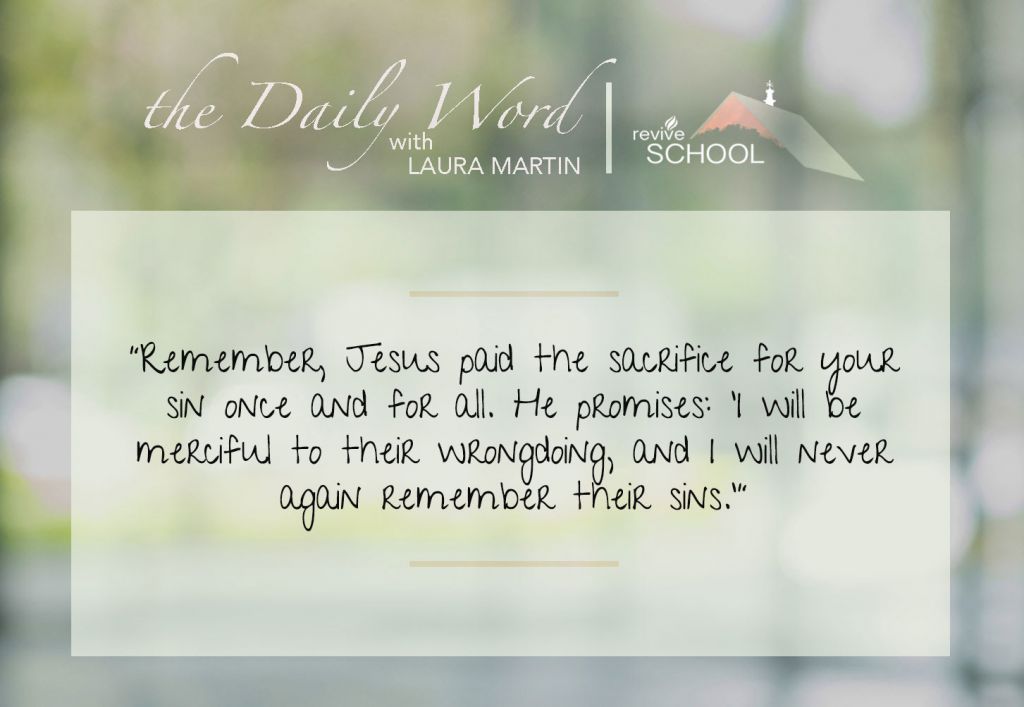
Daily Word
Laura Martin Hebrews 8:1–2
“Now the main point of what is being said is this: We have this kind of high priest, who sat down at the right hand of the throne of the Majesty in the heavens, a minister of the sanctuary and the true tabernacle that was set up by the Lord and not man.”
FURTHER SCRIPTURE
- Jeremiah 31:31 — “‘Look, the days are coming’—this is the Lord’s declaration—‘when I will make a new covenant with the house of Israel and with the house of Judah.’”
- Hebrews 8:6 — “But Jesus has now obtained a superior ministry, and to that degree He is the mediator of a better covenant, which has been legally enacted on better promises.”
- Hebrews 8:12 — “For I will be merciful to their wrongdoing, and I will never again remember their sins.”
Lesson and Daily Word
Each day has two parts: the Lesson and the Daily Word. Use these buttons to go from one to the other.
Teaching Notes and Questions
Next to the video, these tabs show the Teaching Notes and the Questions. Your answer to a question saves when you leave the answer box.
The Bible passage
This link opens the passage on Bible Gateway, and that gives the passage its tick. If you read it in your own Bible, tick it by hand in Progress.
Your progress on this lesson
A part ticks itself when you play the video or audio to the end, read the notes or the Daily Word to the end, or answer every question. You can also tick a part by hand here.
Downloads
Here you can save the video, the audio and the lesson as PDF files. Downloads do not count toward your progress.
Need help?
Use this button to send us a question or tell us about a problem. You can also take this tour again from there.