
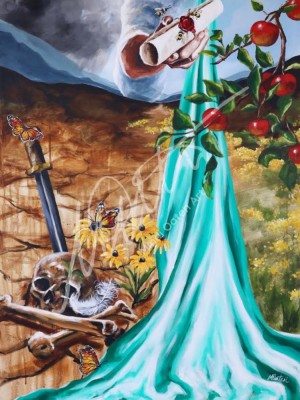
The Parable Of The Adulterous Wife
Discover Jesus as: New David Ezekiel 16-17 Read on Bible Gateway (HCSB)
Lesson
Audio Only
Teaching Notes
INTRO
Yesterday we only covered chapter 14. Chapter 15 has only eight verses, and it is the parable of the useless vine. Throughout the book of Ezekiel, God gives one vision after another to him, which he was to dramatize and/or proclaim to the people in captivity in Babylon. In chapter 4 Ezekiel was required to lay on his left side for 390 days to represent the period of disobedience from the time Rehoboam became king until the fall of Zedekiah’s reign 394 years later. Wiersbe points out that since Rehoboam was faithful to God for three years, the total period of disobedience was around 390 years.1
At only eight verses, chapter 15, the parable of the useless vine, is the Lord’s proclamation that He could not move forward with Israel because they had become useless to Him. Chapter 16 is the longest chapter in the book (63 verses long). To be honest I wanted to teach on chapter 17, which has only 24 verses, but God wouldn’t let me. Chapter 16 is titled Parable of God’s Adulterous Wife (HCSB).
The Major Prophets shared a mission. Isaiah prophesied about the coming destruction but did not see it take place. Jeremiah prophesied about its coming and even witnessed some of the deportations. We hear his experiences and feelings in the book of Lamentations. Ezekiel was taken captive to Babylonia during the first exile, so he experienced it from inside Babylon and through the visions God gave him.
TEACHING
Ezekiel 16:1-7: Wiersbe points out that in verses 1-14, “Israel experienced a great love.”2 Normally when we study the Bible we see the bad news first and then the good news. In Ezekiel, the opposite is true. We’ll see the good news and then the bad news. In the first seven verses, Israel experienced God’s love. God’s word was a parable, and Jerusalem was the main character, portraying the woman who became adulterous. Ezekiel was to remind the people of their past. They were brought up in the land of Canaan by pagan parents, those whom the Jews called “the dogs”(v. 1-3). No one had even shown compassion for them at their birth (vv. 4-5). Yet God saw their need and loved them. Constable explains:
“Canaan was the place of Jerusalem’s origin and birth, a land notorious for its depravity. Thus it was understandable that the Israelites would tend toward idolatry. Jerusalem’s founders, in pre-patriarchal days, were Amorites and Hittites, not Hebrews. Amorites and Hittites were two of the Canaanite peoples, and they often represent all the Canaanites in the Old Testament.”3
In verse 6 God says, “I said to you as you lay in your blood: Live!” Some scholars suggest that verse 6 represents the beginning of the covenant between God and Israel. MacArthur states that “Live!” refers to “probably the patriarchal period of Abraham, Isaac, and Jacob, when God formed His people.”4 With God the woman (Israel) thrived (v. 7). The word thrived refers to the people and “described the time of Israel’s growth during the 430-year stay in Egypt; wild but flourishing and beautiful, Israel was ‘naked,’ without the benefits of culture and civilization.”5
Ezekiel 16:8-14: In these verses, the image of the child above changed into a woman of marriageable age. Verse 8 uses the language of Ruth 3:9 by covering the cloak of the redeemer over her. God pledged Himself to her (Israel) in a covenantal agreement between God and His people (v. 8). He washed her and anointed her, dressed her in beautiful clothes and jewelry, and even placed a tiara on her head (vv. 9-12). MacArthur points out, “These gifts were marriage gifts customarily presented to a queen.”6 She was adorned with the best of everything, and she was fed the finest food available. This is referring to the conquest of the land under Joshua and even to the reign of David (v. 13). In verse 14, because God poured out His blessing on her, her fame spread throughout the nations.
Ezekiel 16:15-22: However she (Israel) had become confident in herself and acted like a prostitute, lavishing her sexual favors on everyone who came by (v. 15). Wiersbe explains, “Unlike other prostitutes, [Israel] sought out her lovers and paid them to sin with her! She took the very treasures and blessings that God generously gave to her and devoted them to the making and worshiping of idols—her jewels and garments, her food, and even her children.”7 They had forgotten all that God had done and they turned to idols instead with their detestable and disobedient behavior (vv. 16-22).
Unfortunately, in America, this describes a lot of our believers—who accept all the blessings of God but then turn away from God under their own confidence, becoming disobedient and rebellious against the Lord. And sometimes it seems Christianity has become about building up our own fame rather than leading people to God. When we function in our own idolatry, it always impacts our kids!
Ezekiel 16:23-34: God is a God of judgment, and Israel had pushed Him into judging them (vv. 23-25). In verses 26-29, Ezekiel outlined how Israel had tried to find help everywhere except in God. Verse after verse describes how Israel had prostituted herself to idols and other nations. Israel even paid for those to help her in the same way as a prostitute would pay someone to accept her services (vv. 30-34).
Ezekiel 16:35-42: In these verses, the judgment of Israel’s disobedience was announced. God said He would gather against Israel all the “lovers,” the idols they had worshiped and expose their nakedness (v. 37). Imagine God putting all of your idols in front of you! Then, He would judge them and bring out their bloodshed (vv. 38-41). Verse 40 refers to the required punishment of stoning for an adulterer. God’s wrath would then be satisfied (v. 42).
Ezekiel 16:43-52: God gave His defense for why His actions were necessary (v. 43). God used the proverb, “Like mother, like daughter,” and then compared Israel to Samaria and Sodom (vv. 44–52).
Ezekiel 16:53-60: But God promised to restore Sodom and Samaria (vv. 53-59). And He promised to restore Israel as well: “But I will remember the covenant I made with you in the days of your youth, and I will establish an everlasting covenant with you” (v. 60).
CLOSING
This everlasting covenant is the second coming of Jesus Christ. When you put your trust in Christ you’ll never have to worry about God’s judgment again. Verse 63 says, “So that when I make atonement for all you have done, you will remember and be ashamed, and never open your mouth again because of your disgrace. This is the declaration of the Lord God.”
Ezekiel’s message can be summarized in one verse: “For God loved the world in this way: He gave His One and Only Son, so that everyone who believes in Him will not perish but have eternal life” (John 3:16).
Warren W. Wiersbe, The Exposition Bible Commentary (Colorado Springs: David C. Cook, 2002), p. 173.
Wiersbe, p. 191.
Thomas Constable, Dr. Constable’s Exposition Bible Study Notes: Ezekiel, pp. 122-123; available at https://planobiblechapel.org/tcon/notes/pdf/ezekiel.pdf.
John MacArthur, The MacArthur Bible Commentary (Nashville: Thomas Nelson Publishers, 2005), p. 907.
MacArthur, p. 907.
MacArthur, p. 907.
Wiersbe, p. 191.
Questions
-
In Ezekiel 16, the Lord compared Jerusalem to an unfaithful wife, a prostitute. As you read through the chapter, do you notice any similarities to where you live? If so, in what ways?
-
How did the Lord show how sovereign, forgiving, and loving He is in Ezekiel 16:60-63?
-
How might you explain Ezekiel 17:22-24 to a new believer? Could these verses be connected to John 15:1-5? Why or why not? What other section of Scripture comes to mind when you read these verses?
-
What did the Holy Spirit highlight to you in Ezekiel 16—17 through the reading or the teaching?
Daily Word
Laura Martin Ezekiel 16:62–63
“‘I will establish My covenant with you, and you will know that I am Yahweh, so that when I make atonement for all you have done, you will remember and be ashamed, and never open your mouth again because of your disgrace.’ This is the declaration of the Lord GOD.”
The word of the Lord spoken through Ezekiel symbolically described the nation of Israel as an adulterous wife and eventually as a prostitute. In the beginning Israel received and sought the Lord for help and life. However, ultimately, Israel became self-sufficient, indulged in idols, and turned away from the Lord. Because they turned away, Israel deserved and received wrath and judgment. Even still God offered hope through the everlasting covenant and granted atonement for all Israel had done. These were His chosen people.
The Lord chose you as His child. The Lord longs for you to embrace the abundant life found in Him. Although you are self-sufficient, although you seek other gods, and although you walk in the ways of this world, Jesus continues to love you. God sent His Son to die for you. Jesus died as atonement for your sin so you may receive salvation and have eternal life. God is faithful to keep His everlasting covenant. You just have to receive it. Say, “Yes, I believe Jesus saves me from my sin.” Say yes and you will have eternal life. Say yes to walking with Christ. He said yes to you long ago and loves you so much!
“‘I will establish My covenant with you, and you will know that I am Yahweh, so that when I make atonement for all you have done, you will remember and be ashamed, and never open your mouth again because of your disgrace.’ This is the declaration of the Lord God.”
— Ezekiel 16:62–63
FURTHER SCRIPTURE
- Ezekiel 16:6–7 — “I passed by you and saw you lying in your blood, and I said to you as you lay in your blood: Live! Yes, I said to you as you lay in your blood: Live! I made you thrive like plants of the field. You grew up and matured and became very beautiful. Your breasts were formed and your hair grew, but you were stark naked.”
- John 3:16 — “For God loved the world in this way: He gave His One and Only Son, so that everyone who believes in Him will not perish but have eternal life.”
- Romans 5:8–9 — “But God proves His own love for us in that while we were still sinners, Christ died for us! Much more then, since we have now been declared righteous by His blood, we will be saved through Him from wrath.”
Lesson and Daily Word
Each day has two parts: the Lesson and the Daily Word. Use these buttons to go from one to the other.
Teaching Notes and Questions
Next to the video, these tabs show the Teaching Notes and the Questions. Your answer to a question saves when you leave the answer box.
The Bible passage
This link opens the passage on Bible Gateway, and that gives the passage its tick. If you read it in your own Bible, tick it by hand in Progress.
Your progress on this lesson
A part ticks itself when you play the video or audio to the end, read the notes or the Daily Word to the end, or answer every question. You can also tick a part by hand here.
Downloads
Here you can save the video, the audio and the lesson as PDF files. Downloads do not count toward your progress.
Need help?
Use this button to send us a question or tell us about a problem. You can also take this tour again from there.