

Devastating Judgements
Discover Jesus as: New David Ezekiel 14-15 Read on Bible Gateway (HCSB)
Lesson
Audio Only
Teaching Notes
INTRO
An overview of the book of Ezekiel: the nation of Israel had become divided into two kingdoms. Most of the previous kings were overall not very good kings, so the language in Ezekiel is all about the captivity of the people. Three times deportations are addressed—Daniel’s time, Jeremiah’s time, and Ezekiel’s time. Ezekiel was literally in captivity when he recorded the book. He did not know yet that Jerusalem had been destroyed. The language is confusing because they were prophesying about what was to come. The Major Prophet books of the Bible were written to get people ready for the return of the Messiah.
The people questioned when any of the prophecies would ever come true. Wiersbe breaks chapters 12–14 into four major categories: “false confidence, false prophecy, false piety, and false hope.”1 Wiersbe speaks of “a false confidence in chapter 12 and a false prophecy in chapter 13. Finally, he talks about false piety in chapter 14:1-11 and false hope in 14:12-23.”2 Piety refers to a religion that is fake or false. A false religion had no relationship with Christ. In verses 12-23, there is the language of false hope. The problem with the rebellious house was that they were trusting in things that were not of the Lord, but in things that were false.
TEACHING
Ezekiel 14:1-11: In Ezekiel 3:24, Ezekiel was at his house. He did most of his ministry from his house. The elders came to Ezekiel and sat in front of him. God instructed Ezekiel to shut himself inside his house. The only time he would leave was when God gave him instructions to do so. MacArthur said, “These leaders are pretending to seek God’s counsel (v. 3; Psalm 66:18), as God reveals to the prophet, who saw through their façade and indicted them for determining to pursue their evil way and defy God’s will.”3 These elders wanted to look the part, but they did not want to actually hear the Word of the Lord.
God showed Ezekiel that these elders were false prophets. They had set up idols and stumbling blocks in their hearts and in front of their faces. In verse 4, Ezekiel was to release the word and speak the truth. These elders were all estranged from God because of their idols. God addressed these people based on where their hearts were. This experience was similar to what Jesus had to deal with. Wiersbe said, “Jesus said that the Pharisees in His day were guilty of the same sin (Matthew 15:8-9), and so are some professed Christians today.”4 All the Major Prophets served as the foreshadowing of the coming of Christ. Matthew 15:9 is an example of Christ’s experience with the people.
A spirit of religion resulted in a harsher punishment. The issue now being raised related to the spirit of religion in the people. What Ezekiel had experienced in his house with the elders was the false piety. If this awareness of a false spirit of religion was understood, then there would have been an opportunity to experience revival.
The word from Ezekiel was to repent and turn away from the idols. There was still a chance for a time of repentance. The idols in these verses could represent a number of things that are not for the glory of God. Various things became idols, slowly, over time. Today the attention given to our idols takes away from the time that should be given to the Lord. Wiersbe also said, “It’s not likely that believers today would have a love in their hearts for actual images, but anything that replaces God in our affections and our obedience is certainly an idol.”5
Ezekiel’s message in verse 6 was clear that there was a need to repent and turn away from all idols. Idols would take away their time and their love for the Lord.
If more attention was given to other things than attention given to the Lord, then there would be a need to repent. In verse 7, the message was, “The Jewish exiles needed to change their minds about idols and the sin of worshiping idols, and then turn to the Lord who alone is worthy of worship. God would judge each sinner personally and deal with each one personally (v. 7), and some of them He would use as examples to warn the other exiles (v. 8).”6
MacArthur points out, “God will deceive a false prophet only in a qualified sense. When one willfully rejects His Word, He places a resulting cloud of darkness, or permits it to continue, hiding the truth so that the person is deceived by his own obstinate self-will.”7The Lord deceived these false prophets. MacArthur explains, “This fits with the same principle as when God gives up Israel to evil statues (20:25, 26), counsel that they insist on as they spurn His Word (20:24, 26).”8 MacArthur continues, “When people refuse the truth, He lets them seek after their own inclinations and gives them over to falsehood (20:39). This is the wrath of abandonment noted in Romans 1:18-32.”9This also showed that God allowed choices to be made.
Wiersbe noted, “Everyone in Israel knew the Ten Commandments and understood that it was a sin to make and worship idols (Exodus 20:1-6).”10 They would bear their punishment and the consequences of their choices.
In verse 11 the people would have to go through the punishment and the wrath of abandonment. After that the people of Israel would again be the Lord’s people. In the first 11 verses the elders were seated before Ezekiel, and they were acting religious. In verse 12 the language of hope was given.
In verse 12 the Word of the Lord came to Ezekiel again. Wiersbe explains there were four acts of judgment:
“The first judgment is famine (vv. 12-14): God would break the staff of bread and cut off the lives of humans and animals; the second judgment was wild beasts in the land (Ezekiel 14:15-16); the third judgment was the sword (Ezekiel 14:17-18) which means war; and the final judgment was pestilence (Ezekiel 14:19-20), which usually accompanies famine and war (Revelation 6:3-8).”11
Even Noah, Daniel, and Job would not have been able to deliver Jerusalem and His people from being destroyed. All three of these individuals had strong faith. Even with God’s coming punishment, there would be a remnant that would be left, and they would grieve.
CLOSING
God was determined to bring judgment to bring people back to Him. God does what He does for His cause. God’s judgment was and will be vindicated. Will we see that God is trying to get our attention?
Warren W. Wiersbe, The Bible Exposition Commentary: New Testament (Colorado Springs, David C. Cook, 1989), pp. 184–188.
Wiersbe, pp. 184–188.
John MacArthur, The MacArthur Bible Commentary (Nashville: Thomas Nelson Publishers, 2005), p. 906.
Wiersbe, p. 187.
Wiersbe, p. 187.
Wiersbe, p. 187.
MacArthur, p. 906.
MacArthur, p. 906.
MacArthur, p. 906.
Wiersbe, p. 187.
Wiersbe, p. 188-189.
Questions
-
Ezekiel 14 speaks on leaders and their idols. Take a few minutes and ask the Lord if you have any idols in your own life. If He brings something to mind, ask for forgiveness and lay it down.
-
In your opinion, what would be some examples of idols?
-
When you read Ezekiel 14:13-20, what does the Lord seem to be saying about Noah, Daniel, and Job? Their children and family?
-
In Ezekiel 15:6, God compared the people of Jerusalem to grapevines among the trees in the forest. Examine your walk with the Lord up to this point. Would you consider yourself a grapevine or a tree in the forest? Why?
-
What did the Holy Spirit highlight to you in Ezekiel 14—15 through the reading or the teaching?
Daily Word
Laura Martin Ezekiel 14:6
“Therefore, say to the house of Israel: This is what the Lord GOD says: Repent and turn away from your idols; turn your faces away from all your detestable things.”
Elders of Israel sat before the prophet Ezekiel acting religious. The Lord told the elders, “Repent and turn away from your idols; turn your faces away from all your detestable things.” If they chose not to, Yahweh would turn against them and cut them off from His people. God could see the idols they had set up, not just on the outside but also in their hearts. He recognized their divided hearts of worship. The elders knew they disobeyed God but still chose not to turn away from evil.
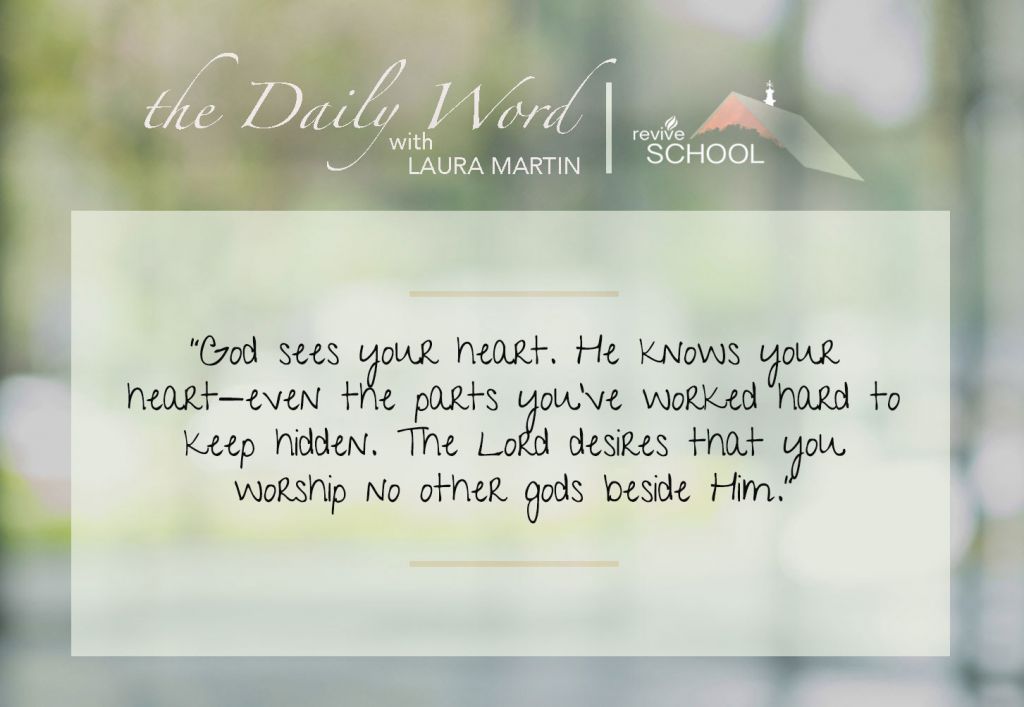
Like the elders of Israel, you may say the right things and be at all the right Christian events, making you look like a great Christ-follower. However, you haven’t fooled God. God sees your heart. He knows your heart—even the parts you’ve worked hard to keep hidden. The Lord desires that you worship no other gods beside Him. Today, ask the Lord, “Is there anything in my life You want me to repent and turn away from?” Don’t let a false god or an idol become the stumbling block for your relationship with Jesus. He has more for you than you can imagine. He has gifts and goodness beyond what you can see right now. But to see or enjoy His blessings, first you need to make time and make space to experience the one true God in your life.
“Therefore, say to the house of Israel: This is what the Lord God says: Repent and turn away from your idols; turn your faces away from all your detestable things.”
— Ezekiel 14:6
FURTHER SCRIPTURE
- Ezekiel 14:4–5 — “Therefore, speak to them and tell them: This is what the Lord God says: When anyone from the house of Israel sets up idols in his heart, puts a sinful stumbling block before his face, and then comes to the prophet, I, Yahweh, will answer him appropriately. I will answer him according to his many idols, so that I may take hold of the house of Israel by their hearts. They are all estranged from Me because of their idols.”
- 1 Corinthians 10:14 — “Therefore, my dear friends, flee from idolatry.”
Lesson and Daily Word
Each day has two parts: the Lesson and the Daily Word. Use these buttons to go from one to the other.
Teaching Notes and Questions
Next to the video, these tabs show the Teaching Notes and the Questions. Your answer to a question saves when you leave the answer box.
The Bible passage
This link opens the passage on Bible Gateway, and that gives the passage its tick. If you read it in your own Bible, tick it by hand in Progress.
Your progress on this lesson
A part ticks itself when you play the video or audio to the end, read the notes or the Daily Word to the end, or answer every question. You can also tick a part by hand here.
Downloads
Here you can save the video, the audio and the lesson as PDF files. Downloads do not count toward your progress.
Need help?
Use this button to send us a question or tell us about a problem. You can also take this tour again from there.