
Hasten With The Message
Discover Jesus as: The Despised One Esther 7-8 Read on Bible Gateway (HCSB)
Lesson
Audio Only
Teaching Notes
INTRO
For the book of Esther, our phrase is The Despised One. Although the book bears the name of Esther who saved the lives of all the Jews in Persia, her uncle Mordecai was also an important part of the story. And Mordecai was the despised one. Mordecai was the one who found out about the decree that would annihilate all the Jews. Mordecai was the one who sat outside the King’s Gate in ashes and sackcloth while mourning, and he was the one who convinced Esther to do whatever she could to protect the Jewish people in Persia. The crisis the Jews were facing was the result of Haman, a royal official and a descendant of King Agag and the Amalekites, who became angry when Mordecai refused to bow before him in respect. Enraged, Haman didn’t just want to destroy Mordecai but to annihilate the entire Jewish population living in Persia.
In chapter 6, the king passes the night before Queen Esther’s second banquet for him and Haman by reading the book of daily events. There the king found the report that Mordecai had prevented the assassination attempt on his life (vv. 1–2). When the king asked what honor had been given to Mordecai, he was told nothing had been done (v. 3). Haman arrived at court ready to ask the king to have Mordecai hung on the gallows (vv. 4-5). Instead, the king asked Haman what he should do to honor someone. Since Haman thought the honor would be his, he told the king to give the man a royal garment and a horse that the king had ridden, clothe the horse, and then parade the man through the city, proclaiming he was being honored by the king (vv. 6–9). The king accepted Haman’s plan but told Haman to give that honor to Mordecai (v. 10). Haman did so. After being honored, Mordecai returned to his place at the King’s Gate (vv. 11–12). Haman, however, returned home and told his wife and friends what had happened (vv. 12-13a). They told Haman that his own downfall was certain (v. 13b). Even as they talked, the king’s eunuch arrived to take Haman to Queen Esther’s banquet.
TEACHING
Esther 7:1–6: When the king and Haman arrived at Queen Esther’s banquet, the king told Esther again that he would give her anything she wanted, even up to half his kingdom (vv. 1–2). The queen responded that if she had the king’s approval, she wanted only that her life and the lives of her people to be spared (v. 3). Esther was sensitive to understand when the right time was to release her word to the king. Esther explained that her people had been “sold out to destruction, death, and extermination.” She went on to tell the king that if her people were only going to be sold into slavery, she would not have even bothered him (v. 4). The king had no idea who or what she was talking about (v. 5). Esther pointed out that evil Haman was the one guilty of planning the destruction of her people. Haman stood terrified before the king and the queen (v. 6)
Esther 7:7–10: The king was so angered by what he had heard that he left the banquet and went into the garden. However, Haman remained with Esther because he realized the king was planning something terrible for him (v. 7). As the king returned, he saw Haman falling on the couch where Esther was reclining and wondered if Haman would actually violate the queen while the king was still in the palace. After the king finished speaking, Haman’s face was covered (v. 8). One of the eunuchs told the king that Haman had already built gallows at his house for the execution of Mordecai. The king commanded that the gallows be used for Haman instead (v. 9). Haman was hung on the gallows and the king’s anger subsided (v. 10).
Although Haman was dead, the king’s decree was still in effect. All of the provinces had already received a copy of the decree stating that they could kill the Jews on a specific day. God’s hand was on His chosen people, even as it appeared that Satan was trying to wipe out the Abrahamic Covenant found in Genesis 12:1–3. This was one of the times that anti-Semitism tried to wipe out a huge population of the Jews. Although we don’t often take biblical history and bring it forward to modern times, it’s almost impossible not to read the story of Esther and Mordecai and not think about the Holocaust (the mass slaughter of the Jews by Hitler during World War II). During the Holocaust,1six million Jews were murdered. Why would one man like Hitler want to annihilate the Jews? Why did Haman want to annihilate the Jews? At Auschwitz, one of the largest of the concentration camps, more than one million Jews were put to death. In Treblinka, more than 925,000 Jews were killed. At Belzec, 600,000 were killed. At Sobibor, around 50,000 were exterminated, in Poland, more than two million were killed, and, in the Soviet Union, another two million were killed.
The list could go on and on, and these were people killed in many of our lifetimes. Altogether, over six million Jews were killed during the Holocaust, and I believe Satan tried to use Hitler to wipe the Jews off the earth. Even today, Satan is still trying to find another Haman, another anti-Christ spirit, to annihilate God’s chosen people. The former Iranian dictator Ahmadinejad said, “There’s no doubt that the new wave [of attacks] in Palestine will wipe off this stigma [Israel] from the face of the Islamic world.” How would it feel to be the country of Israel, knowing every day that Iran wants to wipe your entire nation off the map? This evil spirit is still here today and it’s because of the despised ones. There’s an anti-Semitic language out there that refuses to acknowledge Israel even exists. That’s why Mordecai paints a true picture of the coming Messiah. Mordecai was the one who wouldn’t bow down and instead refused to give in to the enemy. That’s exactly what Christ does, even as The Despised One (Mark 12:10; John 1:11; 1 Peter 2:4). Mordecai pointed to Christ (1 Corinthians 1:28–31).
Esther 8:1–8: The same day that Haman was hanged, the king gave Queen Esther Haman’s estate (v. 1). The king then took the signet ring from Haman and gave it to Mordecai, appointing Mordecai to a high state in the royal house (v. 2). Esther fell at the king’s feet and begged him to revoke the evil decree from Haman (v. 3). The king held out his scepter to Esther, so she stood before him and begged the king to send out a royal edict to revoke the documents Haman had sent out (vv. 4–6). Since it was impossible to revoke the first degree, the king told her that she could write whatever she wanted in the king’s name and seal it with his signet ring and it too could not be revoked (vv. 7–8). Esther was in agreement and did whatever she could to save her people (Isaiah 62:2–6). Esther was not afraid to ask (James 4:2)! That’s what I would want for all of you, for me, for all of us here—don’t be afraid. Be bold enough to ask!
Esther 8:9–17: Mordecai summoned the royal scribes and sent out a new edict to each province, written to each ethnic group in their own language (v. 9). The edicts were sealed with the royal signet ring (v. 10). The edict gave all the Jews in the kingdom permission to defend themselves, to kill, and even annihilate anyone hostile to them on the day the first royal decree said they were to die (vv. 11–12). Couriers rode horses throughout the kingdom with haste, delivering copies of the new edict which made the first decree worthless (vv. 13–14). Mordecai went out from the king’s presence in a royal robe of purple and white and with a gold crown, and the city of Susa rejoiced. The Jews celebrated and rejoiced in every province and city (vv. 15–17). They were pre-celebrating because they already knew they had won. This is the only time you will see other ethnic groups professing to be Jews.
CLOSING
Whitcomb wrote, “It has often been observed that this [fourteenth verse] provides a remarkably cogent illustration of missionary work today. God’s death sentence hangs over a sinful humanity, but He has also commanded us to hasten the message of salvation to every land. Only by a knowledge of, and response to, the second decree of saving grace through the Lord Jesus Christ can the terrible effects of the first decree of universal condemnation for sin be averted.”2 The first decree for each of us is that we are destined for sin and death. But the second decree cried out the good news that Christ came to earth and died on the Cross for our salvation. We should be the couriers (Luke 2:20)! Jesus told the church to go (Matthew 28:19–20).
2 John C. Whitcomb, “Esther,” in The Wycliff Bible Commentary, ed. Charles F. Pfeiffer and Everett F. Harrison (Chicago: Moody Press, 1962), p. 107; quoted in Thomas Constable, Dr. Constable’s Expository Bible Study Notes: Esther, p. 59; available online at https://planobiblechapel.org/tcon/notes/pdf/esther.pdf.
United States Holocaust Memorial Museum; available at https://www.ushmm.org/.
Questions
-
After reading Esther chapter 7, read Proverb 26:24–27. How do these verses in Proverbs describe Haman?
-
The decree was carried urgently per the king’s command to spread the good news throughout the empire. How should we be carrying the good news to those who are perishing?
-
The one who was despised in the book of Esther ended up exalted. How was he a type of Christ? (Isaiah 53:3; John 15:24–25; Acts 2:36; 5:30; Philippians 2:8–9)
-
It was the law of the Medes and Persians that a decree written in the name of the king and sealed with the king’s signet ring could not be revoked. How did King Ahasuerus and Mordecai render the edict to annihilate the Jews powerless (Esther 8:8–12)? How does this compare to the sentence of death mankind was under due to sin, and how it was rendered powerless?
-
Read Psalm 37:10–11 and describe how you see this proven out in Esther chapter 8.
-
What did the Holy Spirit highlight to you in Esther 7—8 through the reading or the teaching?

Daily Word
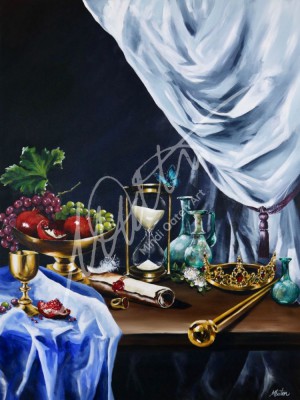
Laura Martin Esther 7:3
“Queen Esther answered, ‘If I have obtained your approval, my king, and if the king is pleased, spare my life—this is my request; and spare my people—this is my desire.’”
FURTHER SCRIPTURE
- Matthew 14:27–29 —“Immediately Jesus spoke to them. ‘Have courage! It is I. Don’t be afraid.’ ‘Lord, if it’s You,’ Peter answered Him, ‘command me to come to You on the water.’ ‘Come!’ He said. And climbing out of the boat, Peter started walking on the water and came toward Jesus.”
- Matthew 17:20 —“‘Because of your little faith,’ He told them. ‘For I assure you: If you have faith the size of a mustard seed, you will tell this mountain, ‘Move from here to there,’ and it will move. Nothing will be impossible for you.’”
- John 14:14 —“If you ask Me anything in My name, I will do it.”
Lesson and Daily Word
Each day has two parts: the Lesson and the Daily Word. Use these buttons to go from one to the other.
Teaching Notes and Questions
Next to the video, these tabs show the Teaching Notes and the Questions. Your answer to a question saves when you leave the answer box.
The Bible passage
This link opens the passage on Bible Gateway, and that gives the passage its tick. If you read it in your own Bible, tick it by hand in Progress.
Your progress on this lesson
A part ticks itself when you play the video or audio to the end, read the notes or the Daily Word to the end, or answer every question. You can also tick a part by hand here.
Downloads
Here you can save the video, the audio and the lesson as PDF files. Downloads do not count toward your progress.
Need help?
Use this button to send us a question or tell us about a problem. You can also take this tour again from there.