
Deuteronomy 27
Discover Jesus as: Prophet Deuteronomy 27 Read on Bible Gateway (HCSB)
Lesson
Audio Only
Teaching Notes
INTRO
In Deuteronomy 26, we talked about giving up the firstfruits, about giving ten percent of the harvest to the poor every third year, and about the covenantal summary. Moses was with the younger Israelites, looking over the plains of Moab, and getting ready to enter the Promised Land. Deuteronomy 27 focused on God’s faithfulness in the future. In Deuteronomy 27-30, Moses explained what could be expected of God’s faithfulness in the future.
TEACHING
Deuteronomy 27:1-4: This was time for a ceremony. Moses and the commanders of the people told the Israelites to “keep every commandment.” When they crossed the Jordan River into the land of Israel, to claim the land that God had already given them–– it was a done deal. They were to set up large stones and cover them with plaster or lime to create a white background1so “all the writing can be seen.” And on this backdrop, they were to write all the words of “this law” (either Deuteronomy or the entire Pentateuch) as soon as they crossed into Israel. They were to do it immediately––don’t put it off, don’t wait.
The place where the Israelites entered was Mt. Ebal, located north of Shechem, in the center of the Promised Land. This is the place where the Lord created the first covenant with Abraham and Abraham first built an altar to the Lord (Genesis 12:6-7). In Deuteronomy, the Israelites were told again to put up an altar. We’re bookending what God has done in Genesis and Deuteronomy.
Deuteronomy 27:5-8: Moses instructed them to build an altar with uncut stones and forbade them to use iron tools on them. The altar was for burnt offerings—to burn up the best. The best would be completely consumed, showing complete devotion to the Lord. With the large stones, the Israelites were remembering what God had done, and with the altar of stones they were showing God their devotion. We, too, can see what God has done in the past. Now it’s time to give up our burnt offerings on the altar to God. Why? So that we can see God move the way we saw Him move in our fathers and our grandfathers. This was the mentality Moses was giving to the younger generation, who had seen what God had done for their forefathers.
Deuteronomy 27:7-10: “There you are to sacrifice fellowship offerings, eat, and rejoice in the presence of the LORD your God.” As we continue to offer ourselves to the Lord, we cannot stay in the posture of, “I’m a Christian and life just stinks.” Who wants to follow that faith? Moses was saying to the people, “I want you to celebrate in joy what you have in the Lord. I want you to have life.” In verse 8, Moses told them to be sure to write clearly all the words of the law on the plastered stone. The Israelites were writing things down, and they were celebrating and rejoicing as proof of their devotion to God.
In verse 9, Moses and the Levitical priests spoke to all Israel and told them to be silent and to listen. This was Moses' third sermon in Deuteronomy, given at the time of transition, and wrapping up his time of leadership. He told them, “This is the day you’ve become the people of God.” They were now receiving what God had intended for them all along––it was being passed down to them. In verse 10, Moses told them how: “Obey the Lord your God and follow His commands and statutes I am giving you today.” In verses 11-12, Moses commanded the people to obey and then named the people who would stand atop Mt. Gerizim, six of the 12 tribes of Israel—Simeon, Levi, Judah, Issachar, Joseph, and Benjamin. They were told to bless the people.
In verse 13, the other six tribes—Reuben, Gad, Asher, Zebulun, Dan, and Naphtali—were to stand atop Mt. Ebal to deliver the curse to the people. Mt. Gerizim had all the vegetation, while Mt. Ebal was barren. It makes sense that on Mt. Ebal, they
would deliver the curse, and on Mt. Gerizim, they would deliver the blessing. While these two groups were voicing blessings or curses in verse 14, the Levities were to release 12 curses to every Israelite.
MacArthur describes it differently, explaining that the Levite priests, who were the voice of the people, would be standing beside the Ark of the Covenant, reading both the blessings and curses, while six tribes faced Mt. Gerizim and the other six tribes faced Mt. Ebal, possibly without either group actually being on those mountains.2The phrase “every Israelite” suggests that the representatives of the 12 tribes would also be present, so everyone had to be able to hear what was going on. As these curses were given, the Israelites had to agree to the conditions, crying out “So be it.”3They agreed to it.
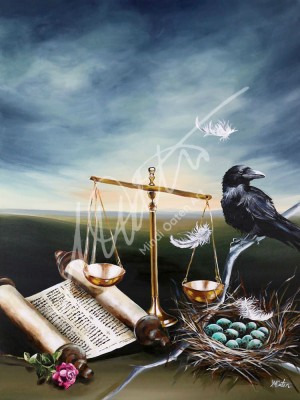
One of the curses (v. 15) was against those who worshipped idolatry. What does it mean to be cursed? MacArthur explains that to be bound by the curse (the opposite of the blessing) meant illness and injury came across a person.4Wiersbe states that curses “weren’t predicting what would happen . . . but were calling upon the Lord to send the curses on His people if they turned away from Him.”5Another curse (v. 16) was for those who dishonored their fathers and mothers. Many of these tie into the Ten Commandments. Other curses were against those who moved a neighbor’s boundary marker, which was a form of stealing (v. 17); those who led a blind man astray (v. 18); those who denied justice to a foreigner, an orphan, or a widow (v. 19); those who sleep with his father’s wife or participate in any form of sexual immorality (bestiality, incest, adultery) (vv. 20-23); and those who commit murder in secret or accept a bribe to kill someone (vv. 24-25). We are told to love God and love our neighbor, so to kill a neighbor goes against the core of what God has told us to be.
After each of these curses, the people would answer, “Amen,” to show that they accepted the curse if they were found to be disobedient. In verse 26, those who disobeyed these laws were cursed. Why was this final curse most important? Because if they didn’t obey these laws (all of Deuteronomy, maybe all of the Pentateuch), they received curses. Remember when Moses first began this sermon, he told them to write everything he was telling them to do. The Israelites couldn’t keep up with all the instructions. And that’s the point. Israel agreed to keep God’s Law on Mt. Sinai, and right after that, they built and worshipped the golden calf. They were agreeing that they were in, but then they couldn’t do it. Warren Wiersbe emphasized that it takes more than learning “a religious vocabulary, and even [memorizing] Bible verses and religious songs,” to be a devoted child of God.6(Matthew 7:21-23)
Jesus was speaking to people who could not keep up with the law. We have to be careful not to become a lip-service believer—saying amen all the time. Praise the Lord that Jesus took care of this (Galatians 3:10-12). This is exactly what Moses was saying. Read James 2:10. This is key! If we can’t keep up with one law, we’re guilty of all.
CLOSING
All sin . . . always, always . . . leads to the ultimate curse. (Romans 3:23; 6:23, Galatians 3:13) Jesus redeemed us from the curse of the law because Jesus became the curse for us. Jesus knew we couldn’t keep up with the laws, so He took on that curse for us. Do you still hang on to that curse, or did you give it all to Jesus? Deuteronomy 27 says that if you can’t live up to these rules, you are cursed. And what I love about Jesus is that He says, “Give it to me. I’ll take that curse for you.”
John MacArthur, The MacArthur Bible Commentary (Nashville: Thomas Nelson, 2005), p 229.
MacArthur, p. 229.
MacArthur, p230.
MacArthur, p. 230, “Key Word.”
Warren W. Wiersbe, The Bible Exposition Commentary: Genesis–Deuteronomy (Colorado Springs, CO: David C. Cook, 2001), 441.
Wiersbe, p. 442.
Questions
-
In Deuteronomy 27:5, the Israelites were told to build an altar of uncut stones. Why do you think they were told that no iron tool could touch the stones? Where were they to set it up? Do you think that the altar points to Christ? Why or why not?
-
In Deuteronomy 27, how many curses were there and what were they?
-
Why do you think that one-third of the curses are based on sexual sin? What do you think this meant for the Israelites? (Ephesians 5:3; Colossians 3:5; I Thessalonians 4:1-8)
-
In verse 26, a person is cursed if they do not heed all the words of the law. Are we still bound by these laws? Why or why not? (Galatians 3:11b-14)
-
What did the Holy Spirit highlight to you in Deuteronomy 27 through the reading or the teaching?

Daily Word
Laura Martin Deuteronomy 27:3
And you shall write on them all the words of this law, when you cross over to enter the land that the LORD your God is giving you, a land flowing with milk and honey, as the LORD, the God of your fathers, has promised you.
Moses instructed the Israelites to write the words of the law on stones covered with plaster after they crossed into the land God had promised them. Moses did not want the people to forget the commands of the Lord. In today’s world, you don’t have to write the Word of the Lord on stones covered with plaster, yet the practice of writing out Bible verses is still a wise discipline.
Do you have a favorite journal, decorative notecards, a chalkboard in your home, or a whiteboard at work? All these tools can be used to write down the Word of the Lord and point you to God’s truth as you go through your day. Write a Bible verse on a notecard and put it by your computer, close to the steering wheel in the car, or on your bathroom mirror. Take time to write down a Bible verse that holds meaning to you. Then as you read the verse throughout the day, give thanks to the Lord for His truth in your life.
“Write all the words of this law on the stones after you cross to enter the land the Lord your God is giving you, a land flowing with milk and honey, as Yahweh, the God of your fathers, has promised you.
— Deuteronomy 27:3
FURTHER SCRIPTURE
- Deuteronomy 6:9 — “Write them on the doorposts of your house and on your gates.”
- Psalm 119:105 — “Your word is a lamp for my feet and a light to my path.”
- Habakkuk 2:2 — “And the Lord answered me: Write down the vision; clearly inscribe it on tablets, so one may easily reads it.”
Lesson and Daily Word
Each day has two parts: the Lesson and the Daily Word. Use these buttons to go from one to the other.
Teaching Notes and Questions
Next to the video, these tabs show the Teaching Notes and the Questions. Your answer to a question saves when you leave the answer box.
The Bible passage
This link opens the passage on Bible Gateway, and that gives the passage its tick. If you read it in your own Bible, tick it by hand in Progress.
Your progress on this lesson
A part ticks itself when you play the video or audio to the end, read the notes or the Daily Word to the end, or answer every question. You can also tick a part by hand here.
Downloads
Here you can save the video, the audio and the lesson as PDF files. Downloads do not count toward your progress.
Need help?
Use this button to send us a question or tell us about a problem. You can also take this tour again from there.