
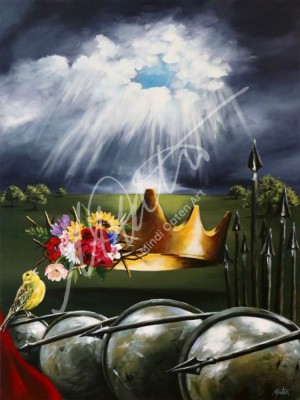
David's Kingdom is Forever
Discover Jesus as: Eternal Throne 2 Samuel 7-8 Read on Bible Gateway (HCSB)
Lesson
Audio Only
Teaching Notes
INTRO
Second Samuel 7 is unique and one of the most important chapters of the Old Testament. At this point, David had stopped running and was settling into his new role as the anointed king of Israel. Chapter 7 focuses on how the Eternal Throne (our phrase for 2 Samuel) will be walked out.
TEACHING
2 Samuel 7:1–3: David had settled into his palace in Jerusalem, and the Lord had put David’s enemies to rest (Exodus 33:14). This rest was promised prophetically and can only be found in the Lord. Sometimes the reason we deal with burnout is because we have yet to find true rest in Him. Now, as king, David's desire was to honor God. He looked at his house of cedar and questioned why it was right for the Lord not to have a permanent dwelling. When David confronted the prophet Nathan about it, Nathan told him to do what was in his heart, for God was with him (Psalm 132:1–5).
The prophet Nathan was not a “yes man.” In fact, in 2 Samuel 12, he was the one who confronted David with his sin. Nathan came in to speak God’s Word into David. However, in here in chapter 7, Nathan spoke too soon and apparently didn’t inquire of the Lord for guidance (v. 3). Dale Ralph Davis states, “Nathan knew what [David] was thinking. It was noble, rational, and right. One didn’t need to think twice about it. Nathan urged David to ‘just do it.’”1
2 Samuel 7:4–8: Nathan had quickly given David the go-ahead to build God a house, but God had another plan—the Davidic Covenant that pointed to the coming Messiah. Why did God say “no” to David? Constable gives three reasons God denied David’s desire: “First, there was no pressing need to do so since the ark had resided in tents since the Exodus.... Second, God had not commanded His people to build Him a permanent temple.... Third, David was an inappropriate person to build a temple since he had shed much blood.”2In verse 4, God corrected the word Nathan spoke to David. In all the years since the Israelites had left Egypt, God had not asked for a house (vv. 5–7). Wiersbe explains God used the metaphor of a shepherd to show He had called David to be a leader to His people, not a builder of His temple (v. 8).3Yet, “God’s servants must learn to accept the disappointments of life, for as A. T. Pierson used to say, ‘Disappointments are His appointments.’”4Constable states it was not that “God was disciplining David or had rejected him that He prohibited David’s good intention. God was simply redirecting His servant. He was to be a ruler, not a temple builder.”5Likewise, there are times when God has to redirect us from doing something we think He needs us to do, to what He wants us to do. We must not get ahead of Him doing what we think needs to be done, but instead, we are to rest in Him, accepting that He has a plan that goes back to the Davidic Covenant.
2 Samuel 7:9–13: God said He would make David’s name great (v. 9), reminding David that God was walking out the Abrahamic Covenant through him. One day, one of David’s descendants would build a house for Him, and God would establish the throne of His kingdom forever (Psalm 89:4). We know that this son would be Solomon, the son of David and Bathsheba. God redeemed the situation of David and Bathsheba in the lineage of the Messiah (vv. 12–13).
2 Samuel 7:14–17: God said He would be a father to this descendant who would be a son to Him. He would discipline this son with a human rod but His love would never leave the son. David’s house and kingdom would endure forever, and his throne would be established forever (vv. 14–16). Nathan spoke all these things to David (v. 17).
2 Samuel 7:18-29: David sat in God’s presence and asked, “Who am I, Lord GOD, and what is my house that You have brought me this far?” (v. 18). The rest of the chapter is David’s prayer of thanksgiving.
In the Davidic Covenant, God promised David a house, a kingdom, and a throne that would last forever. David is the lamp of Israel, and the flame will never go out (2 Samuel 21:17). Nelson’s Commentaryexplains these promises: “(1) the line, or house, of David will always be the royal line; (2) the right to rule will always belong to David’s offspring; (3) the right to a literal, earthly kingdom will never be taken from David’s posterity.”6This does not mean there were no pauses in this rule (Hosea 3:4–5).
The rule would always come through the Davidic kingdom (Luke 1:32–33). And, “the ultimate fulfillment of this promise will be realized at the Second Advent when Christ returns to reign over His people” (Revelation 20:1–6).7Second Samuel 7 points to Jesus’ birth (Luke 1) and to His return (Revelation 20).
Wiersbe divides David’s prayer of thanksgiving into three sections.8First, David gave thanks for God’s favor on his life in the present (vv. 18–21). Second, David gave thanks for what God had done for Israel in the past (vv. 22–24). Third, David gave thanks for what God had revealed about the future and asked God for the fulfillment of these promises (vv. 25–29).
CLOSING
Here are three interesting perspectives on this passage from pastor Jack Wellman:
- God sees the future (Isaiah 46:9–10).
- God’s ways are higher than ours (Psalm 33:11; Isaiah 55:8, 9).
- We plan–God directs (Proverbs 10:9; 19:21; 20:24; Jeremiah 10:23).
In 2 Samuel 8, because David was resting in the Lord, David had victories: against the Philistines (v. 1), the Moabites (v. 2), the Arameans (v. 5), and the Edomites (v. 13). “So David reigned over all Israel, administering justice and righteousness for all his people” (v. 15). David began to walk out his calling because he allowed the Lord to speak in his life.
Dale Ralph Davis, 2 Samuel: Out of Every Adversity (Geanies House, Fearn, Ross-shire, IV20 1TW, Great Britain: Christian Focus Publications, 1999), p. 84.
Thomas Constable, Dr. Constable’s Expository Bible Study Notes, pp. 52-53; available online at http://planobiblechapel.org/tcon/notes/pdf/2samuel.pdf.
Warren W. Wiersbe, The Bible Exposition Commentary: 2 Samuel (Colorado Springs: David C. Cook, 2003), p. 323.
Wiersbe, p. 323.
Charles R. Swindoll, David: A Man of Passion and Destiny. Great Lives from God’s Word series. (Dallas: Word Publishing, 1997), p. 162-68; quoted at Constable, p. 53.
Earl Radmacher, Ronald B. Allen, and H. Wayne House, eds., Nelson’s New Illustrated Bible Commentary (Nashville: Thomas Nelson Publishers, 1999), p. 399.
Nelson’s, p. 399.
Wiersbe, p. 325.
Questions
-
Why did David want to build a house of cedar for the ark of God to dwell in? What was God’s response? Have you ever found yourself putting God in some type of box? How?
-
In 2 Samuel 7:12–13 and 16, the Lord spoke of setting up a kingdom from David’s descendants. Do you think this is pointing to Jesus and His eternal reign? Does Jesus come from the lineage of David? (Matthew 1:1–17)
-
How does God continue to keep His promises in 2 Samuel 8:3? (Genesis 15:18–21; 1 Chronicles 18:3)
-
The Word of God has promised complete victory. As children of God, have we taken all the territory we have been promised, or is there some still occupied by the enemy? (Galatians 5:13; Philippians 4:19)
-
What did the Holy Spirit highlight to you in 2 Samuel 7—8 through the reading or the teaching?

Daily Word
Laura Martin 2 Samuel 8:14b–15
“The LORD made David victorious wherever he went. So David reigned over all Israel, administering justice and righteousness for all his people.”
FURTHER SCRIPTURE
- Proverbs 16:9 — “A man’s heart plans his way, but the LORD determines his steps.”
- Isaiah 55:8-9 — “‘For My thoughts are not your thoughts, and your ways are not My ways.’ This is the Lord’s declaration. ‘For as heaven is higher than earth, so My ways are higher than your ways, and My thoughts than your thoughts.’”
- James 1:6 — “But let him ask in faith without doubting. For the doubter is like the surging sea, driven and tossed by the wind.”
Lesson and Daily Word
Each day has two parts: the Lesson and the Daily Word. Use these buttons to go from one to the other.
Teaching Notes and Questions
Next to the video, these tabs show the Teaching Notes and the Questions. Your answer to a question saves when you leave the answer box.
The Bible passage
This link opens the passage on Bible Gateway, and that gives the passage its tick. If you read it in your own Bible, tick it by hand in Progress.
Your progress on this lesson
A part ticks itself when you play the video or audio to the end, read the notes or the Daily Word to the end, or answer every question. You can also tick a part by hand here.
Downloads
Here you can save the video, the audio and the lesson as PDF files. Downloads do not count toward your progress.
Need help?
Use this button to send us a question or tell us about a problem. You can also take this tour again from there.