
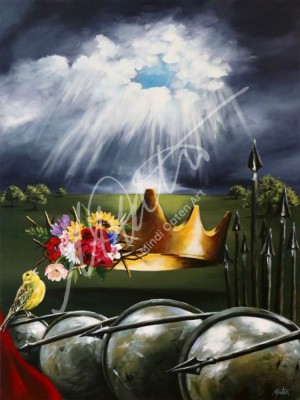
Bringing the Ark to Jerusalem
Discover Jesus as: Eternal Throne 2 Samuel 5-6 Read on Bible Gateway (HCSB)
Lesson
Audio Only
Teaching Notes
INTRO
In 1 Samuel 16:12–13, David was brought before Samuel and then chosen by God as the next king of Israel. Verse 13 states that “the Spirit of the LORD took control of David from that day forward.” In the remainder of 1 Samuel, God began to bless David, preparing him to one day sit on Israel’s throne. Yet David was in a constant struggle and tension between his anointing as the future king and Saul’s anointing as the current king. In the first part of 2 Samuel, David was established as king of Judah, and in chapter 5, all the tribes of Israel came together to anoint David as king over Israel. The Lord told David that while he had been a shepherd of sheep, he would now shepherd His people and rule over Israel (2 Samuel 5:1-3).
Israel said to David, as the anointed one, that they were his own flesh and blood, foreshadowing the coming of Jesus as the Anointed One. Jesus became flesh and blood for us. There’s also an interesting parallel between Saul as the first king and Adam as the first man, to David as the second king and Jesus as the second Adam.
Some of you have had prophetic words spoken over you, and there’s probably been a tension in your life as you’ve walked through that calling. You may not have had the public anointing yet. But none of that should discredit the truth of that anointing for you. As David walked out his calling, he developed perseverance and integrity in the process. David was 30 years old when he became king. It’s interesting that Jesus was 30 years old as well when He began His ministry.
In the remainder of chapter 5, David led his troops to take over Jerusalem from the Jebusites. The Israelites were supposed to have taken care of the Jebusites when they fought for the Promised Land. Since that had not happened, David took this on in a strategic move. By establishing Jerusalem as the new capital, David created an alliance between northern and southern Israel. The Jebusites believed the city was so fortified that they put the blind and the lame on the fortifications to fight them. David and his men entered the city through the water shaft and took the city. This was David’s first battle as king. When the Philistines heard David was king, they went after him, planning to defeat him. However, God gave the Philistines to David as well.
TEACHING
2 Samuel 6:1–5: David brought together 30,000 choice men to take the ark to Jerusalem (vv. 1–2). David and his troops went to get the ark where it had been left at Abinadab’s house for 50 years. The Philistines had captured the ark in battle, but they began to develop physical tumors from having it in their presence (1 Samuel 6). They sent it back on a new cart to see if the ark had caused their ailments, and the cows pulled it back to Beth-shemesh. The people there did not treat the ark with reverence and God struck 70 men down. The ark was taken to Abinadab’s house where it stayed (1 Samuel 7). Because the ark had been returned to them on a new cart, David and his troops placed the ark on another new cart (v. 3).
2 Samuel 6:6–11: As they proceeded with the cart and the ark, the oxen stumbled and the cart shook. Uzzah reached out to the ark so it wouldn’t fall off the cart (v. 6). God’s anger burned at Uzzah’s lack of reverence, and He struck Uzzah dead on the spot (v. 7). Under Israel’s law, people were to treat it with reverence and respect. The ark was not handled properly. David became angry and then fearful of God at what happened (vv. 8–9). The ark was taken to the house of Obed-edom, instead of Jerusalem, and while it stayed there for three months, Obed-edom’s household was blessed (vv. 10–11). When the presence of God dwells in our midst, things begin to change and fruit comes out of it. There are times in my own life when I’m not seeing fruit produced in my ministry, and I have to stop and seek the Lord to figure out why.
2 Samuel 6:12–19: People reported to David that the Lord was blessing Obed-edom’s family because of the presence of the ark, so David went to bring the ark up to Jerusalem with gladness (v. 12). When the Levites carried the ark six paces, which represented the six days of creative process of God, the ark was stopped and David sacrificed an ox and a fattened calf (v. 13). David was the king, and he also took on the posture of the priest by wearing the linen ephod and dancing in worship (v. 14). All of Israel came with David, shouting and blowing the ram’s horn, as he brought the ark into the city (v. 15). Michal, David’s wife and Saul’s daughter, looked out the window and saw David dancing before the Lord,
and “she despised him in her heart” (v. 16). I wonder if we are reluctant to worship God in abandon with our actions because we are concerned about what others will think of us. In this passage, I see Michal giving her opinion so much that it could have swayed David’s response and reaction to God. The ark was placed inside the tent David had set up for it, and David offered burnt offerings and fellowship offerings to God (v. 18).
The burnt offering was the whole offering, which means the only part of the sacrificed animal not burned was the skin, which was given to the Levites. The peace offering was about recognizing the coming of God’s peace to the individual or to the group. The peace offering was supposed to be eaten there as a part of the sacrifice, not taken home. Everyone, Israelite and outsider, received a part of the peace offering. This is a beautiful picture of the sacrifice of Christ Jesus, the peace that has come for all people. Interestingly, there was no sin offering or guilt offering involved in this process. After the offerings, David blessed the people in the Lord’s name. David also gave a loaf of bread, a date cake, and a raisin cake to each person in the community of Israel, men and women alike, and they all departed for their own homes (v. 19). Then David went home to bless his own household, what is described in 1 Chronicles as ministering to his own family. David honored families, his own and those of his people.
2 Samuel 6:20–23: When David got home, Saul’s daughter, Michal, chastised him for his actions and said he had exposed himself and acted vulgar (v. 20). David didn’t accept Michal’s chastisement and said he was dancing before the Lord who had chosen him over Michal’s family to rule (v. 21a). Then he stated, “I will celebrate before the LORD, and I will humble myself even more and humiliate myself. I will be honored by the slave girls you spoke about” (vv. 21b–22). David was basically telling Michal he was done with her. And verse 23 confirms this, “And Saul’s daughter Michal had no child to the day of her death.”
CLOSING
David established a place in Jerusalem to be his capital. And he showed that, above all else, he wanted God to be the true King over Israel. David wanted God ruling over him, so he had to have the ark and God’s presence in his capital. It’s why we call God the King of kings and Lord of lords. David honored God’s presence and put His presence in the correct place—above everything and everyone.
One last thought is about the theme of the Eternal Throne. When Israel placed the ark on a cart, someone died, so they came back and placed the ark on the shoulders of the Levites. Isaiah 9:6 says that “the government will rest upon his shoulders.” Jesus said, “For My yoke is easy and My burden is light” (Matthew 11:30). God’s presence should be resting upon us and causing us to be elevated from that place. I believe their putting the ark on their shoulders was a foreshadowing of Jesus carrying God’s presence on His shoulders.
Questions
-
Do you think that sometimes we are like the Jebusites, believing we are secure because of earthly possessions, status, or knowledge, while there is a “water shaft” (2 Samuel 5:8) or place of vulnerability or weakness in our lives?
-
In 2 Samuel 5:13, do you think David was doing the same thing the Jebusites did in verse 6 (taking advantage of his position)?
-
Should David have put the ark of the covenant on a new cart rather than having it carried (Numbers 4:5–6, 15; 2 Samuel 6:3)? Where might he have gotten this idea (1 Samuel 6:7–8)? What can we learn from David’s mistake of failing to seek the Lord and instead doing things in the way of the world?
-
In 2 Samuel 6:20, Michal was embarrassed about how David was dressed and how he danced before the Lord. What was her consequence (2 Samuel 6:23)? Have you ever disagreed with or judged others for how they express their worship? Have you ever been embarrassed to express yourself in a manner like David did, just because of what people might think? Why or why not?
-
What did the Holy Spirit highlight to you in 2 Samuel 5—6 through the reading or the teaching?

Daily Word
Laura Martin 2 Samuel 6:21–22
“David replied to Michal, ‘I was dancing before the LORD who chose me over your father and his whole family to appoint me ruler over the LORD’s people Israel. I will celebrate before the LORD, and I will humble myself even more and humiliate myself. I will be honored by the slave girls you spoke about.’”
FURTHER SCRIPTURE
- Psalm 16:11 — “You reveal the path of life to me; in Your presence is abundant joy; in Your right hand are eternal pleasures.”
- Psalm 30:11–12 — “You turned my lament into dancing; You removed my sackcloth and clothed me with gladness, so that I can sing to You and not be silent. Lord my God, I will praise You forever.”
- 2 Corinthians 3:17 — “Now the Lord is the Spirit, and where the Spirit of the Lord is, there is freedom.”
Lesson and Daily Word
Each day has two parts: the Lesson and the Daily Word. Use these buttons to go from one to the other.
Teaching Notes and Questions
Next to the video, these tabs show the Teaching Notes and the Questions. Your answer to a question saves when you leave the answer box.
The Bible passage
This link opens the passage on Bible Gateway, and that gives the passage its tick. If you read it in your own Bible, tick it by hand in Progress.
Your progress on this lesson
A part ticks itself when you play the video or audio to the end, read the notes or the Daily Word to the end, or answer every question. You can also tick a part by hand here.
Downloads
Here you can save the video, the audio and the lesson as PDF files. Downloads do not count toward your progress.
Need help?
Use this button to send us a question or tell us about a problem. You can also take this tour again from there.