
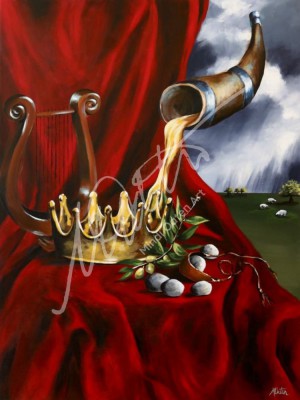
On the Battle Lines
Discover Jesus as: Anointed One 1 Samuel 17 Read on Bible Gateway (HCSB)
Lesson
Audio Only
Teaching Notes
INTRO
As we continue to move through 1 Samuel, it’s amazing to see all these things coming together. In chapter 4, Hannah was told her son would one day anoint the king, and in chapter 16, Samuel did just that. Yesterday, we talked about the implications
of the king coming from Jesse’s lineage, the tribe of Judah, and Bethlehem. At this point, David was still tending sheep for his father and playing music for Saul whenever the evil spirit took over Saul.
The backdrop for chapter 17 is David had been anointed, but now he had to wait for God’s timing to take on the role of king. Consider these who had to wait too. Noah waited for decades for the flood to come. Abraham waited 25 years for Isaac to come. Moses spent 40 years working as a shepherd before God led him to Egypt to deliver His people. During periods of waiting, God continues to refine people to be more like Him. It’s all about embracing God’s timing in your anointing. The church today has received life, but we are not walking it out (John 10:10). In 1 Samuel 17:1–16, we will see David walk out his anointing under the control of the Holy Spirit, even as the enemy mocked him. In the New Testament, the Holy Spirit never leaves us. We are all anointed and have been sealed with the Holy Spirit (2 Corinthians 1:21–22).
TEACHING
1 Samuel 17:1–7: The army of the Philistines and the army of Israel lined up across the Valley of Elah in battle positions (vv. 1–2). The valley is not large, they would have been able to look across the valley and see the faces of their opponents. Both armies were atop hills (v. 3). Goliath, whose name meant “Conspicuous One,” was nine-feet and nine-inches tall1(v. 4). Goliath’s armor weighed 125 pounds. The iron point of his spear alone weighed 15 pounds (vv. 5–7a). Constable states, “This is an unusually long description of an individual for the Old Testament. The writer evidently wanted to impress Goliath’s awesome power and apparent invulnerability on the readers.”2
1 Samuel 17:8–11: Goliath shouted at the Israelites, goading them into sending out a champion to fight him. Goliath promised that if the Israelite champion won, the Philistines would be their servants. If Goliath killed the Israelite champion, the Israelites would serve the Philistines (vv. 8–10). The enemy is going to constantly pick us apart, tell us lies, and attack what we know to be true. When Saul and the Israelite army heard Goliath’s words, they bought into the lies and were terrified (v. 11). When the church becomes okay with surviving in the world, when we don’t engage in the battle, then we are buying into the enemy’s lies as well.
1 Samuel 17:12–16: Jesse’s three oldest sons followed Saul into war. David, the youngest, kept going back and forth between his chores as a shepherd and his responsibilities to King Saul (vv. 12–15). Meanwhile, every morning and evening for 40 days, Goliath came out and challenged the Israelites (v. 16). Notice how the enemy’s lies can be relentless! When the enemy is mocking us, we have to stop staring at the enemy and listening to his lies. The church today is on the front lines, we are in a position to do something about the battle.
1 Samuel 17:17–19: In Bethlehem, Jesse pulled together supplies and instructed David to deliver them to the Israelite camp. Notice the ten loaves of bread Jesse included (v. 17). The name Bethlehem meant “house of bread.” Jesse also sent cheese to the commander and told David to check on his brothers (v. 18). The brothers were with Saul “fighting with the Philistines” (v. 19). They weren’t actually fighting, but were waiting on Israel’s side of the battle lines. Sometimes, the church today
thinks we’re fighting, but we’re not. We have to move off the front lines into the battle. That’s the goal of Time to Revive and Revive School! We tend to want revival, but we want God to use someone else to do it.
1 Samuel 17:20–29: Moving off the front line and into the battle takes preparation. David made preparation. He got up early in the morning and made sure the sheep were taken care of before he left Bethlehem with supplies. He arrived in time to see
the armies head out in battle formation, facing each other (vv. 20–21). Because David had taken care of his responsibilities, he could leave his supplies, run to the battle, and check on his brothers (v. 22). Goliath came out again, shouting his challenge
(v. 23), and the Israelites retreated (v. 24). David asked what the reward was for killing Goliath (vv. 25–27).
The rewards included wealth and a place in Saul’s family through marriage to Saul’s daughter. When we fight in the battle, there is a reward for us as well (Matthew 5:10–12; 6:20). But be prepared for opposition from within the camp. David’s brother Eliab attacked David’s integrity and sense of responsibility (Psalms 78:72; v. 28), making David question what he had done wrong
(v. 29). Wiersbe says, “Whenever you step out by faith to fight the enemy, there’s always somebody around to discourage you, and often it begins in your own home.”3
1 Samuel 17:30–39: Because of his interest, David was taken to Saul (v. 31). God had already qualified David for the battle through protecting the sheep (vv. 32–36). David claimed the victory (v. 37). Saul’s armor did not fit David, but David did not need it (vv. 38–39). He was confident in the Lord and he did not need fancy weapons. Wiersbe says, “Saul didn’t have the faith to believe that God could do something new, so he suggested the old-fashioned time-honored method of warfare.”4Five years after his anointing, 17-year-old David was ready to walk out his call.
1 Samuel 17:40–58: David chose five stones, and with his sling in his hand, he approached Goliath (v. 40). It is time for new wineskins(Acts 11:19–26) in the American church. We are not changing culture. Let us pray to find one little thing we can tweak or change to see how that can make a difference. Finally, David was able to engage in the battle (vv. 41–47). David knew the victory was the Lord’s. As Goliath came forward, David ran toward him and defeated him with a stone and a sling (vv. 48–50). David used Goliath’s own sword to cut off his head (v. 51). The army of Israel chased the Philistines down, killed them, and plundered their camps (vv. 52–53).
CLOSING
The Israelites had stood on the front lines for days, just staring at the enemy. But when David came and walked out his call, his anointing, they were able to experience life more abundantly.
1 John 2:20, 27: “But you have an anointing from the Holy One, and all of you have knowledge . . . The anointing you received from Him remains in you, and you don’t need anyone to teach you. Instead, His anointing teaches you about all things and is true and is not a lie; just as He has taught you, remain in Him.”
When we walk out the Holy Spirit anointing that we've been given, just like the Israelites, we can experience the fulness of God that He wants for you and me. The questions is: Do you want to be the soldiers who are staring or David who is walking out his calling?”
Earl Radmacher, Ronald B. Allen, H. Wayne House, eds., Nelson’s New Illustrated Bible Commentary (Nashville: Thomas Nelson Publishers, 1999), p. 367.
Thomas Constable, Dr. Constable’s Expository Bible Study Notes: 1 Samuel, p. 88; available at http://planobiblechapel.org/tcon/notes/pdf/1samuel.pdf.
Warren W. Wiersbe, The Bible Exposition Bible Commentary: 1 Samuel (Colorado Springs: David C. Cook, 2003), p. 252.
Wiersbe, p. 253.
Questions
-
David was going to feed his father’s sheep (v. 15). Where in the New Testament, do we hear Jesus speak of feeding sheep (John 21:17)? What differences can you see between these sheep?
-
Why was Saul’s army afraid of Goliath (vv. 4–7)? What does God say about fear (Joshua 1:9; Isaiah 41:10; 2 Tim 1:7)? Have you conquered a fear with God’s help? How? (1 John 4:18)
-
Why did David’s brother get angry with him? (1 Corinthians 1:27–29; James 3:14, 16; 4:11) Why do you think David responded the way he did to his brother Eliab? (1 Samuel 17:29)
-
Young David had so much confidence in God he went to battle against a giant with only a few rocks. What giants have you battled against with the help of God? How did they turn out?
-
What did the Holy Spirit highlight to you in 1 Samuel 17 through the reading or the teaching?

Daily Word
Laura Martin 1 Samuel 17:37
“The LORD who rescued me from the paw of the lion and the paw of the bear will rescue me from the hand of this Philistine. Saul said to David, ‘Go, and may the LORD be with you.’”
David had been anointed by Samuel to be the king of Israel, but he remained in the pasture tending the sheep. While bringing food to his brothers who served in the army, David heard about Goliath, and he saw the Israelites retreat in fear of him. However, David was not afraid of battling this giant warrior. David knew the same God who rescued him from the paw of a lion and the paw of a bear would rescue him from the hands of this Philistine. He walked in faith, he walked in his anointing, and he walked as God created him, trusting the Spirit of God to be with him. Using weapons he was familiar with—ones he had used for years while tending sheep, David found victory by defeating Goliath with just a slingshot and a stone.
Like David, it’s time to face your giants. What is the overwhelming concern, or giant, you face that seems to get more difficult as time passes? It’s time to recognize the Lord is with you and the victory belongs to Him. You are anointed with the power of the Holy Spirit, and through His power, you are able to overcome your giants. Stop standing on the sidelines. Go after it. The battle belongs to the Lord.
“The Lord who rescued me from the paw of the lion and the paw of the bear will rescue me from the hand of this Philistine. Saul said to David, ‘Go, and may the Lord be with you.’”
—1 Samuel 17:37
FURTHER SCRIPTURE
- 1 Samuel 17:45–47 — “David said to the Philistine: ‘You come against me with a dagger, spear, and sword, but I come against you in the name of Yahweh of Hosts, the God of Israel’s armies—you have defied Him. Today, the Lord will hand you over to me…Then all the world will know that Israel has a God, and this whole assembly will know that it is not by sword or by spear that the Lord saves, for the battle is the Lord’s. He will hand you over to us.’”
- Psalm 18:39 — “You have clothed me with strength for battle; You subdue my adversaries beneath me.”
- 1 John 2:27 — “The anointing you received from Him remains in you, and you don’t need anyone to teach you. Instead, His anointing teaches you about all things and is true and is not a lie; just as He has taught you, remain in Him.”
Lesson and Daily Word
Each day has two parts: the Lesson and the Daily Word. Use these buttons to go from one to the other.
Teaching Notes and Questions
Next to the video, these tabs show the Teaching Notes and the Questions. Your answer to a question saves when you leave the answer box.
The Bible passage
This link opens the passage on Bible Gateway, and that gives the passage its tick. If you read it in your own Bible, tick it by hand in Progress.
Your progress on this lesson
A part ticks itself when you play the video or audio to the end, read the notes or the Daily Word to the end, or answer every question. You can also tick a part by hand here.
Downloads
Here you can save the video, the audio and the lesson as PDF files. Downloads do not count toward your progress.
Need help?
Use this button to send us a question or tell us about a problem. You can also take this tour again from there.