
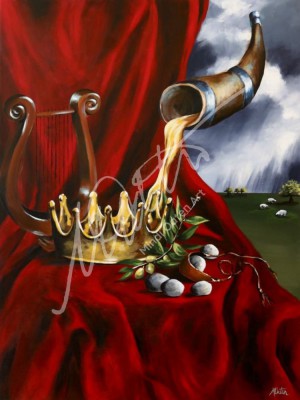
God's Anointed King
Discover Jesus as: Anointed One 1 Samuel 15-16 Read on Bible Gateway (HCSB)
Lesson
Audio Only
Teaching Notes
INTRO
The phrase for the Messiah in 1 Samuel is Anointed One. If there’s any passage that clearly shows that, it would be 1 Samuel 16. Saul was the first anointed king of Israel, but he was letting his son Jonathan take the lead. We saw it in chapter 14 and now chapter 15 as well. In 1 Samuel 15:1–3, Saul was told to destroy allthe Amalekites, including the women, children, and their livestock. But, in verses 4–9, Saul allowed King Agag and the best of the livestock to live. The Lord regretted making Saul king (vv. 10–15). Because of his disobedience, Saul was rejected by both the Lord and by Samuel (vv. 16–23). Saul pleaded with Samuel to forgive him, and when Samuel turned away, Saul grabbed his robe and tore it. Samuel said the kingship had been torn away from Saul as well (vv. 24–30). Verse 28 explains the kingship had already been given to Saul’s neighbor, David. Samuel carried out God’s judgment and hacked Agag to pieces. He never saw Saul again (vv. 32–35).
TEACHING
1 Samuel 16:1: God sent Samuel to Jesse of Bethlehem to anoint a new king (v. 1). God did the choosing of the king of Israel. This new king was prophesied in Genesis 3:15 and Numbers 24:17. These are not the only prophecies in Scripture about the coming King, the coming Messiah. They all point to God’s chosen King who would come from Israel. 1 Samuel 2:10 says, “Those who oppose the LORD will be shattered; He will thunder in the heavens against them. The LORD will judge the ends of the earth. He will give power to His king; He will lift up the horn of His anointed.” We know that this anointing will come through the kingship of Israel. God clearly has a plan for His Son to become King (Psalm 2:1–4, 7–9). Ruth 4:12 and 22 also explain that the King would come from the tribe of Judah. If Samuel knew Scripture, he would have recognized this next king could be the one God promised (Genesis 49:10; Micah 5:2).
1 Samuel 16:2–5: Surprisingly, Samuel’s first response was fear. Samuel was more afraid of Saul than he was of God (Proverbs 29:25). God told Samuel to take a young cow with him as a sacrifice and to invite Jesse to the sacrifice. Then, God would tell him what to do next (vv. 2–3). Read 1 Samuel 2:10 again. Samuel would have heard this prophesy given to his mother Hannah about what he would do. Imagine his walk to Bethlehem, knowing that he was fulfilling that prophesy! That is what makes his fear so surprising (2 Samuel 2:7; 5:3). When Samuel arrived, the elders were afraid of what he was there to do and asked him why he had come (v. 4). MacArthur suggests they had heard of what Samuel had done to Agag and questioned what he was there to do.1Samuel responded to the elders he had come in peace to offer a sacrifice to God, and he instructed them to consecration themselves and go with him. MacArthur explains that “worship of Yahweh was always preceded by cleansing or washing, both of the outward garments and the inner man.”2(Exodus 19:10, 14; 1 John 1:9). Samuel consecrated Jesse and his sons and invited them to the sacrifice, without knowing there was a son who was absent (v. 5).
1 Samuel 16:6–13: When Samuel saw Jesse’s son Eliab, whose name means “My God is Father,” he thought the anointed one was before him (v. 6). But the Lord told Samuel not to look at the sons’ appearances, but to look at their hearts (v. 7). MacArthur explains, “The Hebrew concept of heartembodies emotions, will, intellect, and desires. The life of the person will reflect his heart.”3Jeremiah 17:10; Matthew 12:34). In verses 8–10, each son was presented to Samuel, but God did not choose them. Samuel finally asked if there were other sons, and Jesse said his youngest son was out tending sheep. Samuel told Jesse to send for that son while they all waited for him to come before they ate (v. 11). When David arrived, God said “Anoint him, for he is the one” (v. 12). The anointed are exalted by God, not man. Samuel anointed David in the presence of his brothers and the “Spirit of the Lord took control of David from that day forward” (v. 13). Later, David would be anointed a second time before his tribe of Judah and a third time before the entire nation of Israel.
Jacob, Gideon, and Joseph were all the youngest sons in their families as well. David was described as the firstborn of Israel who began as a shepherd and became king (Psalm 78:70–72). David was a type of Christ. David was rejected by his own brothers who saw him as worthless; Jesus’ family thought He had lost His mind (Mark 3:21).
The Old Testament has many examples of the Spirit of the Lord empowering people: Samuel/Saul–1 Samuel 10:6, 10; Saul–1 Samuel 11:6; Saul’s agents–1 Samuel 19:20, 23; David–2 Samuel 23:2; Jahaziel–2 Chronicles 20:14; the Davidic king–Isaiah 61:1; Ezekiel–Ezekiel 11:5; 37:1. In the New Testament, the Spirit came upon Jesus at His baptism (Matthew 3:13–17) when He was anointed by the Father and empowered by the Spirit (Acts 1:8).
1 Samuel 16:14–17: When the Spirit of the Lord left Saul, God sent an evil spirit to torment him (v. 14). Nelson’s Commentarysuggests this affliction by an evil spirit has four possible sources: “(1) demon possession as divine punishment; (2) demonic attack or influence; (3) an evil messenger, like the one sent to entice Ahab; or (4) a spirit of discontent created by God in Saul’s heart.”4Whatever the cause, Saul’s servants noticed (v. 15). They offered to find someone to play the lyre for him, to soothe him when he came under attack (vv. 16–18). David was sent with gifts from Jesse to the king (vv. 19–20). David became Saul's armor bearer, a sign of David’s service in humility (vv. 21–22).
CLOSING
To close, David had all the components of a person anointed of God:
- He had a heart for God.
- He was rejected my man.
- He was exalted by God.
- He was empowered by the Spirit of God.
- He was a man of integrity.
- He was a man of faith.
- He walked in humility.
As David walked in humility, God positioned him for more.
John MacArthur, The MacArthur Bible Commentary (Nashville: Thomas Nelson Publishers, 2005), p. 327.
MacArthur, p. 327.
MacArthur, p. 327.
Earl Radmacher, Ronald B. Allen, H. Wayne House, eds., Nelson’s New Illustrated Bible Commentary (Nashville: Thomas Nelson Publishers, 1999), p. 366.
Questions
-
In 1 Samuel 15:3, why do you think the Lord commanded that every living thing had to be destroyed?
-
What ultimately happened when Saul disobeyed God and allowed the king and the choice livestock to live? Can you think of a time when you may have disobeyed God? What was the outcome?
-
In 1 Samuel 16, the Lord told Samuel to go to Bethlehem. Why didn’t Samuel want to go? What purpose did he have for going?
-
When you read 1 Samuel 16:7, what does this speak to you about the Lord (Proverbs 21:2; 1 Peter 3:4)? Are we guilty of only looking at the outside sometimes? (John 7:24; 2 Corinthians 10:7)
-
What did the Holy Spirit highlight to you in 1 Samuel 15—16 through the reading or the teaching?

Daily Word
Laura Martin 1 Samuel 16:7
“But the LORD said to Samuel, ‘Do not look at his appearance or his stature, because I have rejected him. Man does not see what the LORD sees, for man sees what is visible, but the LORD sees the heart.’”
FURTHER SCRIPTURE
- Proverbs 4:23 — “Guard your heart above all else, for it is the source of life.”
- Proverbs 31:30 — “Charm is deceptive and beauty is fleeting; but a woman who fears the Lord is to be praised.”
- Matthew 12:34 — “Brood of vipers! How can you speak good things when you are evil? For the mouth speaks from the overflow of the heart.”
Lesson and Daily Word
Each day has two parts: the Lesson and the Daily Word. Use these buttons to go from one to the other.
Teaching Notes and Questions
Next to the video, these tabs show the Teaching Notes and the Questions. Your answer to a question saves when you leave the answer box.
The Bible passage
This link opens the passage on Bible Gateway, and that gives the passage its tick. If you read it in your own Bible, tick it by hand in Progress.
Your progress on this lesson
A part ticks itself when you play the video or audio to the end, read the notes or the Daily Word to the end, or answer every question. You can also tick a part by hand here.
Downloads
Here you can save the video, the audio and the lesson as PDF files. Downloads do not count toward your progress.
Need help?
Use this button to send us a question or tell us about a problem. You can also take this tour again from there.