
Solomon's Wisdom
Discover Jesus as: Something Greater 1 Kings 3-4 Read on Bible Gateway (HCSB)
Lesson
Audio Only
Teaching Notes
INTRO
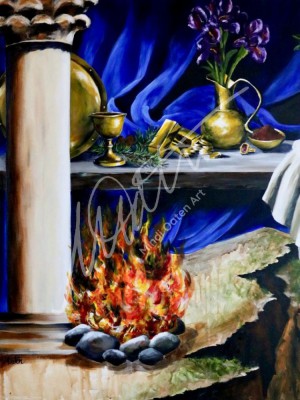
I think as we keep going through historical books, everything we’ve studied can sometimes seem to run together. I feel like looking at the paintings can help remind us exactly what each book was about. I want us to continue to see the Messiah in all of our studies. He is even in the book of 1 Kings. As we go through these chapters, I want you to consider how they point us to the coming Messiah.
TEACHING
1 Kings 3:1: This verse is a great summary of Solomon’s life. Solomon made an alliance with Pharaoh, the king of Egypt, by marrying his daughter. She came to the city of David, where Solomon was building his palace, God’s temple, and a wall around Jerusalem.
1 Kings 3:2: During this period, people had been making sacrifices on the high places because there had been no temple (1 Kings 1:7–13). After the new temple was completed, sacrifices in the high places were condemned).
1 Kings 3:3–4: Solomon went to one of the high places, made sacrifices, and burned incense. He then traveled to Gibeon because it was the most famous high place in Israel. There, he offered 1,000 burnt offerings. Gibeon was seven miles northwest of Jerusalem, and was the same place where Moses’s tabernacle and the bronze altar was originally constructed.
1 Kings 3:5: At Gibeon, the Lord appeared to Solomon at night in a dream. God instructed Solomon, “Ask. What should I give you?” God uses dreams and visions to speak to us. Do not discredit your own dreams. If you have a dream you think could be from the Lord, write it down, pray about what the dream could mean, and share it with someone to see what they think. Joel 2:28-28 and Acts 2:17 both say dreams and visions are going to happen in the last days.
1 Kings 3:6–7: Before Solomon asked for anything, he gave thanks to God. Many believe Solomon was roughly 20 years old at this time. He understood the big picture and God’s promises, but he also realized he was still very young (1 Timothy 4:12). He recognized he needed God’s help.
1 Kings 3:8: It is believed Solomon served as king over 4,000,000 people. The author of 2 Samuel 24:9 wrote that in Israel, there were 800,000 fighting men, and in Judah there were 500,000 fighting men. Add women, children, the elderly, and men unable to fight, and that’s a lot of people. Solomon desired to honor the promises he made to God and his father.
1 Kings 3:9: Solomon asked for an obedient heart to judge God’s people and to discern between good and evil. Solomon wrote Proverbs 4:5–7. He saw the value of wisdom and wanted to be able to walk out his call (1 Corinthians 1:24; James 1:5).
1 Kings 3:11–13: It pleased the Lord that Solomon requested an obedient heart, so the Lord granted Solomon’s request. The Lord gave Solomon a wise and understanding heart. Solomon was divinely unique. Because of Solomon’s selfless request, God blessed him with riches and honor as well. No kingdom would ever equal Solomon’s.
1 Kings 3:14: God told Solomon that if he kept His ways and commands the way his father, King David did, he would have a long life (Psalm 90:10). David died before the age 70 and Solomon died around the age of 70.
1 Kings 3:15: Solomon woke and realized he had experienced a dream. He traveled back to Jerusalem and brought offerings before the ark of the Lord’s covenant. Then, he gave a feast.
1 Kings 3:16–22: In the middle of the feast, two prostitutes came and presented a situation that required Solomon’s judgment. These two women lived in the same house and had both recently given birth. One woman claimed that during the night, the other woman’s baby died. That woman then got up, took the other woman’s child, and proclaimed it was her own. As this information was presented to Solomon, the other woman spoke up and said, “No, it is your son who is dead.” The women began to argue in front of the king.
1 Kings 3:23–25: Solomon asked for his sword. He told the women that he would cut the living boy in two and they would each receive one half of the child.
1 Kings 3:26–27: The real mother was filled with anguish and compassion. She would rather give her baby up than see him killed. The other woman told the king to go ahead and cut the baby in half. Solomon then gave the baby to the first woman—the baby’s real mother.
1 Kings 3:28: All Israel heard about Solomon’s wisdom and stood in awe. They realized God’s wisdom was with him.
CLOSING
When Solomon could have asked for anything, he requested wisdom. Through that wisdom, Solomon’s reign was also one of peace. Biblical scholar Paul van Gorder gives five reasons Solomon’s reign was notable:1
- Wisdom (1 Kings 3:9–12; 4:29–34): In Matthew 12:42, Queen Sheba came to hear Solomon’s great wisdom. What she discovered was there was Something Greater than Solomon in Israel, the presence of the Lord. The wisdom in 1 Kings 3:9–12 points to Jesus and Isaiah 11:2–4. Isaiah had prophesized about Jesus. Both Solomon and Jesus would have wisdom, but Jesus’ wisdom would be greater.
- Peace and Prosperity (1 Kings 4:25): This was an unusual time of peace and prosperity in a torn apart country (1 Kings 4:25; Micah 4:3-4). The Something Greater than Solomon was the Messiah.
- The Building of the Temple (1 Kings 5—7): This was the highpoint of Solomon’s reign (Ezekiel 40—49; 2 Thessalonians 2:3–4; Revelation 11:1–2). When the Messiah returns, we will have a third temple.
- God Enters the Temple (1 Kings 8): The structure of the Temple was completed and dedicated (Micah 4:2).
- Visit from Queen Sheba (1 Kings 10): The nations will come and worship Him (Zechariah 14:8-9, 16). Everything about Solomon points to Something Greater. In Matthew 12:42 Jesus says, “something greater than Solomon is here!”
1 Paul R. Van Gorder, The Old Testament Presents . . . Reflections of Christ: 1 Kings, available online at http://www.thebookwurm.com/ref-1kin.htm.
Questions
-
When the Lord appeared to Solomon in a dream asking what he wished the Lord to give him, what does Solomon request? How did Solomon demonstrate humility? (1 Kings 3:6–9)
-
What things did the Lord promise to Solomon in addition to what he asked for (1 Kings 3:13–14)? How did this point to the theme for 1 Kings: Something Greater? (1 Kings 1:47; Hebrews 1:8–9)
-
After Solomon’s judgement between the two prostitutes, all Israel heard and feared the king because they saw the wisdom of God was in him to administer justice. Why would this cause fear? (Job 12:22; Psalm 72:4–5; Proverbs 15:12; 21:15; 2 Corinthians 5:10)
-
First Kings 4:20 states Judah and Israel were as the grains of sand on the seashore in abundance. This it the fulfillment of what promise (Genesis 22:17)? Does this bring confidence that God will continue to fulfill His promises? (2 Corinthians 1:20a)
-
Solomon’s wisdom surpassed the wisdom of all the sons of the east and all the wisdom of Egypt. How is he a type of Christ? (Matthew 12:42; 1 Corinthians 1:30; Colossians 2:2–3)
-
What did the Holy Spirit highlight to you in 1 Kings 3—4 through the reading or the teaching?

Daily Word
Laura Martin 1 Kings 3:9
“So give Your servant an obedient heart to judge Your people and to discern between good and evil. For who is able to judge this great people of Yours?”
FURTHER SCRIPTURE
- Proverbs 4:6–7 — “Don’t abandon wisdom, and she will watch over you; love her, and she will guard you. Wisdom is supreme—so get wisdom. And whatever else you get, get understanding.”
- James 1:5 — “Now if any of you lacks wisdom, he should ask God, who gives to all generously and without criticizing, and it will be given to him.”
- James 3:17 — “But the wisdom from above is first pure, then peace-loving, gentle, compliant, full of mercy and good fruits, without favoritism and hypocrisy.”
Lesson and Daily Word
Each day has two parts: the Lesson and the Daily Word. Use these buttons to go from one to the other.
Teaching Notes and Questions
Next to the video, these tabs show the Teaching Notes and the Questions. Your answer to a question saves when you leave the answer box.
The Bible passage
This link opens the passage on Bible Gateway, and that gives the passage its tick. If you read it in your own Bible, tick it by hand in Progress.
Your progress on this lesson
A part ticks itself when you play the video or audio to the end, read the notes or the Daily Word to the end, or answer every question. You can also tick a part by hand here.
Downloads
Here you can save the video, the audio and the lesson as PDF files. Downloads do not count toward your progress.
Need help?
Use this button to send us a question or tell us about a problem. You can also take this tour again from there.