
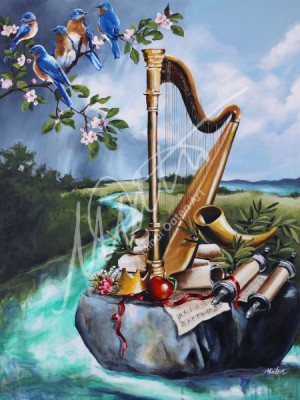
Protection Through Intimacy
Discover Jesus as: King of Glory Psalms 91 Read on Bible Gateway (HCSB)
Lesson
Audio Only
Teaching Notes
INTRO
The author of Psalm 91 is unknown. MacArthur observed, “This psalm describes God’s on-going sovereign protection of His people from the ever-present dangers and terrors which surround humanity” and proposed it was written for an army before they went to battle.1 We all want God’s sovereign protection in our lives. Scripture testifies to the many ways God preserved and protected people like Moses, David, Peter, and Paul. MacArthur noted this Psalm declares, “Nothing can harm a child of God unless the Lord permits it.”2
TEACHING
Psalm 91:1-2: God is called “the Most High” in verses 1 and 9. Because Israel was a place where the sun could be very hot and dangerous to one’s health, a shadow was a metaphor for care and protection.3 Wiersbe noted the description of God as “the Almighty” described “the all-sufficient God who is adequate for every situation.”4 The psalmist declared confidence in the Lord and not in himself. As he referred to God as “my refuge and my fortress” (v. 2), he acknowledged he could not be these things for himself and expressed trust in God to be both on his behalf. This is the sort of confidence the Lord commanded Abram to have in Genesis 17:1, “When Abram was 99 years old, the Lord appeared to him, saying, ‘I am God Almighty. Live in My presence and be blameless.’”
Psalm 91:3–6: These verses described the very real troubles of life with which followers of the Lord still have to deal. “The hunter’s net” in v. 3 represented the net a fowler, a person who trapped birds, used to catch his prey. The image served as a metaphor representing God’s deliverance from any plan to endanger the life of one who follows Him.5
“The destructive plague” (v. 3) references diseases and epidemics that might arise. The Lord promised to keep His followers from all of it. The psalmist described God as covering His followers “with His feathers,” meaning God was near and looking over them. This image was reinforced with a description of taking “refuge under His wings,” which implies intimacy with the Lord. Jesus described the type of protection He longed to offer Jerusalem in a similar way: “Jerusalem! Jerusalem! She who kills the prophets and stones those who are sent to her. How often I wanted to gather your children together, as a hen gathers her chicks under her wings, yet you were not willing” (Matthew 23:37)!
The psalmist listed more common situations that would face followers of the Lord: the terror of the night, the arrow, and plagues and pestilence (vv. 5–6). Intimacy with the Lord will protect His followers from all of these as well.
Psalm 91:7–9: The psalmist referenced thousands of people falling to pestilence, but it does not cause followers of the Lord to be fearful. This could be a reference to the plagues that came upon Egypt as part of God’s deliverance of Israel. God also promised He would multiply the efforts of His people when they encountered enemies, “Five of you will pursue 100, and 100 of you will pursue 10,000; your enemies will fall before you by the sword” (Leviticus 26:8). “How could one man pursue a thousand, or two put ten thousand to flight, unless their Rock had sold them, unless the Lord had given them up” (Deuteronomy 32:30)?
The psalmist promised that those who followed the Lord would see all these things take place because of their intimacy with Him (vv. 8–9). The psalmist specifically referenced “the Most High” in verse 9, God’s personal name, to demonstrate the level of intimacy His people have with Him.
Psalm 91:10–13: The psalmist used more images to reinforce the idea of the Lord’s protection. Another promise for protection from plague was made (v. 10), and angels are described as being ordered to protect the Lord’s people (v. 11) to the point the people would not hurt their feet on stones (v. 12). God’s people would even be able to withstand lions and poisonous snakes (v. 13).
Interestingly, Satan used verses 11 and 12 in his temptation of Jesus: “Then the Devil took Him to the holy city, had Him stand on the pinnacle of the temple, and said to Him, ‘If you are the Son of God, throw Yourself down. For it is written: ‘He will give His angels orders concerning you, and they will support you with their hands so that you will not strike your foot against a stone’” (Matthew 4:5–6). Satan misquoted this passage in order to frame his temptation of Jesus, but Jesus’ response, “It is also written: Do not test the Lord your God” (Matthew 4:7). This helps us understand we are not to put the Lord’s promise of protection to the test by intentionally creating dangerous situations for the Lord to deliver us.
Psalm 91:14–16: The speaker switches from the psalmist to the Lord in these verses. The Lord Himself promised protection to the psalmist because of his loving devotion. The Lord promised protection because the psalmist “knows My name” (v. 14). The Lord promised to answer the psalmist, be near in times of trouble, “rescue him and give him honor” (v. 15). Finally, the psalmist would receive “long life” and the Lord Himself would “show him My salvation” (v. 16).
MacArthur noted that while the promises of this psalm could be true of believers in every age of history, the clear references to a messianic king point to this psalm being fulfilled in the life of Jesus.6
CLOSING
How do we develop intimacy with God that gives us this level of relationship with God? The Authentic Intimacy blog prescribed five steps to cultivate intimacy with God:7
- Desire intimacy with God—David wrote of his desire “to dwell in the house of the LORD all the days of my life” (Psalm 27:4).
- Know God’s love language—God wants us to love Him with our obedience (Psalm 51:16–17).
- Love God affectionately.
- Don’t give up!
- Share in His work.
The word 'protection' is throughout Psalm 91. Embrace it so you can start walking out your calling without fear.
John MacArthur, John MacArthur Bible Commentary (Nashville: Thomas Nelson Publishers, 2005), p. 658.
MacArthur, p. 659.
MacArthur, p. 659.
Warren W. Wiersbe, The Bible Exposition Commentary: Old Testament (Colorado Springs: David C. Cook, 2004), p. 257.
MacArthur, p. 659–660.
MacArthur, p. 658.
“5 Secrets to Intimacy with God,” www.authenticintimacy.com, published June 4, 2015; available at https://www.authenticintimacy.com/resources/1409/5-secrets-to-intimacy-with-god.
Questions
-
What feelings are you left with after you meditated on Psalm 91? Do these verses fill you with peace, comfort, and love? Why or why not?
-
Psalm 91:2 mentions my Lord alone is my refuge, my place of safety, he is my God and I trust him. Do you see God as your safe place and refuge? Do you believe you can trust God? Spend a few minutes with God asking Him these questions.
-
Praises are lifted to God all throughout Psalms. Then, in Psalm 91:9–10, God said “if” (in some versions), which means some action is needed on our part. Where else do we read that God’s children need to “do” something in an if/then construction? (Exodus 23:22; Deuteronomy 4:29; 1 Chronicles 28:9; 2 Chronicles 7:14; Revelation 3:20)
-
Psalm 91 is full of promises from God. After you read Psalm 91, look at John 14:23–24. What similarities do you see? How does this speak to you?
-
What did the Holy Spirit highlight to you in Psalm 91 through the reading or the teaching?

Daily Word
Laura Martin Psalm 91:1–2
“The one who lives under the protection of the Most High dwells in the shadow of the Almighty. I will say to the LORD, ‘My refuge and my fortress, my God, in who I trust.’
FURTHER SCRIPTURE
- Psalm 91:3–4 — “He Himself will deliver you from the hunter’s net, from the destructive plague. He will cover you with His feathers; you will take refuge under His wings. His faithfulness will be a protective shield.”
- 2 Corinthians 4:8–9 — “We are pressured in every way but not crushed; we are perplexed but not in despair; we are persecuted but not abandoned; we are struck down but not destroyed.”
- 2 Thessalonians 3:3 — “But the Lord is faithful; He will strengthen and guard you from the evil one.”
Lesson and Daily Word
Each day has two parts: the Lesson and the Daily Word. Use these buttons to go from one to the other.
Teaching Notes and Questions
Next to the video, these tabs show the Teaching Notes and the Questions. Your answer to a question saves when you leave the answer box.
The Bible passage
This link opens the passage on Bible Gateway, and that gives the passage its tick. If you read it in your own Bible, tick it by hand in Progress.
Your progress on this lesson
A part ticks itself when you play the video or audio to the end, read the notes or the Daily Word to the end, or answer every question. You can also tick a part by hand here.
Downloads
Here you can save the video, the audio and the lesson as PDF files. Downloads do not count toward your progress.
Need help?
Use this button to send us a question or tell us about a problem. You can also take this tour again from there.