
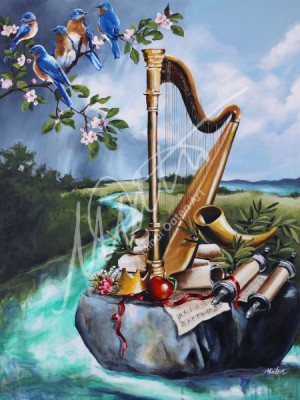
God Is In The Highs And Lows
Discover Jesus as: King of Glory Psalms 86-87 Read on Bible Gateway (HCSB)
Lesson
Audio Only
Teaching Notes
INTRO
The psalms were either written while the writer was experiencing the height of joy or a pit or valleys of sadness and despair. There are psalms that are confident and others that make you say, “Oh, my.” Just reading through and teaching the book of Psalms has been fun because the psalms are so real.
In my life, I’ve had some really high highs and some really low lows. If I had written down my thoughts, I might not have had the flowery words, but I think the sentiment would be the same. As I read through the psalms, I realize I think the same way. We are going to start in Psalm 86. I realize some are coming to this study experiencing highs while others are experiencing lows. The word of God will speak to both.
TEACHING
Psalm 86:1–7: David was crying out to the Lord, asking for provision and mercy. How many of you can relate to these first seven verses? Have you been in a situation where you are miserable or in pain? I have! Pain brings an emotional response. The psalms to me are soul expressions written out of emotion. While I know God is good, I have to bring my own understanding of God, my own reasoning, and stay faithful.
God is never closer than when He is necessary! This isn’t a prayer of contentment; this is a cry of anguish. I love the idea of bringing my humanity to the Lord and Him coming back asking, “Do you trust me? Do you believe me? Do you think I am here? Do you think I listen?” All of these things tend to build a relationship between the Spirit of God and my soul. I think David was an excellent writer.
Psalm 86:8–11: David wanted God’s attention, but he didn’t want God to think he did not trust the Lord. The part that speaks to me is when David wrote, “Unite my heart to fear thy name.” When I hear words like these, I hear David asking, “Please come through this with me. I don’t want to mess up my trust here, but I don’t understand. Teach me thy way. Help me to see how it looks for You. Take away the things that would say God doesn’t care or has abandoned you. Bring my reasoning together with what I know of who You are. If You’re satisfied, I am satisfied.”
In the midst of my personal pain, I had to focus on others who had it worse than me. That was how I could compensate. If I know God delivers me, and I am satisfied He hears me, because He says He does, I am going to stop agonizing and ask for healing. So, I look at these things thinking about what it would have been like for David. I can’t imagine what he went through, but when I see a psalm like this one, I see David’s heart for the Lord.
Psalm 86:12–13: David praised the Lord and glorified His name. I regard this as David saying, “I look and remember what You have done for me. Thank You!” There is a thankfulness here, yet David still made his case to God. He was struggling. I don’t think he was in pain, but he had a sorrow of heart as enemies were pursuing him.
Psalm 86:14–17: The proud and the assemblies of violent men were after David. David prayed, “Give me strength and hope. Show me that something is happening for my good.” I know there are those listening who are crying out to God, do you hear? Understand? or care? I pray that God would be of help and that God will care for those of you who are listening and need to hear from God right now. I’ve been so blessed, and yet I deal with hard and painful things.
These psalms help me to be more honest in my prayers. Psalms are very personal, which is why they are so relatable. Pain and suffering are a part of our story. You don’t see David doubting God’s goodness. I believe that today someone needs to hear this: You can call on God and tell Him anything you like. He is not going to be overwhelmed with your situation. His Holy Spirit that can visit and comfort you, bringing wisdom and understanding. I encourage you today to let God speak to you. Cry out. He hears your prayers.
Psalm 87:1-3: I can’t leave out Psalm 87 because Israel and Jerusalem are a central part of this ministry. This is a psalm from the sons of Korah and is a beautiful stand-alone psalm. Verse 2 states, “The LORD loveth the gates of Zion more than all the dwellings of Jacob.” Zion represents Jerusalem. It seems to say that God has a central city, He loves all Israel, but there is a city He holds in an especially high regard. What does Jerusalem mean? Teacher of Peace. Teacher of peace means standard, or emblem. God loves Jerusalem more than all the rest of Israel.
It says in Psalm 76:1–2, “In Judah God is known; His name is great in Israel. In Salem also is His tabernacle, and His dwelling place in Zion” (KJV). Salem is Jerusalem.
Psalm 87:4–6: God started out with a covenant with Israel that has expanded to other believers. From the surrounding nations, those who know God will be counted citizens of Jerusalem. They will be considered birthright citizens. God Himself will secure and provide for Jerusalem.
Psalm 87:7: This verse shows how God set Israel apart. Israel still plays a major role in the prophetic part of the last days. They’re going to get their Messiah. Everything hinges and springs out of Zion, because Christ is the representation of Zion.
The first place Salem (Zion) is mention is in Genesis 14:18:
“And Melchizedek king of Salem brought forth bread and wine: and he was the priest of the most high God. And he blessed him, and said, Blessed be Abram of the most high God, possessor of heaven and earth: And blessed be the most high God, which hath delivered thine enemies into thy hand. And he gave him tithes of all.” (KJV)
Hebrews 7:1 is another place that talks about Melchizedek:
“For this Melchizedek, king of Salem, priest of the most high God, who met Abraham as he was returning from the slaughter of the kings, and blessed him; to whom also Abraham gave a tenth part of all; first being by interpretation King of righteousness, and after that also King of Salem, which is, King of peace. Without father, without mother, without descent, having neither beginning of days, nor end of life; but made like unto the Son of God, abideth a priest continually.” (KJV)
I don’t see any humans who could fit this description. This psalm has clues that tie into the plans of God. God is going to play everything out thought this tiny nation of Jerusalem, which no one can destroy.
CLOSING
Understand these two chapters do not go together. I have spoken on two chapters that are very different, and yet the Holy Spirit has revealed a connection between the two. The God who has written Psalm 87 is the same God who sees me in Psalm 86. The same God who put a plan in place for thousands of years is the same God who knows my name. That is the beauty of these chapters. Even in pain and suffering, God is glorious! He is the strength that lifts us up!
Questions
-
In Psalm 86:11, David wrote, “Teach me Your way, Lord; I will walk in thy truth; Unite my heart to fear Your name.” Have you ever prayed a prayer like this? Are God’s ways always our ways?
-
How is God’s truth different from our truth? Are we supposed to be afraid of God and, if so, in what sense?
-
David asked for a sign in Psalm 86:17. Have you ever asked God for a sign? Do you think it’s okay to ask God for specific signs under the New Testament? (Judges 6:36–40; Matthew 12:39; Romans 8:14; 1 Corinthians 1:22; 2 Corinthians 5:7)
-
What or where is Psalm 87 talking about when it refers to Zion? (Hebrews 11:9–10; Revelation 21:10–27)
-
What did the Holy Spirit highlight to you in Psalms 86—87 through the reading or the teaching?

Daily Word
Laura Martin Psalm 87:7
“Singers and dancers alike will say, ‘My whole source of joy is in you.’”
Ask yourself: Is my whole source of joy in the Lord? Rather than living dry and weary, let the living water of the Lord be your whole source for joy. He alone can satisfy your heart.
May all things in life funnel and filter their way through the Lord. May He deliver you from the pit and pull you out with His compas- sion and graciousness. The Lord will be slow to anger, rich in truth, and faithful to love. That’s who God is. Let the river of His great love and the streams of His grace and mercy flow together as the one true source of joy. Stop looking elsewhere. Stop looking for some joy from the things of this world, some joy from temporary pleasures, some joy from earthly relationships, and then some joy from Jesus. Instead, let the Lord be the source of joy through everything. And once you discover the Lord as your whole source for joy, it will make you want to dance!
“Singers and dancers alike will say, ‘My whole source of joy is in you.’”
— Psalm 87:7
FURTHER SCRIPTURE
- Psalm 86:13 — “For Your faithful love for me is great, and You deliver my life from the depths of Sheol.”
- Isaiah 58:11 — “The Lord will always lead you, satisfy you in a parched land, and strengthen your bones. You will be like a watered garden and like a spring whose waters never run dry.”
- 2 Corinthians 3:5 – “It is not that we are competent in ourselves to consider anything as coming from ourselves, but our competence is from God.”
Lesson and Daily Word
Each day has two parts: the Lesson and the Daily Word. Use these buttons to go from one to the other.
Teaching Notes and Questions
Next to the video, these tabs show the Teaching Notes and the Questions. Your answer to a question saves when you leave the answer box.
The Bible passage
This link opens the passage on Bible Gateway, and that gives the passage its tick. If you read it in your own Bible, tick it by hand in Progress.
Your progress on this lesson
A part ticks itself when you play the video or audio to the end, read the notes or the Daily Word to the end, or answer every question. You can also tick a part by hand here.
Downloads
Here you can save the video, the audio and the lesson as PDF files. Downloads do not count toward your progress.
Need help?
Use this button to send us a question or tell us about a problem. You can also take this tour again from there.