
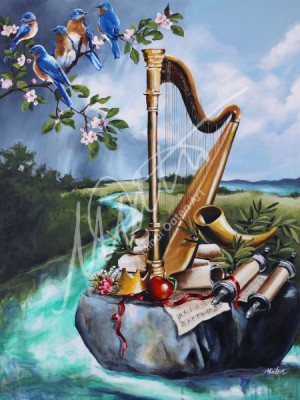
Feeling Abandoned By God
Discover Jesus as: King of Glory Psalms 74 Read on Bible Gateway (HCSB)
Lesson
Audio Only
Teaching Notes
INTRO
Psalm 74 is another psalm of lament. This psalm was written by Asaph. “Asaph, Heman, and Ethan were Levites who served as a musicians and worship leaders at the sanctuary during David’s reign.”1 These three had created “guilds” so their sons and other generations would be trained to continue to lead worship after they were gone. Some scholars have suggested the author of Psalm 74 may not have been Asaph the worship leader but a namesake of his.2 MacArthur explains the psalm’s lament focuses on the issue that “it was bad enough that Israel’s enemies had destroyed the temple; but even worse, it seemed to the psalmist that God had abandoned them.”3
TEACHING
Psalm 74:1-11: : Wiersbe uses three word-pictures to outline this psalm. Verses 1–11 point to “The Sanctuary: ‘The Lord Has Rejected Us!’”4 Verses 1–2 express the feeling of being abandoned by God. God had promised not to abandon His people (Deuteronomy 4:29–31; 26:18–19), but they were feeling that He had (Lamentations 5:20–22). The statement “remember your people” doesn’t mean God had forgotten them, but rather it was a request for God to work for them.5 They requested that God restore the ruins left after the temple was desecrated in Jerusalem (vv. 3–4). “Make your way,” asked that God walk around Jerusalem to see the damage that was still taking place in Jerusalem (1 Kings 6:18–22). The damage is described as men cutting trees and smashing carvings with axes, hatchets, and picks (vv. 5–6). Not only was the temple destroyed, but every meeting place and synagogue were burned down as well (vv. 7–8).6 In verses 9-11, and 19, God had not raised up new prophets for them, and they questioned how much longer they would be in the situation (Jeremiah 29:10; Lamentations 2:9). As they appealed to God, they also blamed God and questioned if He would even show up.
Psalm 74:12–17: Verses 12–17 point to “The Throne: ‘The Lord Reigns!’”7Nelson’s Commentary explains, “The Lord is King by virtue of His creation of the earth (Psalm 93).”8 Asaph stated God had divided the sea and smashed the sea monsters (vv. 12–14). Constable explains, “In Canaanite mythology, the sea and its serpents joined together as enemies of Baal. Supposedly Baal was victorious over these enemies and subsequently became king. The poets of the Bible used the language of Canaanite myth to describe the victories of God in the formation of the earth, in the deliverance of His people from Egypt, and in future battles.”9 In some places in the Old Testament, the Leviathan is equated with Satan (v. 14)10 (Isaiah 27:1). God had given the Hebrews springs of water and dried up rivers when the people needed to cross over (v. 15). Asaph outlined God’s dominion over the earth—the day and night was His because He had created the moon and the sun (v. 16). God created the seasons and established the boundaries of the earth (v. 17).
Psalm 74:18–23: Verses 18–23 point to “The Covenant: ‘The Lord Remembers Us!’”11 Wiersbe explains, “Since righteousness and justice are the foundation of His throne, it was logical for Asaph to move in his thoughts from God’s throne to God’s covenant with Israel (Leviticus 26; Deuteronomy 28:30).12 Asaph emphasized the enemy had mocked Yahweh and insulted His name (v. 18). He begged the Lord not to give the life of His dove (Israel) over to the beasts (their enemies) (v. 19). Asaph asked God to remember His covenant with them and not let the oppressed be shamed (vv. 20–21). Asaph called on God to defend His cause and His people instead of allowing the insults against Him to continue (vv. 22–23). These are the same requests made in verse 3. Wiersbe states, “The nation had been ravaged, the city of Jerusalem had been wrecked, and the temple had been destroyed and burned—but the essentials had not been touched by the enemy! The nation still had Jehovah God as their God, His Word and His covenant had not been changed, and Jehovah was at work in the world!”13
Think about the history of the temple:
- The tabernacle was built (Exodus 27:8).
- For 440 years, the tabernacle was in Israel (Leviticus 26:1).
- For 369 years, the tabernacle was in Shilo (1 Samuel 1:3).
- David conquered Jerusalem in 1004 B.C. (2 Samuel 5), established an altar, and moved the ark of the covenant to Mount Moriah (1 Samuel 6).
- David planned to build a house for God (1 Kings 28:19).
- King Solomon built the first temple in 950 B.C. (1 Kings 7:46–51), and dedicated it (1 Kings 9:3).
- Temple worship took place for 426 years.
- Babylonians destroyed the first temple in 586 B.C. (Jeremiah 34), and the Jews were taken into exile (Jeremiah 31).
- Daniel prayed toward Jerusalem (Daniel 6:11).
- The altar was rebuilt (Ezra 1:2).
- The prophet Haggai exhorted the people to rebuilt God’s temple (Haggai 1:2–4).
- Ahasuerus held a feast with stolen temple treasures in 365 B.C. (Esther 1:7).
- The temple cornerstone was placed, and the people wept and rejoiced (Ezra 2:13).
- Ezra taught the people with the public reading of the Torah (Ezra 3:12).
- The temple was purified in 165 B.C.
- Work was completed on Herod’s temple (the second temple) (Psalm 48:2) and became the center of Jewish national life.
- The second temple was destroyed by the Romans in A.D. 70. Jesus stated that the temple would be destroyed (Matthew 24:1–2).
- We are waiting for the third temple to be built. Somehow, peace will come to Israel and the temple will be rebuilt on the Temple Mount (Matthew 24:15; 2 Thessalonians 2:3–4; Revelation 11:1–2).
CLOSING
God is still at work in our world today. He has not forgotten us, and He has not abandoned us. He never will! When the third temple is built, will you be crying out for the Lord? Will you be ready?
Warren W. Wiersbe, The Bible Exposition Commentary: Old Testament (Colorado Springs: David C. Cook, 2004), p. 221.
Wiersbe, p. 221.
John MacArthur, John MacArthur Bible Commentary (Nashville: Thomas Nelson Publishers, 2005), p. 646.
Wiersbe, pp. 224.
Wiersbe, pp. 224.
Wiersbe, pp. 224.
Wiersbe, pp. 224..
Earl Radmacher, Ronald B. Allen, and H. Wayne House, eds., Nelson’s New Illustrated Bible Commentary (Nashville: Thomas Nelson Publishers, 1999), p. 696.
Wiersbe, p. 186.
Constable, p. 288.
Wiersbe, p. 225.
Wiersbe, p. 225.
Wiersbe, p. 225.
Questions
-
In Asaph’s appeal to God in the first two verses, what series of endearing terms did he use to describe the people of God? What actions of God toward His people did Asaph ask God to remember? What did he mean by asking God to remember? (Leviticus 26:42)
-
What did the people of Judah believe about the presence of the temple despite how they lived? (Jeremiah 7:4–11)
-
In what ways can the Lord be described as King? (Psalm 44:4; 93; 96:13; 97:1–6; 98:6–9; 99:1–3)
-
What were the salvation works of the Lord from the past that Asaph was describing in verses 12–17? Are there times when you recall what God did in the past to help you through a tough situation or circumstance?
-
What are some promises in Scripture given to God’s people to remind us that He will never fail us?
-
What did the Holy Spirit highlight to you in Psalm 74 through the reading or the teaching?

Daily Word
Laura Martin Psalm 74:11–12
“Why do You hold back Your hand? Stretch out Your right hand and destroy them! God my King is from ancient times, performing saving acts on the earth.”
Do you ever wonder why God doesn’t just stretch out His hand and cure the sick, destroy the evil in the world, or make the pain go away? By faith, you believe He can. By faith, you trust He will. By faith, you believe He has a plan. You have seen the work of His hands in the past, you have witnessed miracles, and you know the power of the Lord God Almighty. But in this moment, in this circumstance, He doesn’t seem to be moving like you know He can, and you begin to feel abandoned by God.
And yet you wait. You wait and you remember the works of His hands and give thanks for the times in your life you witnessed Him perform saving acts on the earth. And you surrender your will to the Lord. You say: “Not my will, but Your will be done.” Because even when you don’t see Him moving, the Lord God is in your midst, working in ways you cannot see. Today, hold on to the hope, be on watch, and expect the Lord’s power to reign in your life for His glory.
“Why do You hold back Your hand? Stretch out Your right hand and destroy them! God my King is from ancient times, performing saving acts on the earth.”
— Psalm 74:11–12
FURTHER SCRIPTURE
- Isaiah 65:24 — “Even before they call, I will answer; while they are still speaking, I will hear.”
- Luke 22:42 — “Father, if You are willing, take this cup away from Me—nevertheless, not My will, but Yours, be done.”
- John 5:17 — “But Jesus responded to them, ‘My Father is still working, and I am working also.’”
Lesson and Daily Word
Each day has two parts: the Lesson and the Daily Word. Use these buttons to go from one to the other.
Teaching Notes and Questions
Next to the video, these tabs show the Teaching Notes and the Questions. Your answer to a question saves when you leave the answer box.
The Bible passage
This link opens the passage on Bible Gateway, and that gives the passage its tick. If you read it in your own Bible, tick it by hand in Progress.
Your progress on this lesson
A part ticks itself when you play the video or audio to the end, read the notes or the Daily Word to the end, or answer every question. You can also tick a part by hand here.
Downloads
Here you can save the video, the audio and the lesson as PDF files. Downloads do not count toward your progress.
Need help?
Use this button to send us a question or tell us about a problem. You can also take this tour again from there.