
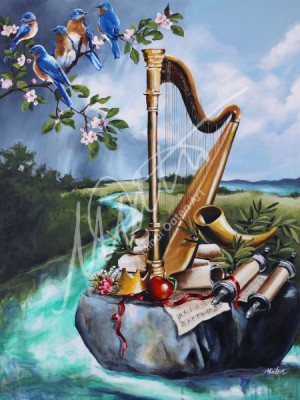
Misplaced Trust in Wealth
Discover Jesus as: King of Glory Psalms 49-50 Read on Bible Gateway (HCSB)
Lesson
Audio Only
Teaching Notes
INTRO
Psalm 49 is a wisdom psalm. The sons of Korah wrote it for the choir director for the people to sing. According to Nelson’s Commentary, Psalm 49 is one of instruction set to music. The psalm “calls for the wise person to realize that there is nothing to fear from the oppressive rich: like animals, they too will die. But the righteous will live forever.”1 The title for Psalm 49 is “Misplaced Trust in Wealth.”
The authors were the sons of Korah. Their background is interesting. God told Moses and Aaron to take a census of the Kohathite men between the ages of 30 and 50 years old (Numbers 4:1–5). Aaron and his sons had the responsibility to take care of the most holy objects. These items included: the ark, the table of God’s presence, the bowls and pitchers used in the drink offering, the lampstand and the lamps from the tabernacle, and the gold altar (Numbers 4:7–20). Whenever the camp moved, these also had to be packed up and moved. Then the Kohathites would transport the objects, but they could not touch these items themselves or even look at them or they would die (Numbers 4:15, 20). God also told Moses and Aaron to take care of the Kohathite clans so they would not be wiped out by the Levites because the Kohathites had an important function to fulfill (Numbers 4:17–20).
In Numbers 16, Korah and other prominent Israelite men rebelled against Moses and Aaron and told them all the Israelites were holy. They questioned why Moses and Aaron exalted themselves above the Israelite community (vv. 1–3). This was jealousy on their part because they had been carrying these holy things their entire lives but could not touch them, but Moses and Aaron could. Moses responded by saying he did what God called him to do. He said if these who rebelled lived and died like everyone else, there would be no proof he did what God wanted him to do. However, if God did something unprecedented, and the ground opened and swallowed them all, along with everything they had, the people of Israel would know God was in charge. (vv. 28–30). The ground immediately opened just as Moses had described and swallowed all of
Korah’s people and all of their possession into Sheol, and then closed back over them (vv. 31–35). While it looks like they were all swallowed up, the census in Numbers 26 showed a small group of Korah’s people did not die (vv. 9–11).
TEACHING
Psalm 49:1-4: Nelson’s Commentary explains verses 1–4 as “a call for understanding” that goes out to all people universally.2 The Hebrew word for “world” (v. 1), means “the total human scene, the whole sphere of passing life.”3 The phrase “riddle” or “dark saying” means “enigma” and “refers to a perplexing moral problem: how do the righteous come to terms with oppressive rich people who seem to have no thought for God?”4 The psalmists said they would explain this dilemma using a musical instrument.
Psalm 49:5–9:The psalmist acknowledged the sins of his foes but said he had no fear for them. They put their trust in their personal wealth but did not have enough money to redeem themselves before God. The word “pit” (v. 9) referred to “the power of death in its dark aspect.”5 Only God can deliver anyone from the power of death. Wiersbe explains that it is not a sin to
be wealthy “if we acknowledge God as the Giver and use what He gives to help others and glorify His name.”6 (Mark 10:24–25; Luke 16:15.)
Psalm 49:10–12:The wealthy without God would die and others would receive their wealth. All they had to show for their lives was their eternal resting place—their graves. Humankind, like animals, will die. Having wealth will not prevent that from happening.
Psalm 49:13–15:Those who followed this path were arrogant, and they were headed for Sheol. But God has the power to redeem the wealthy and the poor from the power of Sheol. This points to the redemptive work of “the Lord [who] has already ransomed us from sin and the power of the grave.”7
Psalm 49:16–20:Therefore, they were not to be afraid of those who had wealth, who would take nothing with him when he died, and would never again see the light of day. But, “A man with valuable possessions but without understanding is like the animals that perish” (v. 20).
CLOSING
Having the background of the sons of Korah brings this passage to life. You have to wonder if the words of Psalm 49 came from the family experiences outlined in Numbers. The wisdom of this psalm seems to have deep roots in what happened to the people of Korah who wanted what others had and missed the important role they already had. These lyrics came from someone who had learned what was real and what was important.
Earl Radmacher, Ronald B. Allen, and H. Wayne House, eds., Nelson’s New Illustrated Bible Commentary (Nashville: Thomas Nelson Publishers, 1999), p. 680.
Nelson’s Commentary, p. 680.
Warren W. Wiersbe, The Bible Exposition Commentary: Old Testament (Colorado Springs: David C. Cook, 2004), p. 187.
Nelson’s Commentary, p. 681.
Nelson’s Commentary, p. 681.
Wiersbe, p. 187.
Wiersbe, p. 188.
Questions
-
Who was the intended audience for Psalm 49? What is the overall message the psalmist was trying to get across?
-
What is the problem with trusting in wealth (Mark 10:23–24; 1 Timothy 6:17)? What is the purpose for the wealth God gives us (Matthew 6:33; 2 Corinthians 9:10–12; 1 Timothy 6:18–19)? How can you know if you are trusting in wealth or in God?
-
In Psalm 49, what are some things that money cannot buy or do? (Matthew 16:26; Luke 12:20–21; 1 Timothy 6:7)
-
If God does not hunger for food, what does Scripture say He does “hunger” for? (Hosea 14:2; Romans 12:1)
-
What did the Holy Spirit highlight to you in Psalms 49—50 through the reading or the teaching?

Daily Word
Laura Martin Psalm 49:6–7
“They trust in their wealth and boast of their abundant riches. Yet these cannot redeem a person or pay his ransom to God.”
Do you ever find yourself looking at your neighbors and comparing your life to theirs? Perhaps they seem more successful or wealthier from the world’s perspective. Whether you have much or little on this earth, the key is to focus your heart and mind on the Lord, not on the things of this world. Jesus said it is easier for a camel to enter through the eye of a needle than for a rich man to enter the kingdom of God. So keep your eyes on Jesus and not on others or on accumulating more wealth.
Today, give thanks for the gifts God has given you—both material and spiritual, remembering every good and perfect gift comes from the Lord. Resist the temptation to compare yourself to others or even to judge others and their success. Trust the Lord with a pure heart and live obediently to the things the Lord is calling you to do. Whether rich or poor, the Lord desires all people to give up their lives for the sake of the Gospel. The more you give up, the richer you become in the Lord. You can never outgive God!
“They trust in their wealth and boast of their abundant riches. Yet these cannot redeem a person or pay his ransom to God.”
— Psalm 49:6–7
FURTHER SCRIPTURE
- Matthew 16:25–26 — “For whoever wants to save his life will lose it, but whoever loses his life because of Me will find it. What will it benefit a man if he gains the whole world yet loses his life? Or what will a man give in exchange for his life?”
- Mark 10:24–25 — “But the disciples were astonished at His words. Again Jesus said to them, ‘Children, how hard it is to enter the kingdom of God! It is easier for a camel to go through the eye of a needle than for a rich person to enter the kingdom of God.’”
- Luke 16:14–15 — “The Pharisees, who were lovers of money, were listening to all these things and scoffing at Him. And He told them: ‘You are the ones who justify yourselves in the sight of others, but God knows your hearts. For what is highly admired by people is revolting in God’s sight.’”
Lesson and Daily Word
Each day has two parts: the Lesson and the Daily Word. Use these buttons to go from one to the other.
Teaching Notes and Questions
Next to the video, these tabs show the Teaching Notes and the Questions. Your answer to a question saves when you leave the answer box.
The Bible passage
This link opens the passage on Bible Gateway, and that gives the passage its tick. If you read it in your own Bible, tick it by hand in Progress.
Your progress on this lesson
A part ticks itself when you play the video or audio to the end, read the notes or the Daily Word to the end, or answer every question. You can also tick a part by hand here.
Downloads
Here you can save the video, the audio and the lesson as PDF files. Downloads do not count toward your progress.
Need help?
Use this button to send us a question or tell us about a problem. You can also take this tour again from there.