
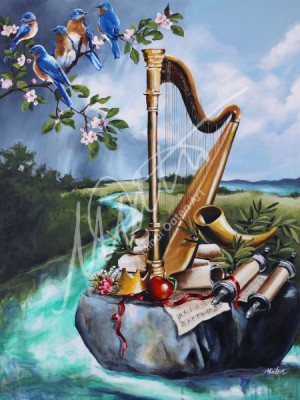
Dedicating the House to God
Discover Jesus as: King of Glory Psalms 29-30 Read on Bible Gateway (HCSB)
Lesson
Audio Only
Teaching Notes
INTRO
This is, amazingly, our 405th lesson in Revive School. What a wonderful opportunity this has been to embrace the study of the Bible as we identify how the Messiah is presented in each book. Psalm 30 is not about our confidence in ourselves, but about what God has done for us. David confessed this in Psalm 30. David found a way to express his emotions through the psalms he wrote.
TEACHING
Psalm 30:1-3: Nelson’s Commentarypoints out that “David begins his song with a strong determination to praise God.”1 David’s praise was in response to God’s protection and healing (vv. 1–2). In our study of Psalm 20, we looked at the eight words that can be prayed: to answer, protect, help, sustain, remember, give, fulfill, and lift up. David used these words repeatedly in his psalms, two (lifted up and healed) in verses 1–2. According to these first verses, David was facing enemies and, according to MacArthur, had recovered from “a near-death experience.”2 David acknowledged he had been guilty, and God had spared him from ultimate punishment (v. 3).
Psalm 30:4–5: David called his people to praise God as well (v. 4). David reminded the people that God’s anger was short lived, and they could find joy in Him in the morning (v. 5; Lamentations 3:22-23). David wrote, “His anger lasts only a moment, but His favor, a lifetime” (v. 5a).
Psalm 30:6–10: David confessed he once found his security in himself and thought he was invincible (v. 6). MacArthur describes David’s attitude as having an “independent attitude and arrogant talk.”3 (Proverbs 1:32; Jeremiah 22:21). David realized “he was acting like his arrogant adversaries” (Psalm 10:6).4 Yet, through God’s favor, David understood who God was and wanted Him to be his Lord (vv. 7–10).
The title of this psalm is: A psalm; a dedication song for the house. Davidic. Let’s work through this title. What house was David referring to? Biblical scholars are not sure. Perspectives include:
- The house was one of David’s palaces, meaning David referred to the place in which he lived.
The temple of the Lord. Most scholars would side with this possibility. First Chronicles 21:1–21 tells the story of how Satan incited David to take a census of the people of Israel. David’s decision was driven by pride, and it was not in response to anything God told him to do. Israel was afflicted because of David’s decision. This is the picture David described in Psalm 30:6. In 1 Chronicles 21:9-15, David was given three choices to right the situation before God, one of which would have taken David’s life. David couldn’t make the choice and asked God to, so God sent a plague on Israel. Psalm 30 is the continuation of David’s learning process as he grew from arrogance about his own abilities to have faith in the power of the Lord (2 Samuel 24:10, 14). In 1 Chronicles 21:16, David fell on the ground before God in humility. Psalm 30:11 records, “You turned my lament into dancing; You removed my sackcloth and clothed me with gladness.” I cannot say with certainty that Psalm 30 was written after the events of 2 Samuel 24, but it follows the events and the feelings of arrogance and pride, and then sadness and humility, that David spoke of. Because of this, David purchased a plot of land on which he could build a place to worship the Lord (1 Chronicles 22:1).
CLOSING
We all have done some sinful things. David’s sin caused 77,000 men to die. I don’t think any of us can measure up to that. God is a redeeming God, and He wants us to be able to experience what it means to worship anew in Him, just as David did. My hope for you is that you can experience the freedom of releasing the weight of that sin so you can rejoice in the Lord.
Psalm 30 ends with these words: “You removed my sackcloth and clothed me with gladness, so that I can sing to You and not be silent. Lord my God, I will praise You forever” (vv. 11b–12). David realized that it was not about him, but how he could glorify God. Following Christ is not about what you can get out of it, but how you can glorify God through your bodies (1 Corinthians 6:19-20).
Earl Radmacher, Ronald B. Allen, and H. Wayne House, eds., Nelson’s New Illustrated Bible Commentary (Nashville: Thomas Nelson Publishers, 1999), p. 668.
John MacArthur, The MacArthur Bible Commentary (Nashville: Thomas Nelson Publishers, 2005), p. 617.
MacArthur, p. 617.
MacArthur, p. 617.
Questions
-
God’s voice is mentioned several times in Psalm 29. How did the Psalmist describe it, and what were some of the things he compared it to? What do you think was happening to David to make him write this psalm?

Daily Word
Laura Martin Psalm 30:5, 11–12
“For His anger lasts only a moment, but His favor, a lifetime. Weeping may spend the night, but there is joy in the morning You turned my lament into dancing; you removed my sackcloth and clothed me with gladness, so that I can sing to You and not be silent. LORD my God, I will praise You forever.”
FURTHER SCRIPTURE
- Lamentations 3:22–23 — “Because of the Lord’s faithful love we do not perish, for His mercies never end. They are new every morning; great is Your faithfulness!”
- Romans 8:28 — “We know that all things work together for the good of those who love God: those who are called according to His purpose.”
- Ephesians 1:7 — “We have redemption in Him through His blood, the forgiveness of our trespasses, according to the riches of His grace.”
Lesson and Daily Word
Each day has two parts: the Lesson and the Daily Word. Use these buttons to go from one to the other.
Teaching Notes and Questions
Next to the video, these tabs show the Teaching Notes and the Questions. Your answer to a question saves when you leave the answer box.
The Bible passage
This link opens the passage on Bible Gateway, and that gives the passage its tick. If you read it in your own Bible, tick it by hand in Progress.
Your progress on this lesson
A part ticks itself when you play the video or audio to the end, read the notes or the Daily Word to the end, or answer every question. You can also tick a part by hand here.
Downloads
Here you can save the video, the audio and the lesson as PDF files. Downloads do not count toward your progress.
Need help?
Use this button to send us a question or tell us about a problem. You can also take this tour again from there.