
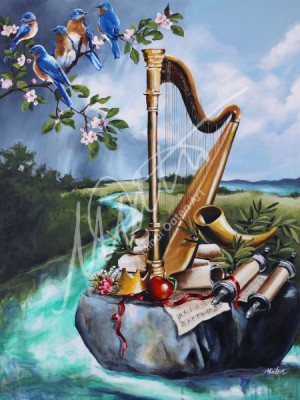
The Head of the Nations
Discover Jesus as: King of Glory Psalms 18 Read on Bible Gateway (HCSB)
Lesson
Audio Only
Teaching Notes
INTRO
Reading the book of Psalms has been an emotional rollercoaster for me. The emotional extremes are significant. Psalm 18 is emotionally up as a psalm of thanksgiving, and it’s one of the royal psalms. “Although the title seems to refer to only one specific occasion (“on the day”), it does state that God’s deliverance was ‘from the hand of all his enemies and from the hand of Saul’. Therefore, it is preferable that the language of this superscription be understood to summarize the testimony of David’s entire life in retrospect.”1 This is the second longest superscription (only Psalm 60 is longer) within the psalms.2 Psalm 18 strongly resembles 2 Samuel 22:1–2.
TEACHING
Psalm 18:1-18: Wiersbe explains that the first 18 verses of Psalm 18 are about how “God delivers when we call on Him.”3 The first three verses present David’s prelude of praises. David says, “I love You, Lord.” MacArthur explains that the Hebrew word for “love” used here was “not the normal word for love that often bears covenant meaning, but is a rare verb form of a word group that expresses tender intimacy.”4 (In John 21:15–17 a similar type of love is expressed.) In verse 2, David uses seven metaphors to describe what God is to him: his rock, his fortress, his deliverer, his mountain, his shield, his salvation, and his stronghold (Psalm 84:9; 89:18). The Lord is ALL David needs when he faces life’s tough battles. God answers his call and saves him from his enemies (v. 3). David faces death and cries out in desperation and terror (vv. 4–5). David cries out while facing death, and God hears him (v. 6).
In verses 7–15, David presents a “theophany, a vivid, poetic picture of God’s presence . . . largely described by various catastrophic responses by all creation.”5 David saw God’s power and anger as the earth shook and the mountains trembled (vv. 7–8). The heavens parted, and God came down to earth, riding a cherub and soaring on the winds (vv. 9–10). He thundered from heaven and hurled arrows and lightning bolts (vv. 13–14). The foundations of the world and the depths of the sea could be seen at God’s rebuke (v. 15). God rescued David out of the deep waters and from his powerful enemy (vv. 16–17). The Lord delivered David (v. 18). (These Scriptures provide examples of love intimacy with the Lord: Psalm 102:13; 103:13; Isaiah 49:15; Hosea 1:7.)
Psalm 18:19–27: Wiersbe explains that verses 19–27 are about how God rewards us when we obey.6
Psalm 18:28–45: Wiersbe points out that these verses are about how God equips us when we submit to Him.7 David went through so many experiences in life to get to this point and God equipped him to grow in those experiences.
Verse 43 states that God delivered David and appointed him as head of the nations. This also speaks about the coming of the Messiah, who will be over all nations. Matthew 25:31–34 gives a picture of Psalm 18:43 in the prophetic picture of the Messiah who is head of the nations: “When the Son of Man comes in His glory, and all the angels with Him, then He will sit on the throne of His glory. All the nations will be gathered before Him, and He will separate them one from another, just as a shepherd separates the sheep from the goats. He will put the sheep on His right and the goats on the left. Then the King will say to those on His right, ‘Come, you who are blessed by My Father, inherit the kingdom prepared for you from the foundation of the world.’” The rest of Matthew 25 explains the sheep nations are those aligned with Israel.
Revelation 7:9–10 supports this picture: “After this I looked, and there was a vast multitude from every nation, tribe, people, and language, which no one could number, standing before the throne and before the Lamb. They were robed in white with palm branches in their hands. And they cried out in a loud voice: Salvation belongs to our God, who is seated on the throne, and to the Lamb!”
CLOSING
Wiersbe states, “God is glorified when we worship him.”8 In all of this, God is glorified in our worship. David’s psalm closes with these words: “Therefore I will praise You, Yahweh, among the nations; I will sing about Your name. He gives great victories to His king; He shows loyalty to His anointed, to David and his descendants forever.”This is a royal Messianic prophecy that points to the Davidic Covenant and then points to the Messianic Covenant. In Romans 15:9 Paul brings Psalm 18 into focus.
John MacArthur, The MacArthur Bible Commentary (Nashville: Thomas Nelson Publishers, 2005), p. 609.
James A. Johnston and R. Kent Hughes, Psalms 1–41, v. 1 (Wheaton: Crossway, 2015), p. 193.
Warren W. Wiersbe, The Bible Exposition Commentary: Old Testament (Colorado Springs, David C. Cook, 2004), p. 123.
MacArthur, p. 609.
MacArthur, p. 609.
Wiersbe, p. 123.
Wiersbe, p. 124.
Wiersbe, p. 125.
Questions
-
Psalm 18 is nearly identical to 2 Samuel 22, but the very first line is not found in 2 Samuel. What is that line? Do you perceive the Lord as your strength? What does (or would that) look like?
-
Look at Psalm 18:20–24; it basically has the same message as Job 23:11–12 and 27:6. How could both men make these claims of righteousness?
-
Three to four times in Psalm 18, depending on the translation, David referred to the Lord as his rock (Psalm 18:2, 31, 46). What book did we study with the theme “Rock”? Do you think of God in this way? Why or why not?
-
Look up Psalm 18:26 in at least three different translations and explain what the second part of this verse means.
-
What did the Holy Spirit highlight to you in Psalm 18 through the reading or the teaching?

Daily Word
Laura Martin Psalm 18:1
“I love you, LORD, my strength.”
Think of a time when you cried out to the Lord with an emotional, heartfelt prayer. Perhaps you needed healing, an impossible provision, supernatural wisdom, or protection from harm’s way. And then God moved—He answered in an “only God” type of way. Did you stop and worship, giving praise and thanksgiving to the Lord? Maybe you didn’t have the words to praise the Lord? Maybe you want to enter His gates with thanksgiving and His courts with praise, but you just feel stuck when you try to articulate it. Take a minute and read David’s words in Psalm 18 aloud. Seriously, do it. David praised the Lord with such a depth of worship and praise. You can learn from this man who cried out to the Lord through every circumstance and witnessed the Lord move in impossible, “only God” ways to deliver and heal him.
Today, begin praising the Lord with the phrase: “I love You, Lord, my strength.” It may seem simple, but repeat the words out loud, over and over, until it comes from a place of real adoration to the Lord. God is glorified when you worship Him. Call to the Lord who is worthy of praise, and you will be saved.
“I love you, Lord, my strength.”
— Psalm 18:1
FURTHER SCRIPTURE
- Psalm 18:2-3 — “The Lord is my rock, my fortress, and my deliverer, my God, my mountain where I seek refuge, my shield and the horn of my salvation, my stronghold. I called to the Lord, who is worthy of praise, and I was saved from my enemies.”
- Mark 12:30 — “Love the Lord your God with all your heart, with all your soul, with all your mind, and with all your strength.”
Lesson and Daily Word
Each day has two parts: the Lesson and the Daily Word. Use these buttons to go from one to the other.
Teaching Notes and Questions
Next to the video, these tabs show the Teaching Notes and the Questions. Your answer to a question saves when you leave the answer box.
The Bible passage
This link opens the passage on Bible Gateway, and that gives the passage its tick. If you read it in your own Bible, tick it by hand in Progress.
Your progress on this lesson
A part ticks itself when you play the video or audio to the end, read the notes or the Daily Word to the end, or answer every question. You can also tick a part by hand here.
Downloads
Here you can save the video, the audio and the lesson as PDF files. Downloads do not count toward your progress.
Need help?
Use this button to send us a question or tell us about a problem. You can also take this tour again from there.