
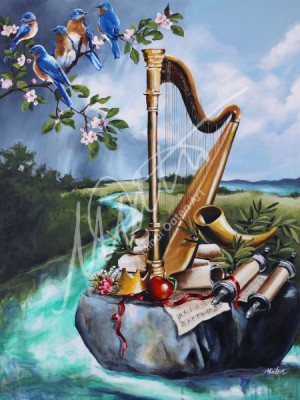
Delight in God's Word
Discover Jesus as: King of Glory Psalms 119 Read on Bible Gateway (HCSB)
Lesson
Audio Only
Teaching Notes
INTRO
Psalm 119 is a fun psalm. Whenever I reference a psalm out on the streets, it’s always Psalm 119. With 176 verses, it is the longest psalm. Psalm 119:105 is one of my favorite verses: “Your word is a lamp for my feet and a light on my path.” This is the answer for going through life. Studying the Word gives you the next step—a light for your path. Verse 105 is the summary of the entire psalm. The author is unknown, but it is known that the psalm was written under duress (vv. 42, 134, 153). There are many verses within the psalm that point to this duress.
TEACHING
Psalm 119:1-76: The psalm was written as an acrostic. It has 22 sections with eight lines each. All eight lines of the first section begin with the first letter of the Hebrew alphabet.1 Each section then follows throughout the Hebrew alphabet. Thomas Constable breaks these sections down as follows:
- The blessing of obeying God’s Word (vv. 1–8)
- The cleansing power of God’s Word (vv. 9–16)
- An appreciation for God’s Word (vv. 17–24)
- A prayer for greater understanding (vv. 25–32)
- Loyal commitment to God’s Word (vv. 33–40)
- God’s Word and salvation (vv. 41–48)
- God’s Word as a source of hope (vv. 49–56)
- Strong commitment to God’s Word (vv. 57–64)
- Confidence in the Word of God (vv. 65–72)
- God’s Word as an object of hope (vv. 73–80)
- The reliability of God’s Word (vv. 81–88)
- The permanence of God’s Word (vv. 89–96)
- The sweetness of God’s Word (vv. 97–104)
- The illumination God’s Word provides (vv. 105–112)
- The reverence God’s Word inspires (vv. 113–120)
- The vindication of those who keep God’s Word (vv. 121–128)
- The wonder of God’s Word (vv. 129–136)
- The righteous character of God’s Word (vv. 137–144)
- The truth of God’s Word (vv. 145–152)
- Love for God’s Word (vv. 153–160)
- Joy in God’s Word (vv. 161–168)
- Salvation in God’s Word (vv. 169–176)2
Scripture says the “Word became flesh,” so all this points to Christ, the ultimate King of Glory (John 1:1, 14).
Within the psalm, eight words are used as synonyms for God’s Word: The Law (used five times); testimonies (used 23 times); precepts (used 21 times); statutes (used 21 times); commandments (used 22 times); judgments (used 19 times); Word (used 39 times); and ordinances (used 23 times).3
Wiersbe points out three kinds of people who reject God’s Word:
To unsaved sinners, the law is an enemy because it announces their condemnation and cannot save them. To legalistic believers, the law is a master that robs them of their freedom. But to spiritually minded believers, the law is a servant that helps them see the character of God and the work of Christ.4
CLOSING
What does the Word of God do for us? Wiersbe points out:
The Word of God performs many wonderful ministries in the life of the devoted believer. It keeps us clean, gives us joy, guides us, and establishes our values. The Word helps us to pray effectively and gives us hope and peace and freedom. Loving the Word will bring the best friends into our life, help us find and fulfill God’s purposes, and strengthen us to witness. When we think we are “down and out,” the Word will revive us and get us back on our feet. 5
When we go to the Word of God, it breathes new life into us. However, the psalmist ended Psalm 119 with this: “I wander like a lost sheep; seek Your servant, for I do not forget Your commands” (v. 176). In spite of all he knew about God’s Word and his desire to follow it, the psalmist acknowledged he still sinned. We need God as the lamp for our feet and a light on my path!
John MacArthur, John MacArthur Bible Commentary (Nashville: Thomas Nelson Publishers, 2005), p. 680.
Thomas Constable, Dr. Constable’s Bible Expository Study Notes: Psalms, pp. 412-432; available at https://planobiblechapel.org/tcon/notes/pdf/psalms.pdf.
Constable, pp. 409–410.
Warren W. Wiersbe, The Bible Exposition Commentary: Old Testament (Colorado Springs: David C. Cook, 2004), p. 310.
Wiersbe, p. 311.
Questions
-
Psalm 119:11 says, “Your word I have treasured in my heart, that I may not sin against You.” Some versions say “hidden” instead of “treasured.” How do you treasure/hide something in your heart (Deuteronomy 6:4–8)? How could treasuring/hiding God’s Word in your heart keep you from sinning against Him?
-
How easy is it for you to do what it says to do in Psalm 119:37? How can vanity or worthless things take away from your reliance on God? How about your relationship with Him? (Proverbs 11:2; 16:18; 29:23; James 4:1–4)
-
How can we walk in liberty, or in freedom, by seeking God’s precepts, as it says in Psalm 119:45 (John 1:14; 8:36)? How does God’s law compare to man’s law? (Psalm 19:7)
-
What does the world teach today that is different from what is stated in Psalm 119:73, “Your hands made me and fashioned me” (Genesis 1:26–27; Jeremiah 1:5)? How can the world’s view be dangerous?
-
A well-known Scripture verse is Psalm 119:105, “Your word is a lamp to my feet and a light to my path.” What do you think this means? Can you think of a specific time/situation in your life when this verse has really stood out?
-
Psalm 119:130 says, “The unfolding of Your words gives light; it gives understanding to the simple.” Who are the simple? Why do you think it’s sometimes easier for the simple to understand God’s word? (Isaiah 55:9; Luke 18:16–17)
-
According to Psalm 119:165, people who love God’s law have great peace. Have you found this to be true in your own life? In other people’s lives? What part of God’s law do you struggle with the most? Would surrendering that to God give you more peace?
-
What did the Holy Spirit highlight to you in Psalm 119 through the reading or the teaching?

Daily Word
Laura Martin Psalm 119:105
“Your word is a lamp for my feet and a light on my path.”
Take a minute to picture yourself on a journey walking along an unknown path. You don’t know when or where you will turn left or right or when you will stop for a bit. It’s dark outside, but thankfully, you have a lamp to light the path in front of you and guide your feet. However, it only illuminates far enough for the next step, requiring you to take one step at a time.
That lamp represents the Word of God. The Word of God brings light into the darkness. The Word reveals your path of life. It may not reveal a five-year plan or even a detailed step-by-step outline, but it will reveal your next step. The Word will instruct you, help you, and shield you. The Word is sweeter than honey on your mouth and brings you hope and understanding. So what do you do with the Word of God? Do you just read it on a Sunday morning and think that time alone will guide your steps for the week? That’s not how the Lord intended it. Open the Word every day. Yes, every day. It will light your path daily on your journey. Today, open your Bible and read the Word.
“Your word is a lamp for my feet and a light on my path.”
— Psalm 119:105
FURTHER SCRIPTURE
- Psalm 16:11 — “You reveal the path of life to me; in Your presence is abundant joy; in Your right hand are eternal pleasures.”
- Psalm 119:103–104 — “How sweet Your word is to my taste—sweeter than honey in my mouth. I gain understanding from Your precepts; therefore I hate every false way.”
- John 1:1, 14 — “In the beginning was the Word, and the Word was with God, and the Word was God . . . The Word became flesh and took up residence among us. We observed His glory, the glory as the One and Only Son from the Father, full of grace and truth.”
Lesson and Daily Word
Each day has two parts: the Lesson and the Daily Word. Use these buttons to go from one to the other.
Teaching Notes and Questions
Next to the video, these tabs show the Teaching Notes and the Questions. Your answer to a question saves when you leave the answer box.
The Bible passage
This link opens the passage on Bible Gateway, and that gives the passage its tick. If you read it in your own Bible, tick it by hand in Progress.
Your progress on this lesson
A part ticks itself when you play the video or audio to the end, read the notes or the Daily Word to the end, or answer every question. You can also tick a part by hand here.
Downloads
Here you can save the video, the audio and the lesson as PDF files. Downloads do not count toward your progress.
Need help?
Use this button to send us a question or tell us about a problem. You can also take this tour again from there.