
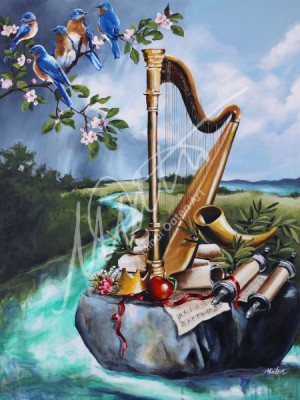
The Priestly King
Discover Jesus as: King of Glory Psalms 110-112 Read on Bible Gateway (HCSB)
Lesson
Audio Only
Teaching Notes
INTRO
Psalms 118 and 110 are the most quoted psalms in the New Testament. That means it was probably quoted in reference to the Messiah. Wiersbe points out verse 1 of Psalm 110 was quoted 25 times, verse 4 was quoted five times, and the psalm was referenced ten times in the book of Hebrews.1 It is a royal psalm written by David, and it presents one of the most prophetic pictures of Christ as King and as Priest. We have been using the phrase King of Glory for the book of Psalms, but for Psalm 110, we could use King and Priest of Glory. Both Jesus and Peter verified David was the author (Matthew 22:43–44; Acts 2:33–35).
TEACHING
Psalm 110:1-3: Christ the King: Verse 1 refers to “the Lord” (God the Father) who made a declaration to “my Lord” (God the Son), the root and offspring of David (Mark 12:36; Revelation 5:5; 22:16). Christ sat at God’s right hand until He came to earth (v. 1b). Jesus sat at the place of honor at the right hand (Hebrews 10:10–12) until God made His enemies Christ’s footstool. MacArthur explains, “The footstool was an ancient Near Eastern picture of absolute victory portraying the idea that one’s enemy was now underfoot”2 (Psalm 8:6–7; 47:3). David was writing a picture of the second coming of Christ, not in reference to the first coming of Jesus (Revelation 19:11-21). Christ is waiting for His enemies to be defeated before He comes back (Hebrews 10:13).
David wrote of the blessings of what God would do. First, the Lord would give Christ His mighty scepter to rule over His kingdom that would extend from Zion (Jerusalem) (v. 2a). This referred to an earthly Zion, not a heavenly Zion. This is the Father allowing the Son to do His work. Second, God would defeat His enemies (v. 2b). Christ’s people would volunteer to go to battle in “holy splendor” for Christ (v. 3a). The army rode pure white horses and wore white garments like priests (Revelation 19:14). MacArthur describes this volunteer army: “The redeemed inhabitants of earth will willingly serve the King of kings and Lord of lords.”3 The phrase, “from the womb of the dawn, the dew of Your youth belongs to You,” (v. 3b), describes Christ.
Psalm 110:4–7: Christ the Priest: The final four verses point to Christ’s priesthood. God had sworn an oath that Christ would be a priest like Melchizedek. Melchizedek was the only person in the Old Testament who served as both king and priest (Genesis 14:17–20) and foreshadowed the coming Messiah (v. 4). We picture the king as one on a horse who came to do battle, while the priest served as a mediator between God and His people. Christ is the ultimate, final King/Priest.
Now the Lord is at the right hand of the Messiah, and He will crush kings on the day of His anger (v. 5). The roles would be reversed—the Father will stand at the right hand of the Son and supply all the Son’s needs. “The day of His anger” will be the “Day of the Lord.” MacArthur explains “the day of His anger/wrath” refers to the Day of the Lord and will find “its global expression at the end of Daniel’s seventieth week (Daniel 9:24–27).4 The Day of the Lord is coming to make way for His Son’s return.
Further, God would judge the nations, pile up corpses, and crush leaders all over the world (v. 6). There are multiple references throughout scripture to the Day of the Lord (Psalm 2:8–9; 50:1–6; Isaiah 2:4; 9:6–7; Daniel 2:44–45; 7:21–27; Matthew 25:32; Revelation 6:15–17; 14:20; 16:17; 18:19–21). Then, Christ will drink from the brook as the victor and will lift His head in victory (v. 7). David was truly functioning as a prophet of God who released a prophetic word (Acts 2:30).
CLOSING
David was inspired by the Holy Spirit to write these verses—to record this word of prophecy. David wrote about the King and Priest of Glory. God will bring forth the Day of the Lord to make way for the King and the Priest Jesus.
Warren W. Wiersbe, The Bible Exposition Commentary: Old Testament (Colorado Springs: David C. Cook, 2004), p. 291.
John MacArthur, John MacArthur Bible Commentary (Nashville: Thomas Nelson Publishers, 2005), p. 674.
MacArthur, p. 674.
MacArthur, p. 674.
Questions
-
When you read Psalm 110:1, what does it mean to you? Have you ever been witness to this action?
-
In Psalm 111:10, what does “fear of the Lord” mean? Where else in Scripture is this kind of fear shown? (2 Chronicles 19:7; Job 28:28; Proverbs 2:5; 8:13; 9:10; 15:33; 16:6)
-
Psalm 112 is full of the great things in store for God’s people. How do these things come from fear of the Lord? Do you fear the Lord? What does that look like in your life?
-
What did the Holy Spirit highlight to you in Psalms 110—112 through the reading or the teaching?

Daily Word
Laura Martin Psalm 110:5–6
“The LORD is at Your right hand; He will crush kings on the day of His anger. He will judge the nations, heaping up corpses; He will crush leaders over the entire world.”
God reigns as the King and the Priest of glory. God will defeat His enemies. God will extend His kingdom. A great army is coming with Jesus’ return. But until then, Jesus sits at the right hand of God. The time will come when God will defeat all enemies and crush kings, bringing forth His anger.
Are you ready?What does it mean to be ready? Acknowledge God’s power. Acknowledge who He is. You have no need to live in fear of the world. So stop fearing the things in this world. Rather, live in fear of the Lord for that is the beginning of wisdom. Fear the Lord for His mightiness and power. Praise His name because great is the name of the Lord. Call upon the name of the Lord to subdue your enemies and proclaim His victory so others will know Jesus Christ is the King and Priest of glory. Yes, proclaim victory in Jesus so others will know Jesus Christ. Amen.
“The Lord is at Your right hand; He will crush kings on the day of His anger. He will judge the nations, heaping up corpses; He will crush leaders over the entire world.”
— Psalm 110:5–6
FURTHER SCRIPTURE
- Psalm 47:3 — “He subdues peoples under us and nations under our feet.”
- Acts 7:55–56 — “But Stephen, filled by the Holy Spirit, gazed into heaven. He saw God’s glory, with Jesus standing at the right hand of God, and he said, ‘Look! I see the heavens opened and the Son of Man standing at the right hand of God!’”
- Acts 15:17–18 — “So the rest of humanity may seek the Lord—even all the Gentiles who are called by My name, declares the Lord who does these things, known from long ago.”
Lesson and Daily Word
Each day has two parts: the Lesson and the Daily Word. Use these buttons to go from one to the other.
Teaching Notes and Questions
Next to the video, these tabs show the Teaching Notes and the Questions. Your answer to a question saves when you leave the answer box.
The Bible passage
This link opens the passage on Bible Gateway, and that gives the passage its tick. If you read it in your own Bible, tick it by hand in Progress.
Your progress on this lesson
A part ticks itself when you play the video or audio to the end, read the notes or the Daily Word to the end, or answer every question. You can also tick a part by hand here.
Downloads
Here you can save the video, the audio and the lesson as PDF files. Downloads do not count toward your progress.
Need help?
Use this button to send us a question or tell us about a problem. You can also take this tour again from there.