
Introducing the Psalms
Discover Jesus as: King of Glory Psalms 1-3 Read on Bible Gateway (HCSB)
Lesson
Audio Only
Teaching Notes
INTRO
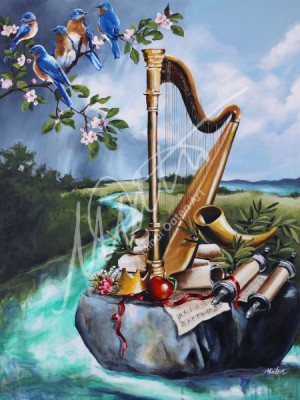
This is the beginning of our study in Psalms, and our 393rd lesson so far. I’m a little nervous about teaching Psalms, not because I’m afraid to show my emotions but because the psalmists were willing to put their hearts on the line in these psalms. The challenge for us all is to let our study of the psalms stretch our ability to be vulnerable before God. The book of Psalms was first called Praises, and then The Book of Praises. In the creation of the Septuagint, the name was changed to Psalms from the Greek word that meant “plucking or twanging of strings,” indicating each psalm was created to be sung with musical instruments.1 Many of the psalms have titles and subtitles that “convey various kinds of information such as authorship, dedication, historical occasion, liturgical assignment to a worship director, liturgical instructions, plus other technical instructions of uncertain meaning due to their great antiquity.”2
The 150 individual psalms have a variety of authors. King David wrote 73, the sons of Korah wrote ten, Asaph wrote 12, Solomon wrote two, and Moses, Heman, and Ethan each wrote one. Fifty psalms were written anonymously, although many scholars suggest the prophet Ezra wrote some of them. The psalms cover a period of 900 or so years, beginning when Moses wrote Psalm 90 and ending when Psalm 126 was written after the exile had been concluded. MacArthur describes a twofold background for the psalms: “(1) the acts of God in creation and history, and (2) the history of Israel.”3 MacArthur further describes two opposing dimensions that exist in the psalms: “(1) a horizontal or temporal reality, and (2) a vertical or transcendent reality.”4 Simply put, that means the experiences of mankind are seen on the horizontal, while the experiences with God are on the vertical.
The collection of psalms has a variety of content that includes: psalms of wisdom of how to live; psalms of lament about the problems of life; psalms of penitence or penance; psalms of kingship; psalms of thanksgiving; and Messianic psalms. Further, the collection is divided into five books. Each section ends with a verse or verses of doxology: (1) Psalms 1—41; (2) Psalms 42—72; (3) Psalms 73—89; (4) Psalms 90—106; and (5) Psalms 107—150.5
Psalm 2 is one of the Messianic psalms, and we’ll be studying many of the Messianic and prophetic psalms as we go. The phrase for the book of Psalms is King of Glory, and it’s where we’ll start out and see how it goes. As we go, keep in mind that prophetic psalms had messages for the people of the time, as well as a future message about the coming of the Messiah.
TEACHING
Psalm 2:1–6: This psalm is about human rebellion against God (v. 1). The kings and rulers of the earth had come together in rebellion against God and His Anointed One—His Son, the Messiah (v. 2). In rebellion, the people wanted to be freed from the restraints of God they felt were holding them back (v. 3). They saw the restraints as “yoke-bonds” which God was using to hold them6 (Jeremiah 5:5; Hosea 11:4). God responded to their rebellion with mocking laughter and then spoke “from His perfectly balanced anger”7 (v. 4–5). God explained He had already consecrated His King—His Son—on Zion, His holy mountain who would present His decree to the world (v. 6–7). Note that this is “the only OT reference to the Father/Son relationship in the Trinity, a relationship decreed in eternity past and demonstrated in the incarnation, thus a major part of the NT.”8 God promised that the nations would be the Anointed One’s inheritance (v. 8).
Psalm 2:9–12: The rebellious will be broken with a rod of iron, so the kings of the world should listen and receive instruction (vv. 9–10). God gave the rebellious the opportunity for repentance so they could serve Him with awe and rejoicing (v. 11). The rebellious people were given two choices: “They could either love and respect the Lord’s Anointed and so experience His great blessing, or they could refuse to submit and incur God’s wrath.”9
CLOSING
Psalm 2 is for us as well. We too have been rebellious. We too have a choice to make. We can choose to be redeemed through the saving work of Jesus Christ and be allowed to experience God’s great blessing in our lives. Or we can choose to remain rebellious, refuse to submit ourselves to God, and incur God’s wrath. The choice is ours and must be made individually.
John MacArthur, John MacArthur Bible Commentary (Nashville: Thomas Nelson Publishers, 2005), p. 596.
MacArthur, p. 595.
MacArthur, p. 595-596.
MacArthur, p. 596.
MacArthur, p. 596-598.
MacArthur, p. 598.
MacArthur, p. 598.
MacArthur, p. 599.
Earl Radmacher, Ronald B. Allen, and H. Wayne House, eds., Nelson’s New Illustrated Bible Commentary (Nashville: Thomas Nelson Publishers, 1999), p. 649.
Questions
-
The writer of Psalm 1 (NASB) used the words walk, stand, and sit. Why do you think he used this verbiage? What is meant by “walk in the counsel of the wicked”? What about “stand in the path of sinners”?
-
Psalm 1:3 uses a simile to describe the man who delights in the law of the Lord. Do you see yourself in this description? Why or why not? What would be significant about a tree that is growing by streams of water?
-
When we read the words, “the way of the wicked leads to ruin” in Psalm 1:6, what should it drive us to do?
-
In Psalm 2:9, the writer said, “You will break them with a rod of iron.” If you are a parent, have you ever needed to “rule with a rod of iron” with your children? Explain this verse through the lens of a loving parent.
-
WWho does Psalm 2 point to? Which verse in this chapter brings you the greatest satisfaction? Why?
-
Have you experienced the Lord’s protection and defense like David describes in Psalm 3? If so, in what way?
-
What did the Holy Spirit highlight to you in Psalms 1—3 through the reading or the teaching?
Daily Word
Laura Martin Psalm 1:1-2
“How happy is the man who does not follow the advice of the wicked or take the path of sinners or join a group of mockers! Instead, his delight is in the Lord’s instruction and he meditates on it day and night.”
The book of Psalms opens with a choice: follow the advice of the wicked, take the path of sinners, and join a group of mockers or delight in the Lord’s instruction and meditate on it day and night. The Word of God says if you choose the second option you will be happy! Happiness expresses feelings of joy and satisfaction. All those who take refuge in the Lord are happy. Even so, happiness is not based on circum- stances or trials. You are to find joy in the Lord in every circumstance, even through trials. You do so by keeping your eyes fixed on Jesus and not on yourself as you go through your day.
So today, try something. Make the choice to open the Word of God and ask the Lord for one verse to focus on all day long. Intentionally listen to music with edifying lyrics. Spend time with people who also delight themselves in Jesus. Then, at the end of your day, ask the Lord to show you how considering His Word and truth all day long had an effect on your day. Try this for a several days in a row as a discipline to stay connected with the Lord, and it may just turn your life around!
“How happy is the man who does not follow the advice of the wicked or take the path of sinners or join a group of mockers! Instead, his delight is in the Lord’s instruction and he meditates on it day and night.”
— Psalm 1:1-2
FURTHER SCRIPTURE
- Psalm 2:12 — “Pay homage to the Son or He will be angry and you will perish in your rebellion, for His anger may ignite at any moment. All those who take refuge in Him are happy.”
- Ecclesiastes 2:26 — “For to the man who is pleasing in His sight, He gives wisdom, knowledge, and joy, but to the sinner He gives the task of gathering and accumulating in order to give to the one who is pleasing in God’s sight. This too is futile and a pursuit of the wind.”
- James 1:2 — “Consider it a great joy, my brothers, whenever you experience various trials.”
Lesson and Daily Word
Each day has two parts: the Lesson and the Daily Word. Use these buttons to go from one to the other.
Teaching Notes and Questions
Next to the video, these tabs show the Teaching Notes and the Questions. Your answer to a question saves when you leave the answer box.
The Bible passage
This link opens the passage on Bible Gateway, and that gives the passage its tick. If you read it in your own Bible, tick it by hand in Progress.
Your progress on this lesson
A part ticks itself when you play the video or audio to the end, read the notes or the Daily Word to the end, or answer every question. You can also tick a part by hand here.
Downloads
Here you can save the video, the audio and the lesson as PDF files. Downloads do not count toward your progress.
Need help?
Use this button to send us a question or tell us about a problem. You can also take this tour again from there.