
God's Word Was Rejected
Discover Jesus as: The Shepherd Micah 1-3 Read on Bible Gateway (HCSB)
Lesson
Audio Only
Teaching Notes
INTRO
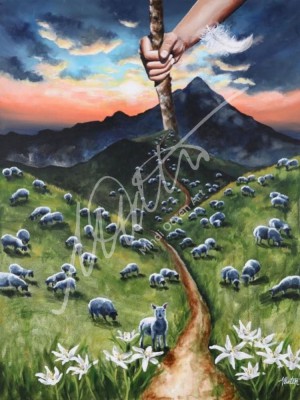
Last week, in our discussion of the minor prophets, we covered Hosea, Joel, and part of Amos. This week, we’ve finished the book of Amos, as well as Obadiah, and Jonah. Today we continue our study with the book of Micah. Mindi’s painting for Micah is one of my favorites. From Micah 5:4, we get the one word that describes Jesus in this book: The Shepherd who reigns. The name Micah means “who is like the Lord?” Micah is the shortened version of the name Micaiah or Michaiah.1 Basically, Micah received a word from the Lord and was commissioned to proclaim it. In Micah 2, he talks about the sins of Judah. We’ve talked before about the fact that the prophets’ messages were not well received because of the oracles, woes, and judgments in them. But then there was this little bit of hope offered.
According to Micah 1:1, Micah was a Moreshite. We know nothing of his parents. He was from Moresheth, located in the foothills of Judah about 25 miles southwest of Jerusalem, near Gath in Philistia.2 The northern kingdom would fall to Assyria during Micah’s ministry. Though Micah dated his ministry with references to the kings of Judah, on occasion, his words were for Israel (the northern kingdom). But overall, his primary focus was the southern kingdom of Judah where he lived. Historically, these were days of economic prosperity and no violence—so things were good. But things were beginning to slip. Syria and Israel invaded Judah and temporarily took wicked Ahaz captive. After Assyria overthrew Syria and Israel, Hezekiah, the good king of Judah, withdrew his allegiance from Assyria. This caused Sennacherib to attack Jerusalem in 701 BC. In 2 Chronicles 32:21, God sent His angel to deliver Judah. God then used Hezekiah to lead Judah back to worshiping the Lord.3 MacArthur explains, “After the prosperous reign of Uzziah, who died in 739 BC, his son Jotham continued the same policies, but failed to remove the centers of idolatry.”4 Judah’s outward prosperity became fake; their idolatry with Baal, the Canaanite fertility god, was integrated with their Old Testament sacrificial system. So, as Amos had spoken into Israel, Micah began to speak into Judah.5
Micah began to proclaim a message of judgment to people who were persistently pursuing evil. In Micah 1:2 and 6:1-2, Micah used imagery almost like a courtroom mentality. Micah portrayed his message like a courtroom with Judah on trial. There are three oracles or warnings in the book of Micah. The command to “listen” was used in each (Micah 1:2; 3:1; 6:1). With each command to listen Micah moves from doom to hope. Each of the three sections includes the sins of the people, the punishment of God to come, and then the promises of hope for the faithful after the judgment.6
TEACHING
Micah 1:1-7: The prophecy was against Samaria, which then reached Jerusalem. Samaria was the capital of the northern kingdom, where a golden calf was worshiped. According to verse 2, God was going to bring judgment against Samaria. The Assyrians would be used as God’s instrument to judge Samaria. Many scholars believe verse 4 describes events that will happen much later—at the return of Christ’s coming in judgment. Jerusalem had become a place of heathen worship and would receive God’s judgment (v. 5). Verses 6-7 describe the coming judgment. Destruction did come to Samaria through the Assyrians in 722 BC. Then destruction of Jerusalem came through Babylon in 586 BC. But many scholars believe this also refers to the judgment that will occur when Christ comes back and judges His people and the other nations.
Micah 1:8-16: These verses contain Micah’s lamentation. As a prophet releasing this word from God, it did not bring Micah joy. He was not excited about what would happen to his people and his city. Micah lamented what would happen to the cities of Gath (“weep town”), Beth-leaphrah (“dust town”), Shaphir (“beauty town”), Zaanan (“march town”), Maroth (“bitterness”), Lachish (“horse town”), and Achzib (“lie town”).7
Micah 2:1-11: Micah began to describe the woes that would come upon his people, specifically the sins of the wealthy. They dreamed up wickedness and then did it (v. 1), taking the fields, houses, and inheritances of others (v. 2). Therefore, God planned disaster for the nation (vv. 3-5). Once the prophet released the word, the false prophets entered into the picture. “Quit your preaching,” they said (v. 6). Instead of listening to Micah, the false prophets communicated a false message of prosperity. However, God’s Word is revealed by those who obey Him and will be rejected by those who don’t obey Him. The message of false prophets will be inconsistent with the message of the Holy Spirit. God called out those who oppressed the poor and took advantage of widows (vv. 8-9). For these reasons, God would deliver them to destruction (v. 10).
Micah 2:12-13: Remember how, in the midst of destruction, there’s always this little bit of hope? God promised to gather the remnant of those who were faithful to Him. The Shepherd would gather His sheep and care for them in the fold. Jesus is the good shepherd who gathers His people. In John 10:11, Jesus said, “I am the good shepherd. The good shepherd lays down his life for the sheep.” Jesus knows His sheep, and they know Him (John 10:14). Micah 4:7-8 is another passage that describes this remnant mentality. This picture only takes place when Christ comes to rule in the millennium. Micah 5:7-8 says the same thing. God, as a shepherd, says that even though judgment is coming against Judah for their sins, He will still gather His people. The remnant is essential in the book of Micah. God doesn’t hold onto His anger forever; He delights in faithful love. God wants the faithful to be part of the remnant because He is patient and loving.
To the word remnant, you have to add the word “regathering.” Though they were scattered all over the place, God began to gather the faithful back into His fold. Verse 13 portrays the image of The Shepherd and king who will be their leader. All of this will take place in the millennium. The Shepherd will gather the flock, but the King will rule over them as King of kings and Lord of lords. John MacArthur said the remnant is “a small nucleus of God’s people, preserved by His sovereign grace, form this righteous remnant in the midst of a national apostasy.”8
CLOSING
God always finds the few that are obedient; those who have persevered, obeyed, and looked to Him. The Shepherd is always looking for His remnant.
We’ll continue more of our study on Micah tomorrow.
John MacArthur, The MacArthur Bible Commentary (Nashville: Thomas Nelson Publishers, 2005), p. 1014.
MacArthur, p. 1014.
MacArthur, p. 1014.
MacArthur, p. 1014.
MacArthur, p. 1014-1015.
MacArthur, p. 1015.
J. Vernon McGee, Thru the Bible Commentary: Jonah and Micah (Nashville: Thomas Nelson, 1991), n. p.
MacArthur, p. 772.
Questions
-
In Micah 2:13, the “One who breaks open the way” will go before them. Do you think this could be a reference to the Messiah? Why?
-
Micah 3:2-4 describes the leaders as devouring the flesh and tearing off the skin of those they lead. What was the role of the leaders supposed to be regarding the people? Read Galatians 5:15. The early church seemed to be dealing with a similar problem. Do you think this biting and consuming one another still happens in the church today? If so, what does it look like?
-
What do you think Micah meant when he said to the prophets that it would be night and darkness for them (Micah 3:6)?
-
What did the Holy Spirit highlight to you in Micah 1—3 through the reading or the teaching?

Daily Word
Laura Martin Micah 3:8
“As for me, however, I am filled with power by the Spirit of the LORD, with justice and courage, to proclaim to Jacob his rebellion and to Israel his sin.”
The Lord called upon the prophet Micah to declare truth to Israel. The Lord continued to appear to Israel even though Israel remained in rebellion. Micah stood apart from the false prophets because the Spirit of the Lord filled him with power, justice, and the courage to proclaim truth to Israel about their sin and rebellion. Yet even with the strong message of justice, warning, and destruction, Micah offered the hope and deliverance of God as their great Shepherd who would gather and lead His remnant. The Lord will know them by name, and they will know His voice.
Dear friends, the Holy Spirit equips you, empowers you, and guides you. He will fill you with joy and peace so that you overflow with hope. The Lord longs to guide you as your Shepherd. He sees your rebellion and your wandering ways, He knows your heart, and He longs to have you safe in His arms. The Lord will equip you with authority in His name to do His work. You don’t have to walk out your calling, doing the will of your heavenly Father in your own strength. You are not alone. The Holy Spirit’s power speaks through you, counseling you, leading you, and guiding you. Today, call upon the name of the Lord, and He will be your strength.
“As for me, however, I am filled with power by the Spirit of the Lord, with justice and courage, to proclaim to Jacob his rebellion and to Israel his sin.”
— Micah 3:8
FURTHER SCRIPTURE
- Micah 2:12 — “I will indeed gather all of you, Jacob; I will collect the remnant of Israel. I will bring them together like sheep in a pen, like a flock in the middle of its fold. It will be noisy with people.”
- John 10:11 — “I am the good shepherd. The good shepherd lays down his life for the sheep.”
- Romans 15:13 — “Now may the God of hope fill you with all joy and peace as you believe in Him so that you may overflow with hope by the power of the Holy Spirit.”
Lesson and Daily Word
Each day has two parts: the Lesson and the Daily Word. Use these buttons to go from one to the other.
Teaching Notes and Questions
Next to the video, these tabs show the Teaching Notes and the Questions. Your answer to a question saves when you leave the answer box.
The Bible passage
This link opens the passage on Bible Gateway, and that gives the passage its tick. If you read it in your own Bible, tick it by hand in Progress.
Your progress on this lesson
A part ticks itself when you play the video or audio to the end, read the notes or the Daily Word to the end, or answer every question. You can also tick a part by hand here.
Downloads
Here you can save the video, the audio and the lesson as PDF files. Downloads do not count toward your progress.
Need help?
Use this button to send us a question or tell us about a problem. You can also take this tour again from there.